

Townsend's Warbler vs Black-throated Green Warbler
Setophaga townsendi versus Setophaga virens
Play a quiz with Townsend's Warbler and Black-throated Green Warbler
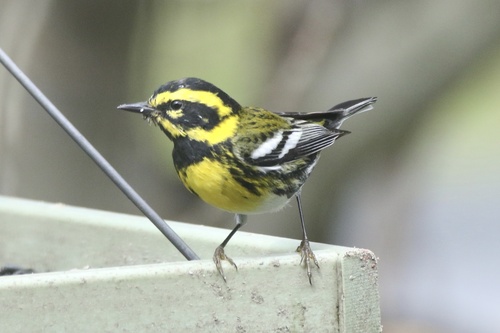 Townsend's Warbler
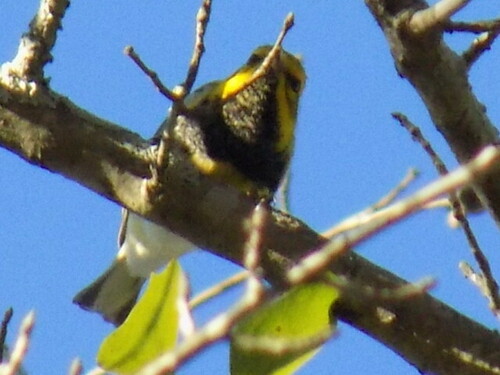 Black-throated Green Warbler
In short
The most reliable field mark to separate Townsend's Warbler from Black-throated Green Warbler is the face pattern: Townsend's shows a bold black cheek patch (malar/ear area) sharply set off against a bright yellow face, while Black-throated Green has a yellow face with only diffuse olive markings and no solid black cheek. Both species have two white wing bars and similar size, but Townsend's is more strongly marked on the face and flanks. Adult males of both can show black throats, but the extent and contrast of black on the face and cap are key. Immatures and females are trickier, but the cheek pattern remains a strong clue.
Identification tips
- Cheek Patch (All Ages): Townsend's Warbler always shows a bold black cheek patch (malar/ear area) sharply contrasting with a yellow face. Black-throated Green Warbler never has a solid black cheek; its face is yellow with diffuse olive markings. This is the single most reliable field mark in all plumages.
- Face Pattern (All Ages): Townsend's has a brighter, cleaner yellow face with a crisp black cheek, while Black-throated Green's yellow face is more muted with olive smudging but no sharp black.
- Cap Color (Adults): Adult male Townsend's has a black cap, while Black-throated Green's crown is olive-green. Female Townsend's has a dark (not black) cap, and immature Townsend's have a dark green cap and cheeks.
- Throat Color (Sex/Age): Both adult males can show a black throat, but only Townsend's extends the black up onto the cap and cheek, creating a hooded look. Female Townsend's has a yellow throat, while female/immature Black-throated Green has a pale throat with black streaks on the breast.
- Flank Streaking (All Ages): Townsend's Warbler has heavier and more extensive black streaking on the flanks compared to Black-throated Green, which has lighter black streaks.
- Wing Bars (All Ages): Both have two white wing bars; this is not a separator.
- Back Color (All Ages): Both are olive above with black streaks, but Townsend's may appear more contrasting due to the stronger face and flank markings.
- Underparts (All Ages): Both have white bellies, but Townsend's often shows a sharper contrast between the white belly and streaked flanks.
- Bill Shape and Structure: Both have thin, pointed bills typical of Setophaga warblers; bill shape is not a reliable separator.
- Flight/Jizz: No distinctive differences in flight pattern or structure are noted between these two; both are small, active, and agile.
- Juvenile/Immature Upperwing: No age-specific upperwing or flight pattern differences are described in the sources; focus on face and cheek pattern for immatures.
- Habitat/Range: Townsend's is more likely in coniferous forests of the Northwest, but both can overlap during migration and winter. Do not rely solely on habitat.
- Voice: Songs are similar and not reliably separable in the field based on the provided notes.
- Sex/Age Pitfalls: Female and immature Townsend's can be confused with Black-throated Green, but the cheek patch remains a strong clue. Always check for the presence or absence of a solid black cheek.
- Hybrid Zone: Townsend's can hybridize with Hermit Warbler, but not with Black-throated Green; hybrids are not a concern for this pair.
Size
Both species are very similar in size and structure, with no meaningful difference for field identification. Black-throated Green Warbler measures 11–12 cm in length, weighs 8.5–11.3 g, and has a wingspan of 17–20 cm [wikipedia]. Townsend's Warbler is described as a small songbird of the same family, and no significant size difference is noted in comparative sources.
Plumage
For all ages, the cheek and face pattern is the most diagnostic: Townsend's Warbler (adults and immatures) has a bright yellow face with a bold black cheek patch extending into the ear coverts, while Black-throated Green Warbler has a yellow face with diffuse olive markings but never a solid black cheek. Adult male Townsend's also shows a black cap and black throat, with yellow on the lower breast; females have a dark (not black) cap and a yellow throat. Immature Townsend's resemble females but with a dark green cap and cheeks. Black-throated Green males have a black throat and upper breast, but the face remains yellow with olive, not black, markings. Females and immature Black-throated Greens have a pale throat and black streaks on the breast, but never a black cheek patch. Both species have two white wing bars and olive upperparts with black streaks on the back and flanks, but Townsend's has more extensive black streaking on the flanks. Underparts are white in both, but Townsend's tends to show more contrast between the white belly and streaked flanks.
Behaviour
Both species are active foragers in the canopy, gleaning insects from foliage and sometimes hovering or flycatching. Townsend's Warbler is noted for foraging higher in conifers and joining mixed flocks outside the breeding season. Black-throated Green Warbler has similar foraging habits. Behavior is not strongly diagnostic between these two.
Habitat
Townsend's Warbler breeds in coniferous forests with large trees along the northwestern coast of North America. Black-throated Green Warbler's habitat is not detailed in the provided notes, but both are associated with forested habitats. In winter, Townsend's may be found further south, including Mexico and Central America. Habitat overlap is possible during migration and winter, so context alone is not a reliable separator.
Voice
Townsend's Warbler's song is a buzzed 'zee-zee-zee-bzz-zee' or 'weazy weazy weazy weazy twea,' similar to Black-throated Green Warbler's song, but the notes do not provide a clear distinction. Both have sharp call notes. Voice is not a reliable field mark for separation based on the available information.
Townsend's Warbler · Black-throated Green Warbler · My Tricky Birds