

Thick-billed Flowerpecker vs Pale-billed Flowerpecker
Pachyglossa agilis versus Dicaeum erythrorhynchos
Play a quiz with Thick-billed Flowerpecker and Pale-billed Flowerpecker
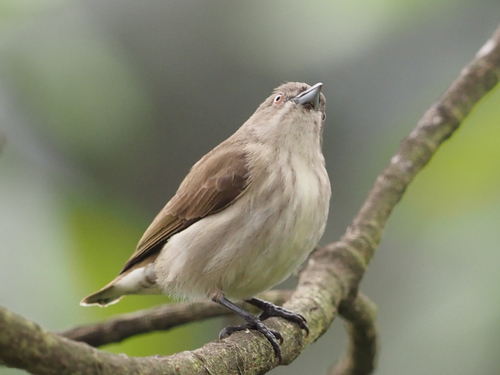 Thick-billed Flowerpecker
 Pale-billed Flowerpecker
In short
The most reliable field mark to separate Thick-billed from Pale-billed Flowerpecker is the bill: Thick-billed has a noticeably stouter, dark bill, while Pale-billed shows a slender, distinctly pale or pinkish curved bill. Plumage differences are subtle but important—Thick-billed has diffuse streaking on the underparts (especially adults and older immatures), while Pale-billed is plain below. Juvenile Thick-billeds have a paler bill base and fewer streaks, but still tend to show some patterning compared to the always plain Pale-billed. Both are tiny, active birds, but Thick-billed often appears bulkier and is more likely in the canopy, while Pale-billed is common in gardens and lower levels. Voice and behavior can help, but bill and underpart pattern are the most consistent field clues.
Identification tips
- Bill color and shape: Thick-billed Flowerpecker has a short, thick, dark bill that looks heavy for its size. Pale-billed has a slender, distinctly pale or pinkish curved bill. This is the single most reliable mark in good light and close views.
- Underpart streaking: Adult and older immature Thick-billeds show diffuse streaks on a light buffy-grey underside. Pale-billed is always plain below—no streaks at any age. This is a key mark, especially in perched birds.
- Juvenile confusion: Juvenile Thick-billed has a paler base to the mandible and fewer streaks below, but usually still shows some underpart patterning. Juvenile Pale-billed is plain below and matches adults in bill color (pale/pinkish). If you see a plain-bellied bird with a pale bill, it's Pale-billed; any streaking or a dark, heavy bill points to Thick-billed.
- Tail pattern: Thick-billed has whitish spots at the tips of the tail feathers, sometimes visible when the tail is spread or fanned. Pale-billed lacks this feature.
- Head markings: Neither species has a supercilium or strong head pattern. Thick-billed may show a faint crown stripe when displaying, but this is rarely visible and not a reliable field mark.
- Upperpart color: Both are brownish or olive above, but Thick-billed can appear slightly darker or more grey-brown, especially in the Sri Lankan race. Pale-billed is more olive or plain brown, but this is subtle and not always useful.
- Size and jizz: Thick-billed is slightly larger and bulkier, but this is hard to judge unless both are side by side. Both are tiny and active; posture and feeding style are more helpful.
- Foraging height: In areas where both occur, Thick-billed is more likely in the canopy, Pale-billed in gardens and lower levels. Use this as supporting context, not a primary mark.
- Feeding behavior: If you see a flowerpecker wiping seeds on a branch after eating berries, it's likely Thick-billed. If it swallows berries whole and later voids seeds, it's likely Pale-billed.
- Tail movement: Thick-billed often jerks its tail side-to-side when perched; Pale-billed does not show this as frequently.
- Vocalizations: Both give 'spick' or 'chip' calls; only Thick-billed has a more rambling, varied song. Calls alone are not always diagnostic.
- Habitat: Pale-billed is common in urban gardens and parks; Thick-billed is more often in forests or higher canopy. Use habitat as a supporting clue.
- Sexes: Both species are sexually monomorphic in the field—do not attempt to separate by sex.
- Subspecies variation: Be aware that some island races of Thick-billed are darker or smaller, but the main field marks (bill, underpart streaking) remain valid.
- Pitfalls: Poor light can make the pale bill of Pale-billed look dark; always check for underpart streaking and bill shape. Immature Thick-billeds can look plainer below, but usually retain some streaking and a heavier bill.
Size
Both species are among the smallest birds in their range, but Pale-billed Flowerpecker is slightly smaller (about 8 cm long, 6.3 g [wikidata]) compared to Thick-billed (about 10 cm long [wikipedia]; mass not given but likely slightly heavier). In the field, size difference is subtle and often masked by posture and activity, so do not rely on size alone for separation.
Plumage
- Juvenile/immature birds: Juvenile Thick-billed Flowerpecker shows a paler base to the mandible and less streaking below than adults, but still has some underpart patterning. Juvenile Pale-billed is plain below, matching adults, and always lacks streaks. No distinctive wing pattern or panels are described for either species at any age.
- Adults: Thick-billed is dark grey-brown above, with dull greyish underparts marked by diffuse streaks on a light buffy background. The rump can be slightly olive. Pale-billed is plain brownish to olive-green above and buff-olive below, with no streaks or strong contrast between upper- and underparts. Thick-billed has whitish tips to the tail feathers, which may be visible when perched or fanned. Sexes are similar in both species.
- Head: Thick-billed may show a faint crown stripe when displaying (from erected crown feathers), but this is rarely visible in the field. Pale-billed lacks any head markings or supercilium.
Behaviour
Both species are active and feed on berries and nectar, but their foraging behavior differs. Thick-billed Flowerpecker tends to forage higher in the canopy, especially in Sri Lanka, and is often seen in the tops of trees. It wipes seeds on branches rather than swallowing berries whole. Pale-billed Flowerpecker is more often found in gardens and lower vegetation, and typically swallows berries whole, later voiding the sticky seeds. Thick-billed frequently jerks its tail side-to-side when perched and may display by fluttering over the female. Both are quick and restless, but Thick-billed can appear slightly bulkier and more deliberate in movement.
Habitat
Thick-billed Flowerpecker is more often found in dense lowland forests or, for the nominate race, in cultivated areas and open forests. In Sri Lanka, it prefers the canopy. Pale-billed Flowerpecker is common in urban gardens, parks, and areas with berry-bearing trees, and is generally more abundant and familiar in human-modified habitats. Both can occur together in some regions, but Pale-billed is much more likely in gardens and lower levels, while Thick-billed prefers higher or less disturbed forest strata.
Voice
Pale-billed Flowerpecker gives a rapid chipping call, often described as a sharp 'chip' or 'spick.' Thick-billed also gives a frequent 'spick' call, but its song is more rambling and can include notes reminiscent of Ashy Prinia. In the field, the calls are similar and not always diagnostic, but the more complex, varied song of Thick-billed may be a clue if heard well.
Thick-billed Flowerpecker · Pale-billed Flowerpecker · My Tricky Birds