

Tennessee Warbler vs Nashville Warbler
Leiothlypis peregrina versus Leiothlypis ruficapilla
Play a quiz with Tennessee Warbler and Nashville Warbler
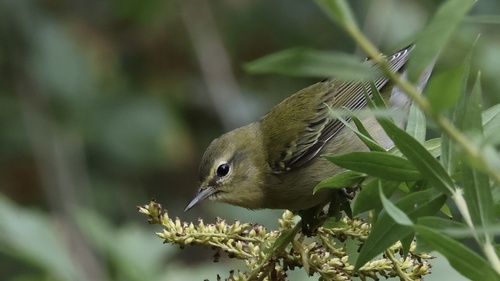 Tennessee Warbler
 Nashville Warbler
In short
The most reliable field mark to separate Tennessee Warbler from Nashville Warbler is the presence of a bold, complete white eye ring on Nashville Warbler of all ages and sexes, which Tennessee Warbler lacks. Tennessee Warbler instead shows a pale eyebrow (supercilium) but no full eye ring. Both species can appear olive-green above and yellowish below, especially in fall and among immatures, but the head pattern and undertail color are key: Nashville Warbler has a gray head with a white eye ring and yellow underparts extending to the vent, while Tennessee Warbler has a grayish or olive crown with a white eyebrow and always white undertail coverts. Structure is similar, but Tennessee Warbler is slightly heavier and longer-winged. In the field, focus on the eye ring vs. eyebrow, undertail color, and head contrast for quick separation.
Identification tips
- White Eye Ring (Nashville only): Nashville Warbler of all ages and sexes has a complete, bold white eye ring. Tennessee Warbler never shows a full eye ring—look for this first.
- Pale Supercilium (Tennessee only): Tennessee Warbler has a pale eyebrow (supercilium) above the eye, but this does not form a ring. Nashville Warbler lacks a pale eyebrow; its eye ring stands out instead.
- Undertail Coverts: Tennessee Warbler always has white undertail coverts, contrasting with the yellowish belly. Nashville Warbler has yellow underparts extending through the vent and undertail region—no white patch here.
- Head Color and Contrast: Nashville Warbler shows a gray head (sometimes with a hidden rusty crown patch in males) that contrasts with the olive-green back, especially in the eastern subspecies. Tennessee Warbler's head is more uniform with the back, with a grayish or olive crown and nape but not sharply set off from the back.
- Yellow Underparts: Nashville Warbler is brighter yellow on the throat, breast, and belly, with the yellow extending to the vent. Tennessee Warbler is paler below, with grayish-white underparts in spring males, more yellowish in fall and immatures, but always with white undertail coverts.
- Wing Bars: Neither species has wing bars, so this is not a useful mark.
- Crown Patch (Nashville male): Adult male Nashville Warbler may show a rusty crown patch when agitated, but it is usually hidden. Tennessee Warbler never shows this feature.
- Tail Flicking: Nashville Warbler often flicks its tail while foraging; Tennessee Warbler does this less frequently. This can help in active birds but is not definitive.
- Bill Shape: Both have thin, pointed bills, but Tennessee Warbler's may appear slightly longer and finer. This is subtle and not reliable for quick ID.
- Back Color: Both can appear olive-green above, but Nashville Warbler's back is more distinctly separated from the gray head (especially in the east), while Tennessee Warbler is more uniformly olive above.
- Sex/Age Pitfalls: Female and immature Tennessee Warblers are duller and more yellowish, resembling Nashville, but always lack the white eye ring and have white undertail coverts. Immature Nashville Warblers are duller but retain the eye ring and yellow vent.
- Seasonal Variation: In fall, both species become yellower below and duller above, increasing confusion. Focus on eye ring vs. eyebrow and undertail color.
- Size: Tennessee Warbler averages slightly heavier and longer, but this is not useful in the field without direct comparison.
- Habitat/Context: During migration, both species can be together in mixed flocks. Breeding range and habitat may help in summer, but are not reliable during migration.
- Hybridization: There is a single record of hybridization, but hybrids are extremely rare and not a practical concern for most observers.
Size
Tennessee Warbler is marginally heavier (9.6 g vs. 8.8 g) and has a slightly longer wingspan (about 19.7 cm vs. 17–20 cm) and length (11.5 cm vs. 11–13 cm), but these differences are subtle and not reliable in the field. Both are small, slim warblers with thin, pointed bills. Structural differences are minimal and not a primary field mark.
Plumage
-
Juvenile and Immature Plumage: Both species' young birds resemble duller versions of the adult female. Tennessee Warbler immatures show a pale yellowish underside, olive upperparts, and a pale supercilium, but never a complete white eye ring. Nashville Warbler immatures always have a full white eye ring, yellow underparts, and a grayish head (less contrasting in western subspecies).
-
Adult Breeding Plumage: Tennessee Warbler males have a slate gray crown and nape, olive back, white underside, and a distinct pale supercilium (eyebrow), with white undertail coverts. Females and non-breeding birds are duller, more yellowish below, but still lack a full eye ring. Nashville Warbler adults have a gray head, olive-green back, bright yellow throat and breast, white belly, and a complete white eye ring. Males may show a rusty crown patch (often hidden). Both sexes have yellow underparts extending to the vent.
-
Fall/Winter Plumage: Tennessee Warbler becomes more yellow below and olive above, but the white undertail coverts and lack of eye ring persist. Nashville Warbler retains its white eye ring and yellow underparts, with the head remaining grayish (less contrast in western birds).
Behaviour
Both species forage actively in shrubs and trees, but Nashville Warbler is noted for frequent tail-flicking and joining loose winter flocks, sometimes with other species. Tennessee Warbler is more arboreal and less likely to flick its tail. These behaviors can help in context, but are not always obvious or consistent.
Habitat
Habitat overlap is broad during migration, but breeding ranges differ: Tennessee Warbler breeds in eastern North America, Nashville Warbler in northern and western US and southern Canada. In migration and winter, both can be found in shrubby or woodland habitats, but Nashville Warbler is more likely in brushy, lower vegetation, while Tennessee Warbler prefers higher canopy foraging. These preferences are not diagnostic in mixed flocks or during migration.