

Motmot

Tawny Owl vs Tengmalm's Owl

Strix aluco versus Aegolius funereus

Play a quiz with Tawny Owl and Tengmalm's Owl
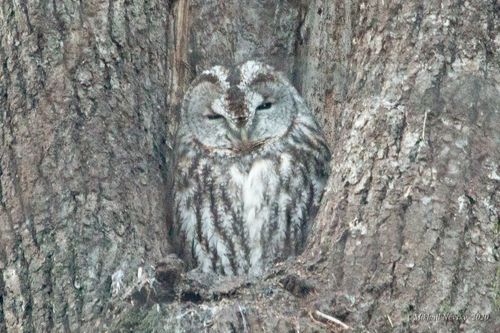
Tawny Owl (Strix aluco) Tawny Owl
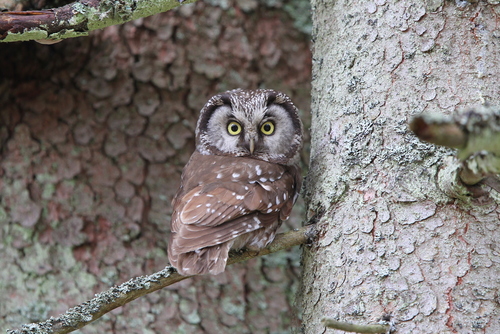
Tengmalm's Owl (Aegolius funereus) Tengmalm's Owl

Media

Loading…

In short

The most reliable field mark to separate Tawny Owl from Tengmalm's Owl is overall size and structure: Tawny Owl is much larger, bulkier, and has a broad, rounded head with dark eyes, while Tengmalm's Owl is distinctly smaller, with a compact build, yellow eyes, and a strikingly spotted appearance on the upperparts and wings. Juvenile Tengmalm's Owls show a unique chocolate-brown plumage with a white 'X' between the eyes and white facial streaks, unlike any Tawny Owl age. In flight, Tawny Owl appears heavy and slow with broad, rounded wings, whereas Tengmalm's Owl is more compact and flies straight and quietly. Careful attention to facial pattern, eye color, and size will resolve most confusion, especially in woodland settings where both may occur.

Identification tips

  1. Size is the first check: Tawny Owl is much larger and heavier than Tengmalm's Owl. If the bird appears small and compact, rule out Tawny Owl.
  2. Facial disc and eye color: Tawny Owl has a plain, rounded facial disc with dark brown eyes; Tengmalm's Owl has a pale disc with a dark border, prominent white 'eyebrows', and yellow eyes.
  3. Juvenile plumage: Juvenile Tengmalm's Owls are chocolate-brown with a white 'X' between the eyes and white facial streaks—never matched by Tawny Owl at any age.
  4. Upperparts and wing pattern: Tengmalm's Owl (all ages after fledging) shows conspicuous white spots on the back and wings, and rows of white spots on the primaries and tail; Tawny Owl is plain above, with no such spotting.
  5. Underparts: Tawny Owl has pale underparts with brown streaks; Tengmalm's Owl has cream-white underparts with russet-brown streaks, but is generally whiter and more crisply marked.
  6. Facial expression: Tengmalm's Owl's 'eyebrows' give a 'surprised' look, especially at close range; Tawny Owl's face is more uniform and lacks this expression.
  7. Flight style: Tawny Owl flies with slow, heavy, broad-winged glides; Tengmalm's Owl is more direct and straight-flying, reflecting its smaller size.
  8. Bill color: Tengmalm's Owl has a light yellow bill; Tawny Owl's bill is darker (not always visible in the field).
  9. Vocalizations: Tawny Owl gives deep, classic hoots; Tengmalm's Owl produces high-pitched trills, whistles, and bill-clapping, never hooting.
  10. Habitat context: Tawny Owl is common in broadleaf and mixed woodlands, including urban parks; Tengmalm's prefers remote, dense coniferous or taiga forests.
  11. Perched jizz: Tawny Owl appears squat and robust, with a large, rounded head; Tengmalm's Owl is more compact and upright.
  12. Sexual dimorphism: Tawny Owl females are noticeably larger than males, but both sexes are much larger than Tengmalm's of any sex.
  13. Behavior when approached: Tengmalm's Owl may allow close approach (3–5 m) before flushing; Tawny Owl is more likely to flush at greater distance.
  14. Seasonal moult: Tengmalm's Owl juveniles retain their distinctive chocolate-brown plumage until post-juvenile moult (August–September), after which white spotting appears; Tawny Owl juveniles are similar to adults in pattern, lacking dramatic changes.
  15. Common pitfalls: In poor light, size and facial pattern are most reliable; beware of misjudging a distant Tawny Owl as a large Tengmalm's, but the lack of white spotting and plain face should clarify.

Size

Tawny Owl is a medium-sized, robust owl with a typical body mass around 475 g [wikidata], and a length of 37–46 cm with a wingspan of 81–105 cm [wikipedia]. In contrast, Tengmalm's Owl is much smaller and more compact, with a noticeably lighter build (no direct mass given, but universally described as 'small owl' [wikipedia]). In the field, the size difference is dramatic: Tawny Owl appears squat and heavy, while Tengmalm's Owl is petite and less bulky. This size gap is especially apparent if seen perched or in flight, and is one of the most reliable separation points.

Plumage

Juvenile Tengmalm's Owls (about 3 weeks old and shortly after fledging) are dull chocolate-brown above and below, with a dark brown facial disc bordered by black and white, and a broad white 'X' between the eyes—this combination is never shown by Tawny Owl of any age. As they mature, Tengmalm's Owls develop conspicuous pearly-white spots on the back and wings, and a facial disc with a dark border and white 'eyebrows', giving a 'surprised' look. Their underparts are cream-white with russet-brown streaks, and the tail and primaries have distinct rows of white spots. Tawny Owl, by contrast, is always plain-faced (no 'eyebrows' or 'X'), with underparts pale and streaked brown, and upperparts either rufous or greyish brown, lacking the bold white spotting of Tengmalm's. Tawny Owl's facial disc is plain and eyes are dark brown, while Tengmalm's Owl has yellow eyes. In all ages, Tawny Owl lacks the crisp white markings and spotted upperwing pattern of Tengmalm's Owl. In flight, Tawny Owl shows broad, rounded wings with a heavy, slow action, while Tengmalm's Owl is more compact and straight-flying.

Behaviour

Tawny Owl tends to fly with long, heavy glides and fewer wingbeats, often at greater height, and appears slow and squat both in flight and perched. Tengmalm's Owl, while also silent in flight, is more direct and straight-flying, reflecting its smaller, more compact build. Tengmalm's Owl is described as confiding and may allow close approach, only flushing at very short range, while Tawny Owl is more wary. Both are nocturnal, but Tengmalm's is especially secretive due to its preference for dense, remote forests.

Habitat

Tawny Owl is widespread in woodlands across Europe and western Siberia, often in mature deciduous or mixed forests, and can adapt to parks and gardens in towns. Tengmalm's Owl (Boreal Owl) prefers more remote, dense taiga and boreal forests, and is much less likely to be seen in urban or open woodland settings. If encountered in deep coniferous forest, especially in the north or at higher elevations, Tengmalm's is more likely; Tawny Owl is more common in lowland, broadleaf, or mixed woods.

Voice

Tawny Owl is famous for its classic 'twit-twoo' hooting, a deep, resonant call. Tengmalm's Owl produces a variety of trills, whistles, and softer calls, including a loud territorial trill and a softer courtship melody, but never the deep hoot of Tawny Owl. Tengmalm's calls are higher-pitched, more mechanical or snipe-like, and include bill-clapping and hissing, especially at the nest. If you hear a deep hoot, it's Tawny Owl; if you hear trills, whistles, or bill-clapping, suspect Tengmalm's.

Submit a better description

Use the same sections as the comparison. Your text is published immediately.

The most reliable field mark to separate Tawny Owl from Tengmalm's Owl is overall size and structure: Tawny Owl is much larger, bulkier, and has a broad, rounded head with dark eyes, while Tengmalm's Owl is distinctly smaller, with a compact build, yellow eyes, and a strikingly spotted appearance on the upperparts and wings. Juvenile Tengmalm's Owls show a unique chocolate-brown plumage with a white 'X' between the eyes and white facial streaks, unlike any Tawny Owl age. In flight, Tawny Owl appears heavy and slow with broad, rounded wings, whereas Tengmalm's Owl is more compact and flies straight and quietly. Careful attention to facial pattern, eye color, and size will resolve most confusion, especially in woodland settings where both may occur.

  1. Size is the first check: Tawny Owl is much larger and heavier than Tengmalm's Owl. If the bird appears small and compact, rule out Tawny Owl.
  2. Facial disc and eye color: Tawny Owl has a plain, rounded facial disc with dark brown eyes; Tengmalm's Owl has a pale disc with a dark border, prominent white 'eyebrows', and yellow eyes.
  3. Juvenile plumage: Juvenile Tengmalm's Owls are chocolate-brown with a white 'X' between the eyes and white facial streaks—never matched by Tawny Owl at any age.
  4. Upperparts and wing pattern: Tengmalm's Owl (all ages after fledging) shows conspicuous white spots on the back and wings, and rows of white spots on the primaries and tail; Tawny Owl is plain above, with no such spotting.
  5. Underparts: Tawny Owl has pale underparts with brown streaks; Tengmalm's Owl has cream-white underparts with russet-brown streaks, but is generally whiter and more crisply marked.
  6. Facial expression: Tengmalm's Owl's 'eyebrows' give a 'surprised' look, especially at close range; Tawny Owl's face is more uniform and lacks this expression.
  7. Flight style: Tawny Owl flies with slow, heavy, broad-winged glides; Tengmalm's Owl is more direct and straight-flying, reflecting its smaller size.
  8. Bill color: Tengmalm's Owl has a light yellow bill; Tawny Owl's bill is darker (not always visible in the field).
  9. Vocalizations: Tawny Owl gives deep, classic hoots; Tengmalm's Owl produces high-pitched trills, whistles, and bill-clapping, never hooting.
  10. Habitat context: Tawny Owl is common in broadleaf and mixed woodlands, including urban parks; Tengmalm's prefers remote, dense coniferous or taiga forests.
  11. Perched jizz: Tawny Owl appears squat and robust, with a large, rounded head; Tengmalm's Owl is more compact and upright.
  12. Sexual dimorphism: Tawny Owl females are noticeably larger than males, but both sexes are much larger than Tengmalm's of any sex.
  13. Behavior when approached: Tengmalm's Owl may allow close approach (3–5 m) before flushing; Tawny Owl is more likely to flush at greater distance.
  14. Seasonal moult: Tengmalm's Owl juveniles retain their distinctive chocolate-brown plumage until post-juvenile moult (August–September), after which white spotting appears; Tawny Owl juveniles are similar to adults in pattern, lacking dramatic changes.
  15. Common pitfalls: In poor light, size and facial pattern are most reliable; beware of misjudging a distant Tawny Owl as a large Tengmalm's, but the lack of white spotting and plain face should clarify.

Tawny Owl is a medium-sized, robust owl with a typical body mass around 475 g [wikidata], and a length of 37–46 cm with a wingspan of 81–105 cm [wikipedia]. In contrast, Tengmalm's Owl is much smaller and more compact, with a noticeably lighter build (no direct mass given, but universally described as 'small owl' [wikipedia]). In the field, the size difference is dramatic: Tawny Owl appears squat and heavy, while Tengmalm's Owl is petite and less bulky. This size gap is especially apparent if seen perched or in flight, and is one of the most reliable separation points.

Juvenile Tengmalm's Owls (about 3 weeks old and shortly after fledging) are dull chocolate-brown above and below, with a dark brown facial disc bordered by black and white, and a broad white 'X' between the eyes—this combination is never shown by Tawny Owl of any age. As they mature, Tengmalm's Owls develop conspicuous pearly-white spots on the back and wings, and a facial disc with a dark border and white 'eyebrows', giving a 'surprised' look. Their underparts are cream-white with russet-brown streaks, and the tail and primaries have distinct rows of white spots. Tawny Owl, by contrast, is always plain-faced (no 'eyebrows' or 'X'), with underparts pale and streaked brown, and upperparts either rufous or greyish brown, lacking the bold white spotting of Tengmalm's. Tawny Owl's facial disc is plain and eyes are dark brown, while Tengmalm's Owl has yellow eyes. In all ages, Tawny Owl lacks the crisp white markings and spotted upperwing pattern of Tengmalm's Owl. In flight, Tawny Owl shows broad, rounded wings with a heavy, slow action, while Tengmalm's Owl is more compact and straight-flying.

Tawny Owl tends to fly with long, heavy glides and fewer wingbeats, often at greater height, and appears slow and squat both in flight and perched. Tengmalm's Owl, while also silent in flight, is more direct and straight-flying, reflecting its smaller, more compact build. Tengmalm's Owl is described as confiding and may allow close approach, only flushing at very short range, while Tawny Owl is more wary. Both are nocturnal, but Tengmalm's is especially secretive due to its preference for dense, remote forests.

Tawny Owl is widespread in woodlands across Europe and western Siberia, often in mature deciduous or mixed forests, and can adapt to parks and gardens in towns. Tengmalm's Owl (Boreal Owl) prefers more remote, dense taiga and boreal forests, and is much less likely to be seen in urban or open woodland settings. If encountered in deep coniferous forest, especially in the north or at higher elevations, Tengmalm's is more likely; Tawny Owl is more common in lowland, broadleaf, or mixed woods.

Tawny Owl is famous for its classic 'twit-twoo' hooting, a deep, resonant call. Tengmalm's Owl produces a variety of trills, whistles, and softer calls, including a loud territorial trill and a softer courtship melody, but never the deep hoot of Tawny Owl. Tengmalm's calls are higher-pitched, more mechanical or snipe-like, and include bill-clapping and hissing, especially at the nest. If you hear a deep hoot, it's Tawny Owl; if you hear trills, whistles, or bill-clapping, suspect Tengmalm's.

Discard your changes?

You have unsaved edits. If you leave now, those changes will be lost.

Tawny Owl · Tengmalm's Owl · My Tricky Birds