

Tawny Owl vs Long-eared Owl
Strix aluco versus Asio otus
Play a quiz with Tawny Owl and Long-eared Owl
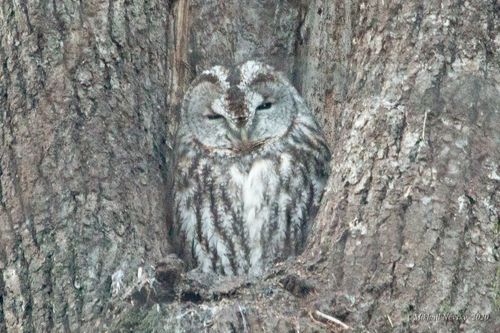 Tawny Owl
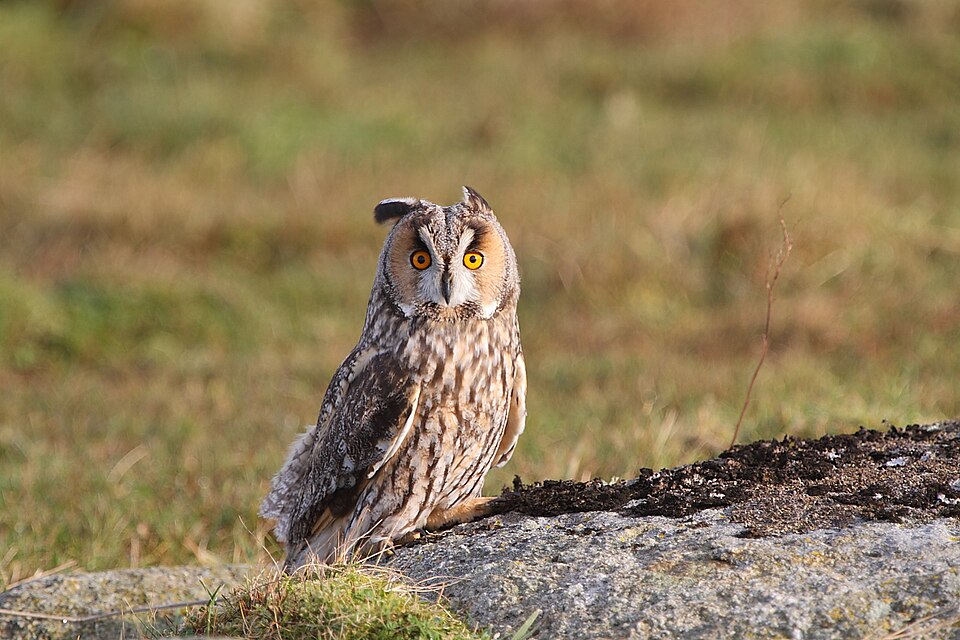 Long-eared Owl
In short
The most reliable field mark to separate Tawny Owl from Long-eared Owl is the presence of prominent, upright ear tufts on Long-eared Owl, which are completely absent in Tawny Owl. In flight, Long-eared Owl appears slim and long-winged, while Tawny Owl is notably stockier and broad-winged. Plumage differences are subtle but consistent: Tawny Owl shows a plain, rounded facial disc and heavily streaked underparts, whereas Long-eared Owl has a more contrasting facial disc with a dark rim and vertical streaking below. Size is also a clue, with Tawny Owl being much heavier and bulkier. These differences hold for all ages, but are especially useful for perched birds or those seen well in flight.
Identification tips
- Ear tufts: Long-eared Owl always shows prominent, upright ear tufts (not ears), especially when alert or disturbed. Tawny Owl never has ear tufts—if you see them, it's not a Tawny.
- Head shape: Tawny Owl has a large, rounded, plain head with no projections; Long-eared Owl's head appears narrower and more angular due to the tufts.
- Facial disc: Tawny Owl's facial disc is plain and rounded, with dark brown eyes blending in. Long-eared Owl's facial disc is rimmed dark, often with a white vertical line or 'moustache,' and the eyes are bright yellow-orange to orange-red, standing out against the face.
- Plumage color: Tawny Owl is generally uniform brown or grey above, with pale, heavily streaked underparts. Long-eared Owl is ochraceous-tawny with variable dark streaks and spots, and often shows contrasting whitish scapulars and a more patterned look.
- Underpart markings: Tawny Owl has bold brown streaks on whitish underparts; Long-eared Owl shows vertical streaks on the upper breast and herringbone (shaft-streaks and crossbars) below, often giving a more patterned appearance.
- Wing shape in flight: Tawny Owl's wings are broad and rounded, giving a heavy, slow flight. Long-eared Owl's wings are long and slim, with more buoyant, agile flight.
- Pale wing panels: In flight, Long-eared Owl can show pale or buffy panels at the base of the primaries, especially in good light—Tawny Owl lacks these.
- Size and structure: Tawny Owl is much heavier and bulkier, with a squat, compact jizz. Long-eared Owl is slim, long-winged, and lighter-bodied.
- Eye color: Tawny Owl has dark brown eyes; Long-eared Owl's are orange to orange-red, a useful mark at close range.
- Perched posture: Tawny Owl often appears hunched and rounded; Long-eared Owl sits upright, sometimes elongating its body and tufts.
- Habitat context: Dense, mature woodland favors Tawny Owl; open woods, edges, and conifer plantations are more likely Long-eared Owl territory.
- Roosting habits: Long-eared Owl may roost communally in winter, sometimes in open or visible sites. Tawny Owl is more solitary and secretive by day.
- Sexual dimorphism: Both species have larger females, but this is not usually visible in the field.
- Juvenile confusion: No unique juvenile upperwing marks are described for either species, so rely on structure and facial features for young birds.
- Common pitfalls: In poor light, Tawny Owl's grey morph can look similar to a pale Long-eared Owl, but ear tufts and facial disc contrast remain reliable. Beware of posture—Long-eared Owl can sometimes flatten its tufts, but the facial disc and slim build still separate it.
Size
Tawny Owl is substantially heavier and bulkier, with an average body mass of 475 g compared to Long-eared Owl's typical 200–330 g (regional variation exists, but Long-eared is always much lighter) [wikidata, wikipedia]. Tawny Owl is also slightly longer (37–46 cm vs. 31–40 cm) and has a similar or slightly broader wingspan (81–105 cm vs. 86–102 cm), but appears much more robust and round-headed. Long-eared Owl is slim, long-winged, and noticeably lighter in the hand or when seen side-by-side.
Plumage
- Juvenile/immature flight: No distinctive upperwing marks are described for either species that are unique to age, but Long-eared Owl's long, slim wings and contrasting pale panels at the base of the primaries can be visible in flight at all ages. Tawny Owl lacks these pale panels and shows broader, more rounded wings.
- Perched birds/adults: Tawny Owl has a plain, rounded facial disc with dark brown eyes and no ear tufts. Its underparts are pale with brown streaks, and the upperparts can be brown or grey, sometimes rufous, but always relatively uniform. Long-eared Owl has a well-developed facial disc with a dark rim, often a white vertical line down the center (sometimes forming a 'moustache'), and prominent ear tufts. Its plumage is ochraceous-tawny with blackish vertical streaks and variable dark markings, especially on the wings and back. The scapulars are marked whitish, and the underparts show herringbone patterning below the upper breast. Eye color is yellowish-orange to orange-red, contrasting with Tawny Owl's dark brown eyes.
Behaviour
Tawny Owl flies with heavy, slow, and silent wingbeats, using long glides on broad, rounded wings. Its flight is less undulating and typically at greater height than other Eurasian owls. Perched, it appears squat and compact. Long-eared Owl is more agile and buoyant in flight, with a slim, long-winged profile. When perched, Long-eared Owl often sits upright and elongates its body, accentuating its ear tufts. Both species are nocturnal and secretive, but Long-eared Owl is more likely to roost communally in winter, sometimes in exposed sites.
Habitat
Tawny Owl is a classic woodland species, favoring mature forests, parks, and wooded urban areas across Europe and western Siberia. Long-eared Owl also breeds widely in Europe and the Palearctic, but is more often found in open woodlands, forest edges, scrub, and even farmland with scattered trees. While their ranges overlap, Tawny Owl is more strictly tied to dense woodland, whereas Long-eared Owl tolerates more open habitats and is more likely to be found in conifer plantations or hedgerows.