

Tambourine Dove vs Southern Anteater-Chat
Turtur tympanistria versus Myrmecocichla formicivora
Play a quiz with Tambourine Dove and Southern Anteater-Chat
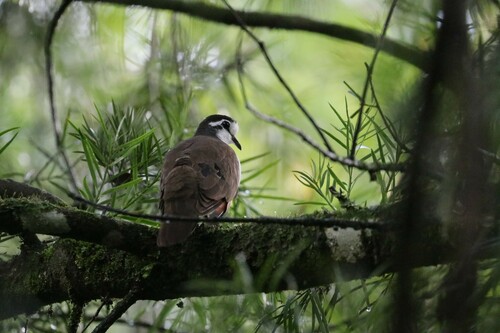 Tambourine Dove
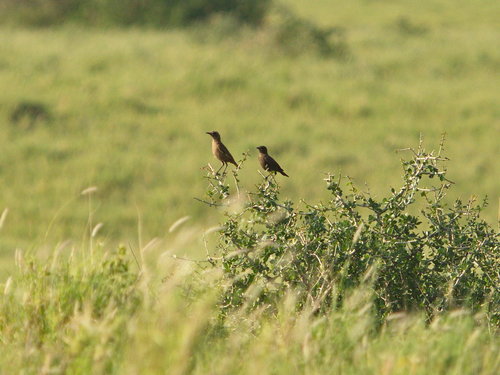 Southern Anteater-Chat
In short
The most reliable way to separate Tambourine Dove from Southern Anteater-Chat is by overall structure and flight: Tambourine Dove is a small, plump pigeon with a short bill and rounded wings, showing chestnut primaries and underwings in flight (all ages), while Southern Anteater-Chat is a slimmer, upright songbird with a slender bill and no chestnut in the wing. Juvenile Tambourine Doves have chestnut fringes on the back and flanks, and even dull females are paler below than any Anteater-Chat. Males of each species are very different (white-faced dove vs. all-black chat), but confusion is possible with female/immature Anteater-Chat and female/immature Tambourine Dove on the ground. Structure, wing color in flight, and habitat are the best clues.
Identification tips
- Chestnut in the wing (flight): Tambourine Dove of all ages flashes chestnut primary flight feathers and underwings when flushed—Southern Anteater-Chat never shows chestnut in the wing. This is the single best field mark, especially for birds seen in flight.
- Juvenile plumage: Juvenile Tambourine Dove has chestnut fringes on the back, breast, and flanks, and is still paler below than any Anteater-Chat. Juvenile Anteater-Chat is brown overall and never shows chestnut or strong pale below.
- Overall structure: Tambourine Dove is plump, short-billed, and compact, with a pigeon-like jizz. Southern Anteater-Chat is slimmer, longer-legged, and more upright, with a slender bill typical of chats.
- Adult male plumage: Male Tambourine Dove has a striking white face with a black spot behind the eye and white underparts; male Anteater-Chat is almost entirely black. Confusion is unlikely here.
- Female/immature confusion: Female and juvenile Tambourine Doves are duller but still have white or pale underparts and lack the uniform brown of female Anteater-Chat. Female Anteater-Chat is brown with a grey bill and legs, and never shows white face or chestnut in the wing.
- Face pattern: Tambourine Dove (male) has a white face and black spot behind the eye; female is pale grey-brown faced. Anteater-Chat (any sex) lacks a white face or eye spot.
- Wing patches (perched): Tambourine Dove shows large dark purple patches on the folded wing (adult male); Anteater-Chat does not show any such patches.
- Underparts color: Tambourine Dove is always paler below, even in juvenile or female plumages, than Anteater-Chat, which is brown or black below.
- Leg and bill color: Tambourine Dove has purple-red eye ring and feet, and a purple bill; Anteater-Chat female has grey bill and legs.
- Flight style: Tambourine Dove flies fast, low, and agile, typical of pigeons. Anteater-Chat's flight is not described, but chats are generally less direct and less powerful in flight.
- Habitat: Dense woodland, gardens, or plantations strongly favor Tambourine Dove; open dry grassland or shrubland is Southern Anteater-Chat territory. Habitat alone can often separate them.
- Foraging behavior: Tambourine Dove is terrestrial, feeding on the ground for seeds and small fruits, often flushed from cover. Anteater-Chat is more likely to be seen perched upright on rocks or shrubs in open country.
- Sociality: Tambourine Dove is usually solitary or in small family groups; Anteater-Chat may be more conspicuous and less shy.
- Voice: A repeated 'du-du-du-du-du' confirms Tambourine Dove. Lack of a similar call from Anteater-Chat can help, but silence is not diagnostic.
- Pitfalls: Female and juvenile Tambourine Doves are duller and can be confused with brown chats, but always check for pale underparts, chestnut in the wing (in flight), and the dove's compact shape. Anteater-Chat never shows chestnut, white face, or pigeon-like structure.
Size
Tambourine Dove is noticeably heavier and more compact, with a body mass of about 67g versus the Anteater-Chat's 42g. The dove is also described as 'plump' and typically 22 cm in length, while Anteater-Chat is slimmer and more upright. In the field, the dove's bulk and short bill contrast with the chat's lighter, more slender build and longer-legged stance.
Plumage
Juvenile Tambourine Dove shows chestnut fringes on the back, breast, and flanks, and all ages display chestnut primary flight feathers and underwings in flight—a unique mark not shown by Anteater-Chat. Adult male Tambourine Dove is white-faced with a black spot behind the eye, white underparts, and large dark purple patches on the folded wings; females are duller, with pale grey-brown face and breast, but still paler below than any Anteater-Chat. Southern Anteater-Chat males are nearly all black, while females are brown overall with grey bill and legs, lacking any white face or chestnut in the wing. The dove always appears paler below, even in juvenile or female plumages, compared to the chat.
Behaviour
Tambourine Dove is shy, usually solitary or in small family groups, and is most often seen when flushed from the forest floor, flying low and fast with agile, direct flight. It forages mainly on the ground for seeds and small fruits. Southern Anteater-Chat is more upright, often perching on low shrubs or rocks, and is adapted to open, dry grassland and shrubland. The chat's behavior is more conspicuous and less secretive than the dove's.
Habitat
Tambourine Dove is strictly a bird of thick woodland, dense gardens, and plantations, rarely venturing into open country. It is absent from dry, open areas. Southern Anteater-Chat, by contrast, is found in subtropical or tropical dry shrubland and grassland, often in much more open and arid environments. If the bird is in dense forest or lush gardens, Tambourine Dove is much more likely; in open grassland or dry scrub, expect Southern Anteater-Chat.
Voice
Tambourine Dove gives a persistently repeated 'du-du-du-du-du' call. There is no vocal description for Southern Anteater-Chat in the provided notes, so voice is only useful for confirming the dove.