

Motmot

Swallow Tanager vs Black-faced Dacnis

Tersina viridis versus Dacnis lineata

Play a quiz with Swallow Tanager and Black-faced Dacnis
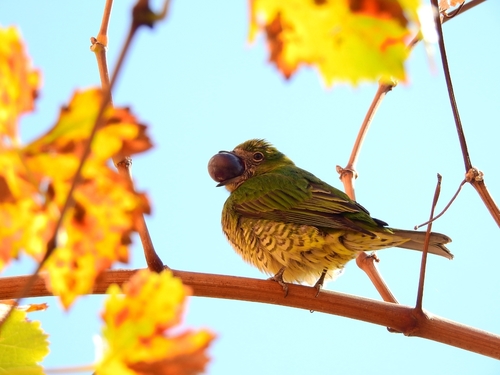
Swallow Tanager (Tersina viridis) Swallow Tanager
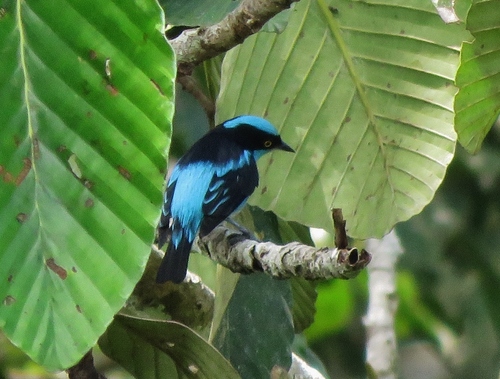
Black-faced Dacnis (Dacnis lineata) Black-faced Dacnis

Media

Loading…

In short

The most reliable field mark between Swallow Tanager and Black-faced Dacnis is overall structure and color pattern: Swallow Tanager is much larger and chunkier, with a broad, flat bill and short tail, while Black-faced Dacnis is noticeably smaller, slimmer, and has a thin, sharply pointed bill. Adult males of both species have turquoise-blue and black in the plumage, but the Swallow Tanager male is much paler below with a white belly and undertail, and a bright turquoise head, while the Dacnis male has a black back and a more limited black mask. Females are easier to separate: Swallow Tanager females are bright grass-green above, while Black-faced Dacnis females are olive-brown and much duller. In flight or at a distance, size, bill shape, and the extent of white on the underparts are key. Both species are sexually dimorphic, so always check for sex-specific marks.

Identification tips

  1. Size and Structure: Swallow Tanager is much larger and bulkier than Black-faced Dacnis. If the bird looks stocky with a broad, flat bill, suspect Swallow Tanager. If it is slim, small, and has a thin, pointed bill, think Dacnis.
  2. Bill Shape: Swallow Tanager has a broad, flat bill; Black-faced Dacnis has a thin, sharply pointed bill. This is visible even at moderate range and is reliable for all ages and sexes.
  3. Adult Male Plumage – Mask and Back: Swallow Tanager male has a large black mask covering the face and throat, with turquoise-blue upperparts and a white belly. Black-faced Dacnis male has a narrower black mask (not on the throat), a black back and mantle, and turquoise only on the crown, rump, and uppertail coverts.
  4. Adult Male Underparts: Swallow Tanager male has a strikingly white belly and undertail, contrasting with turquoise flanks and breast. Black-faced Dacnis male has turquoise on the throat, breast, and flanks, but the white belly is smaller and less contrasting.
  5. Adult Female Plumage: Swallow Tanager female is bright grass-green above with yellowish underparts and green barring on the flanks. Black-faced Dacnis female is dull olive-brown above, pale grayish on the throat, and buffy white on the belly and undertail. This is the easiest separation in the field.
  6. Iris Color: Swallow Tanager has a reddish-brown iris; Black-faced Dacnis has a yellow iris. This can be seen in good light at close range.
  7. Wing and Tail Pattern: Swallow Tanager has turquoise and black in the wings and tail, with turquoise edges and black tips; Black-faced Dacnis has black wings and tail with turquoise only on the tertials, innermost secondaries, and uppertail coverts. No age-specific flight marks are described for either species.
  8. Behavior and Posture: Swallow Tanager often perches upright and appears robust; Black-faced Dacnis is more active, agile, and forages quickly among foliage. If you see a bird sitting still and upright, check for Swallow Tanager; if it is darting about, consider Dacnis.
  9. Habitat and Context: Both species can occur in similar habitats, but Swallow Tanager may be seen nesting in banks or walls, sometimes in loose groups. Dacnis is more often solitary or in pairs, foraging in the canopy.
  10. Vocalizations: If you hear a short, high-pitched "Tsrrip" note, it is likely Black-faced Dacnis. Swallow Tanager's voice is not described here, so silence does not help.
  11. Sexual Dimorphism: Both species are sexually dimorphic, so always check for sex-specific marks. Females are much easier to separate than males.
  12. Geographic Range: Both are widespread in South America, but if you are in Chile or Uruguay, Swallow Tanager is only a rare vagrant, and Black-faced Dacnis does not occur.
  13. Confusion Risk: The main pitfall is confusing adult males at a distance, especially in poor light. Focus on size, bill shape, and the extent of white on the underparts to separate them.
  14. Juvenile/Immature Plumage: No distinctive juvenile or immature wing or flight marks are described for either species, so rely on structure and general color.
  15. Group Association: Swallow Tanager may be seen in loose breeding groups; Black-faced Dacnis is usually alone or in pairs. Use this as a supporting clue, not a primary mark.

Size

Swallow Tanager is more than twice as heavy as Black-faced Dacnis (29 g vs. 13 g) and is also longer (14–15 cm vs. 11 cm). In the field, Swallow Tanager appears stocky and robust, with a broad, flat bill and short tail. Black-faced Dacnis is much more delicate, with a slim, pointed bill and a more compact, agile appearance. When seen together, the size difference is striking, but even singly, Swallow Tanager's bulk and bill shape are distinctive.

Plumage

No age-specific upperwing or flight marks are described for either species, but adult males are most likely to be confused. Swallow Tanager males are bright turquoise-blue above, with a black mask covering the face and throat, and a white belly and undertail. Their wings are mostly turquoise with black tips and edges, and the tail is black with turquoise edges. Black-faced Dacnis males have a turquoise crown and mask, but the mask is restricted to the face and does not include the throat; the back and mantle are black, and the rump and uppertail coverts are turquoise. Their underparts are turquoise on the throat, breast, and flanks, but the belly and undertail are white. Females are much easier: Swallow Tanager females are bright grass-green with yellowish underparts and green barring, while Black-faced Dacnis females are olive-brown above, pale grayish on the throat, and buffy white on the belly and undertail. Both species have some turquoise and white in the wings and tail, but the patterns are different and more extensive in Swallow Tanager. Iris color also differs: Swallow Tanager has a reddish-brown iris, while Black-faced Dacnis has a yellow iris.

Behaviour

Swallow Tanager often perches more upright and appears bulkier, sometimes in loose groups, and may nest in cavities in banks or walls. Black-faced Dacnis is more active, agile, and tends to forage quickly among foliage, often higher in the canopy. Swallow Tanager may be seen in semi-colonial breeding groups, while Dacnis is usually solitary or in pairs. Flight style is not described in detail, but Swallow Tanager's heavier build may give it a steadier, less fluttery flight compared to the more nimble Dacnis.

Habitat

Both species are widespread in South America, but habitat preferences may overlap. Swallow Tanager is found from Panama and Trinidad south through most of South America, except Chile and Uruguay, and is often seen in open woodlands, forest edges, and sometimes near human structures for nesting. Black-faced Dacnis is found in every mainland South American country except Argentina, Chile, Paraguay, and Uruguay, and is typically associated with forest edges and canopy. Both can occur in similar habitats, so context alone is not diagnostic.

Voice

Black-faced Dacnis is not highly vocal, but its most common call is a short, high-pitched, finely modulated "Tsrrip" note. Its song is a mix of buzzy, whistled, and cheep notes, but is rarely heard. Swallow Tanager's vocalizations are not described in the provided notes, so voice is not a reliable separator unless the Dacnis call is heard.

Submit a better description

Use the same sections as the comparison. Your text is published immediately.

The most reliable field mark between Swallow Tanager and Black-faced Dacnis is overall structure and color pattern: Swallow Tanager is much larger and chunkier, with a broad, flat bill and short tail, while Black-faced Dacnis is noticeably smaller, slimmer, and has a thin, sharply pointed bill. Adult males of both species have turquoise-blue and black in the plumage, but the Swallow Tanager male is much paler below with a white belly and undertail, and a bright turquoise head, while the Dacnis male has a black back and a more limited black mask. Females are easier to separate: Swallow Tanager females are bright grass-green above, while Black-faced Dacnis females are olive-brown and much duller. In flight or at a distance, size, bill shape, and the extent of white on the underparts are key. Both species are sexually dimorphic, so always check for sex-specific marks.

  1. Size and Structure: Swallow Tanager is much larger and bulkier than Black-faced Dacnis. If the bird looks stocky with a broad, flat bill, suspect Swallow Tanager. If it is slim, small, and has a thin, pointed bill, think Dacnis.
  2. Bill Shape: Swallow Tanager has a broad, flat bill; Black-faced Dacnis has a thin, sharply pointed bill. This is visible even at moderate range and is reliable for all ages and sexes.
  3. Adult Male Plumage – Mask and Back: Swallow Tanager male has a large black mask covering the face and throat, with turquoise-blue upperparts and a white belly. Black-faced Dacnis male has a narrower black mask (not on the throat), a black back and mantle, and turquoise only on the crown, rump, and uppertail coverts.
  4. Adult Male Underparts: Swallow Tanager male has a strikingly white belly and undertail, contrasting with turquoise flanks and breast. Black-faced Dacnis male has turquoise on the throat, breast, and flanks, but the white belly is smaller and less contrasting.
  5. Adult Female Plumage: Swallow Tanager female is bright grass-green above with yellowish underparts and green barring on the flanks. Black-faced Dacnis female is dull olive-brown above, pale grayish on the throat, and buffy white on the belly and undertail. This is the easiest separation in the field.
  6. Iris Color: Swallow Tanager has a reddish-brown iris; Black-faced Dacnis has a yellow iris. This can be seen in good light at close range.
  7. Wing and Tail Pattern: Swallow Tanager has turquoise and black in the wings and tail, with turquoise edges and black tips; Black-faced Dacnis has black wings and tail with turquoise only on the tertials, innermost secondaries, and uppertail coverts. No age-specific flight marks are described for either species.
  8. Behavior and Posture: Swallow Tanager often perches upright and appears robust; Black-faced Dacnis is more active, agile, and forages quickly among foliage. If you see a bird sitting still and upright, check for Swallow Tanager; if it is darting about, consider Dacnis.
  9. Habitat and Context: Both species can occur in similar habitats, but Swallow Tanager may be seen nesting in banks or walls, sometimes in loose groups. Dacnis is more often solitary or in pairs, foraging in the canopy.
  10. Vocalizations: If you hear a short, high-pitched "Tsrrip" note, it is likely Black-faced Dacnis. Swallow Tanager's voice is not described here, so silence does not help.
  11. Sexual Dimorphism: Both species are sexually dimorphic, so always check for sex-specific marks. Females are much easier to separate than males.
  12. Geographic Range: Both are widespread in South America, but if you are in Chile or Uruguay, Swallow Tanager is only a rare vagrant, and Black-faced Dacnis does not occur.
  13. Confusion Risk: The main pitfall is confusing adult males at a distance, especially in poor light. Focus on size, bill shape, and the extent of white on the underparts to separate them.
  14. Juvenile/Immature Plumage: No distinctive juvenile or immature wing or flight marks are described for either species, so rely on structure and general color.
  15. Group Association: Swallow Tanager may be seen in loose breeding groups; Black-faced Dacnis is usually alone or in pairs. Use this as a supporting clue, not a primary mark.

Swallow Tanager is more than twice as heavy as Black-faced Dacnis (29 g vs. 13 g) and is also longer (14–15 cm vs. 11 cm). In the field, Swallow Tanager appears stocky and robust, with a broad, flat bill and short tail. Black-faced Dacnis is much more delicate, with a slim, pointed bill and a more compact, agile appearance. When seen together, the size difference is striking, but even singly, Swallow Tanager's bulk and bill shape are distinctive.

No age-specific upperwing or flight marks are described for either species, but adult males are most likely to be confused. Swallow Tanager males are bright turquoise-blue above, with a black mask covering the face and throat, and a white belly and undertail. Their wings are mostly turquoise with black tips and edges, and the tail is black with turquoise edges. Black-faced Dacnis males have a turquoise crown and mask, but the mask is restricted to the face and does not include the throat; the back and mantle are black, and the rump and uppertail coverts are turquoise. Their underparts are turquoise on the throat, breast, and flanks, but the belly and undertail are white. Females are much easier: Swallow Tanager females are bright grass-green with yellowish underparts and green barring, while Black-faced Dacnis females are olive-brown above, pale grayish on the throat, and buffy white on the belly and undertail. Both species have some turquoise and white in the wings and tail, but the patterns are different and more extensive in Swallow Tanager. Iris color also differs: Swallow Tanager has a reddish-brown iris, while Black-faced Dacnis has a yellow iris.

Swallow Tanager often perches more upright and appears bulkier, sometimes in loose groups, and may nest in cavities in banks or walls. Black-faced Dacnis is more active, agile, and tends to forage quickly among foliage, often higher in the canopy. Swallow Tanager may be seen in semi-colonial breeding groups, while Dacnis is usually solitary or in pairs. Flight style is not described in detail, but Swallow Tanager's heavier build may give it a steadier, less fluttery flight compared to the more nimble Dacnis.

Both species are widespread in South America, but habitat preferences may overlap. Swallow Tanager is found from Panama and Trinidad south through most of South America, except Chile and Uruguay, and is often seen in open woodlands, forest edges, and sometimes near human structures for nesting. Black-faced Dacnis is found in every mainland South American country except Argentina, Chile, Paraguay, and Uruguay, and is typically associated with forest edges and canopy. Both can occur in similar habitats, so context alone is not diagnostic.

Black-faced Dacnis is not highly vocal, but its most common call is a short, high-pitched, finely modulated "Tsrrip" note. Its song is a mix of buzzy, whistled, and cheep notes, but is rarely heard. Swallow Tanager's vocalizations are not described in the provided notes, so voice is not a reliable separator unless the Dacnis call is heard.

Discard your changes?

You have unsaved edits. If you leave now, those changes will be lost.

Swallow Tanager · Black-faced Dacnis · My Tricky Birds