

Swainson's Thrush vs Song Thrush
Catharus ustulatus versus Turdus philomelos
Play a quiz with Swainson's Thrush and Song Thrush
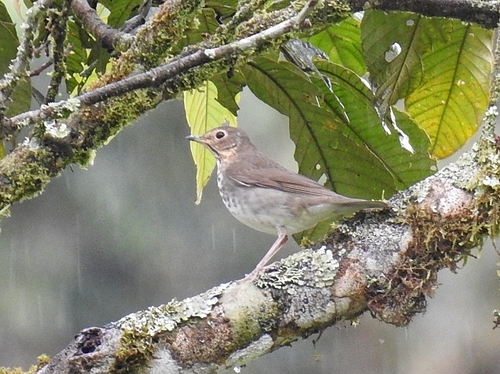 Swainson's Thrush
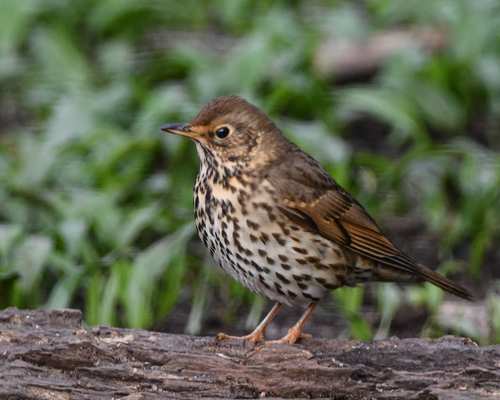 Song Thrush
In short
The most reliable field mark between Swainson's Thrush and Song Thrush is the underwing color in flight: Swainson's Thrush shows a white-dark-white underwing pattern, while Song Thrush has a warm yellow underwing. Swainson's Thrush is smaller and slimmer, with a more delicate build and a distinct pale eye ring, whereas Song Thrush is bulkier, with a plain brown back and bold, neat black spots on cream or buff underparts. Juvenile Song Thrushes show buff or orange streaks on the back and wing coverts, which Swainson's Thrush lacks. Voice and song are also distinct, but in the field, underwing color and overall structure are the fastest separation points.
Identification tips
- Underwing color in flight: Swainson's Thrush shows a white-dark-white underwing pattern; Song Thrush has a warm yellow underwing. This is one of the quickest field separations if you see the bird in flight (all ages).
- Juvenile upperparts: Juvenile Song Thrushes have buff or orange streaks on the back and wing coverts, lacking in Swainson's Thrush. If you see these streaks, it's Song Thrush.
- Eye ring: Swainson's Thrush has a prominent pale brown eye ring, giving a spectacled look. Song Thrush lacks this feature and has a plainer face.
- Breast spotting: Song Thrush has bold, neat black spots on cream or yellow-buff underparts, especially on the breast and flanks. Swainson's Thrush has finer, less contrasting spots on a paler, whiter background.
- Upperparts tone: Swainson's Thrush is brown above, with eastern birds more olive and western birds more rufous. Song Thrush is plain brown, but the tone can be colder in eastern populations.
- Bill color: Swainson's Thrush has a shorter, more delicate bill; Song Thrush's bill is yellowish and stouter.
- Leg color: Both have pink legs, so this is not a reliable separator.
- Size and structure: Song Thrush is larger, bulkier, and more robust, with a rounder body. Swainson's Thrush is slimmer and lighter.
- Song: Swainson's Thrush sings an ethereal, upward-spiraling flute-like song; Song Thrush repeats musical phrases, often with mimicry and loudness.
- Call: Song Thrush gives a sharp 'tsip' or 'chook-chook'; Swainson's Thrush's call is less distinctive in these notes.
- Habitat: Swainson's Thrush is found in dense North American forests; Song Thrush is common in European gardens, parks, and woods.
- Geographic context: In Europe, a thrush with a strong eye ring is unlikely to be Song Thrush; in North America, a bulky thrush with bold spots is unlikely to be Swainson's.
- Perched behavior: Song Thrush often perches in the open; Swainson's Thrush is more secretive and stays lower in cover.
- Flight style: Song Thrush appears more robust and direct in flight; Swainson's Thrush is lighter and more fluttery.
- Pitfalls: Beware of confusing juvenile Song Thrushes with other spotted thrushes; always check for the presence or absence of the eye ring and underwing color in flight.
Size
Song Thrush is noticeably larger and heavier, with an average body mass of 72 g compared to Swainson's Thrush's 23–45 g. Song Thrush measures 20–23.5 cm in length, while Swainson's Thrush is 16–20 cm. In the field, Song Thrush appears bulkier and more robust, while Swainson's Thrush is slimmer and more delicate overall.
Plumage
- Juvenile/immature birds: Song Thrush juveniles have buff or orange streaks on the back and wing coverts, a feature absent in Swainson's Thrush of any age. Swainson's Thrush juveniles resemble adults in overall pattern, lacking these streaks.
- Underwing (all ages): Swainson's Thrush shows a white-dark-white underwing pattern typical of Catharus thrushes. Song Thrush has a warm yellow underwing, which is especially visible in flight.
- Upperparts: Swainson's Thrush is brown above, with eastern birds more olive-brown and western birds more reddish brown. Song Thrush is plain brown above, but the tone varies geographically (colder in the east of its range).
- Underparts: Swainson's Thrush has white underparts with brown flanks and a lighter brown, finely spotted breast. Song Thrush has cream or yellow-buff underparts with bold, neatly defined black spots, especially on the breast and flanks, becoming paler on the belly.
- Face: Swainson's Thrush has a distinct pale brown eye ring, giving a 'spectacled' look. Song Thrush lacks a strong eye ring.
- Bill and legs: Swainson's Thrush has pink legs and a shorter, more delicate bill. Song Thrush has yellowish bill and pink legs/feet.
Behaviour
Both species forage on the ground and in low vegetation, but Song Thrush is more robust and often seen in open lawns or gardens, while Swainson's Thrush prefers dense woodland and is more secretive. Song Thrushes are more likely to be seen perched in the open or singing from rooftops and trees. Swainson's Thrush tends to stay lower and is less conspicuous when singing.
Habitat
Swainson's Thrush is a North American species, typically found in dense forests, especially during migration and breeding. Song Thrush is native to the West Palearctic and is common in a wider variety of habitats, including gardens, parks, woodlands, and hedgerows. If seen in Europe, a thrush is unlikely to be Swainson's; in North America, Song Thrush would be a major rarity.
Voice
Swainson's Thrush has a hurried series of flute-like tones that spiral upwards, often described as ethereal and ascending. Song Thrush delivers a loud, clear song of repeated musical phrases, sometimes mimicking other species or even man-made sounds. Song Thrushes are among the loudest for their size, while Swainson's is more musical and less repetitive. Their calls also differ: Song Thrush gives a sharp 'tsip' or 'chook-chook', while Swainson's is less well described here.