

Surf Scoter vs White-winged Scoter
Melanitta perspicillata versus Melanitta deglandi
Play a quiz with Surf Scoter and White-winged Scoter
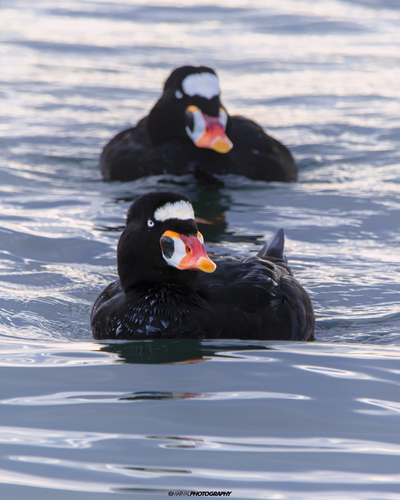 Surf Scoter
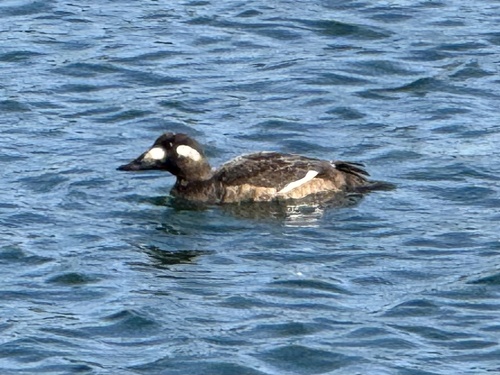 White-winged Scoter
In short
The most reliable field mark to separate Surf Scoter from White-winged Scoter in flight is the wing pattern: Surf Scoter of all ages shows entirely dark wings, while White-winged Scoter has a bold white secondary patch (the 'white wing') visible in flight, especially on adult males but also present, though sometimes less obvious, on juveniles and females. At rest, Surf Scoter males are velvety black with distinctive white forehead and nape patches, while White-winged Scoter males show a white comma-shaped mark around the eye and lack the forehead/nape patches. Females and immatures of both species are brown, but Surf Scoter females tend to have a blockier bill and often a pale nape patch, while White-winged Scoter females are larger, bulkier, and have a feathered gape and a more two-stepped head profile. Bill shape and facial pattern are key for trickier female/immature birds, but flight views of the upperwing are the single best separator.
Identification tips
- Wing pattern in flight (all ages): Surf Scoter shows entirely dark wings; White-winged Scoter always shows a bold white patch (speculum) on the upperwing. This is the single most reliable field mark in flight for any age or sex.
- Adult male head pattern: Surf Scoter males have a white forehead and nape patch; White-winged Scoter males have a white comma-shaped mark around the eye but no forehead/nape patches.
- Bill shape (females/immatures): Surf Scoter has a blocky, squarish bill base and a more flattened head profile. White-winged Scoter has a feathered gape and a 'two-stepped' profile between bill and head, making the bill look more integrated into the face.
- Bill color (adult males): Surf Scoter male's bill is swollen, patterned with orange, white, red, and yellow with a black spot near the base. White-winged Scoter male's bill is orange-red with a large black knob at the base.
- Female/immature facial pattern: Surf Scoter females/immatures often show indistinct pale cheek patches and sometimes a whitish nape patch (unique among scoters). White-winged Scoter females/immatures have variable white spots in front of and behind the eye (especially in juveniles), but adults may lack these and appear uniformly brown in winter.
- Juvenile belly color: Surf Scoter juveniles are paler and browner overall with a whitish breast and belly. White-winged Scoter juveniles have a mottled white belly and more extensive white in the greater secondary coverts (especially in males).
- Size and bulk: White-winged Scoter is larger and bulkier than Surf Scoter, with a broader body and longer bill. This is most apparent in mixed flocks but subtle on lone birds.
- Head profile (females/immatures): Surf Scoter has a more flattened head and blocky bill base; White-winged Scoter shows a two-stepped head profile with a feathered gape.
- Bill base feathering: The feathering along the base of the upper mandible forms a right angle on White-winged Scoter, while Surf Scoter's bill base is more squared and blocky.
- Resting wing pattern: At rest, the white wing patch of White-winged Scoter may be hidden, so do not rely on this mark unless the bird is in flight or stretching its wings.
- Habitat preference: Surf Scoter is more likely in rougher surf zones, while White-winged Scoter can be found on large inland lakes as well as coastal waters, but there is extensive overlap.
- Plumage seasonality: Surf Scoter males may appear browner and duller in summer but retain the basic head pattern; White-winged Scoter males may have reduced eye markings and browner flanks in second-year plumage.
- Mixed flocks: Both species often occur together, so check each individual carefully, especially in large scoter flocks.
- When marks fail: For distant or backlit birds, rely on wing pattern in flight above all else; for resting females/immatures, bill shape and head profile are most useful.
- Juvenile secondary coverts: Juvenile male White-winged Scoters have more extensive white in the greater secondary coverts than juvenile females, which can help in close views.
Size
White-winged Scoter is significantly larger and bulkier than Surf Scoter. Female White-winged Scoters average about 1,180 g and 52.3 cm in length, with males up to 1,380 g and 55 cm, while Surf Scoter averages 950 g and 44–48 cm. This size difference is most apparent in direct comparison or in mixed flocks, but can be hard to judge on lone birds. White-winged Scoter also has a broader, heavier body and a larger bill.
Plumage
- Juvenile/immature and female flight: Surf Scoter of all ages and sexes shows completely dark wings in flight, lacking any white patches. White-winged Scoter always shows a white secondary patch (speculum) on the upperwing, which is diagnostic in flight for all ages and sexes, though sometimes less bold in juvenile females.
- Adult males (resting): Surf Scoter males are entirely black with a white forehead patch and a white nape patch; bill is swollen and patterned with orange, white, red, and yellow. White-winged Scoter males are all black except for a white comma-shaped mark around the eye and a white speculum (often hidden at rest); bill is orange-red with a large black knob at the base.
- Females and immatures: Surf Scoter females are browner, with a fairly uniform plumage, slightly darker above, and often show indistinct pale cheek patches and sometimes a whitish nape patch (unique among scoters). Bill is black with green or blue tones, blocky and square-based. White-winged Scoter females are brownish but bulkier, with variable facial patches (more obvious in juveniles), and a feathered gape. Juveniles of both species are paler below, but White-winged Scoter juveniles have a mottled white belly and more extensive white in the greater secondary coverts (especially males).
Behaviour
Both species are sea ducks and often seen diving for food in coastal waters, but White-winged Scoter tends to appear bulkier and more ponderous in movement, both on water and in flight. Surf Scoter can appear more compact and agile. Flock structure and feeding behavior are otherwise similar, and not reliably diagnostic.
Habitat
Both species breed in northern North America and winter along the Pacific and Atlantic coasts. Surf Scoter is generally more coastal and often seen in rougher surf zones, while White-winged Scoter may be found on larger inland lakes as well as coastal waters. Overlap is extensive in wintering areas, so habitat alone is not a reliable separator.