

Superb Starling vs Purple Starling
Lamprotornis superbus versus Lamprotornis purpureus
Play a quiz with Superb Starling and Purple Starling
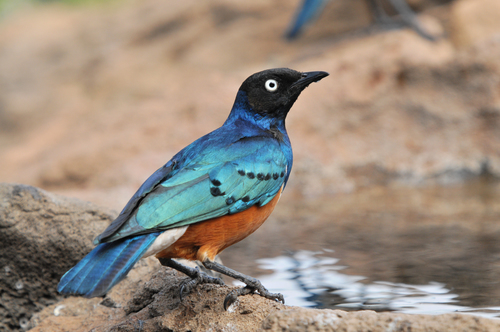 Superb Starling
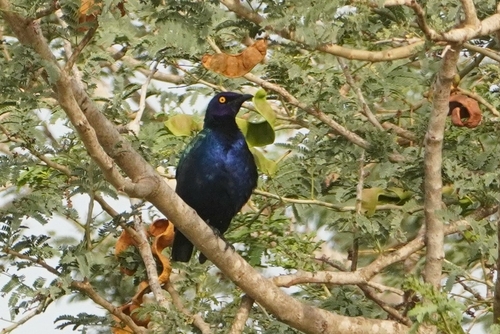 Purple Starling
In short
The most reliable way to separate Superb Starling from Purple Starling is by eye color in adults: Superb Starling shows pale creamy-white eyes, while Purple Starling has striking yellow eyes. Plumage patterns also help—Superb Starling has a black head, iridescent blue-green upperparts, a white breast band, and a rufous belly, while Purple Starling is metallic purple with glossy green wings and lacks the white breast band. Juvenile birds of both species are duller, but Superb Starling juveniles have brown eyes and only a faint breast band, whereas Purple Starling juveniles have grey underparts and a brown iris. Superb Starling is smaller and shorter-tailed than the bulkier Purple Starling. In the field, focus on eye color, breast band, and overall color impression for the most reliable separation.
Identification tips
- Adult eye color: Superb Starling adults have pale creamy-white eyes, while Purple Starling adults show bright yellow eyes. This is the most reliable single mark in good light.
- Juvenile eye color: Both species have brown eyes as juveniles, so eye color is not diagnostic at this age. Only use eye color for adults.
- Breast band (adults): Superb Starling shows a distinct white breast band separating the blue breast from the rufous belly. Purple Starling never shows a white breast band.
- Belly color (adults): Superb Starling has a rufous-orange belly, sharply demarcated by the white breast band. Purple Starling has a metallic purple body with no rufous belly.
- Overall color impression: Superb Starling is blue-green above with a black head and rufous belly; Purple Starling is metallic purple on head and body with glossy green wings.
- Juvenile underparts: Superb Starling juveniles are duller but still show some patterning; Purple Starling juveniles have plain grey underparts and are overall much duller, with a brown iris.
- Size and structure: Superb Starling is smaller (18–19 cm, 65.5 g), more compact, and short-tailed. Purple Starling is larger (22–23 cm), bulkier, and also short-tailed but appears more robust.
- Bill and feet: Both species have strong feet and a long, narrow bill, so these features are not reliably diagnostic.
- Wing and tail pattern: No distinctive age-specific upperwing or tail pattern is described for either species that would separate them in flight.
- Undertail coverts: Superb Starling has white undertail coverts and wing linings, which may be visible in flight or when the bird is fluffed up. Purple Starling's undertail is not described as distinctive.
- Sex differences: Both species are sexually monomorphic (sexes look alike), so do not rely on sex for identification.
- Voice: Superb Starling has a complex, loud song with trills and chatters, and harsh screeching calls. Purple Starling's voice is not described, so use caution with vocal ID.
- Perched vs. in flight: Most field marks (eye color, breast band, belly color) are best seen on perched birds or in good light. In flight, size and overall color impression may help but are less reliable.
- Pitfalls with immatures: Juvenile birds of both species are duller and lack the strong adult field marks. Use caution and focus on structure, size, and any residual patterning.
- Geographic overlap: Both species are African starlings but are not always found in the same regions. If seen together, rely on the above field marks for separation.
Size
Superb Starling is noticeably smaller and more compact, measuring 18–19 cm in length with a body mass around 65.5 g [wikidata]. Purple Starling is larger and stockier, at 22–23 cm, and appears more robust overall. The tail of Superb Starling is relatively short, while Purple Starling also has a short tail but the bird's greater bulk and length are apparent when seen side by side or with experience.
Plumage
-
Juveniles: Superb Starling juveniles are duller versions of adults, lacking a clear white breast band and starting with brown eyes that turn creamy white with age. Purple Starling juveniles are much duller than adults, with grey underparts and a brown iris. Both lack the strong iridescence of adults, but the grey underparts of Purple Starling juveniles contrast with the more muted but still patterned look of Superb Starling juveniles.
-
Adults: Superb Starling adults have a black head, iridescent blue-to-green back, upper breast, wings, and tail, a distinct white breast band, and a rufous-orange belly. The undertail coverts and wing linings are white. Eye color is pale creamy-white. Purple Starling adults are metallic purple on the head and body, with glossy green wings, a short tail, and a bright yellow eye. They lack the white breast band and rufous belly of Superb Starling.
-
Key contrasts: The white breast band and rufous belly of Superb Starling are never matched by Purple Starling. The overall purple gloss and yellow eye of Purple Starling are unique among these two.
Behaviour
Both species are robust, strong-footed starlings with similar general behavior. No diagnostic behavioral differences are noted in the sources for field separation.
Voice
Superb Starling is noted for a long, loud song with trills and chatters, and a variety of harsh calls including a complex screeching sequence. Purple Starling's voice is not described in the provided notes, so vocalizations are not reliably diagnostic between these two based on current information.