

Summer Tanager vs Scarlet Tanager
Piranga rubra versus Piranga olivacea
Play a quiz with Summer Tanager and Scarlet Tanager
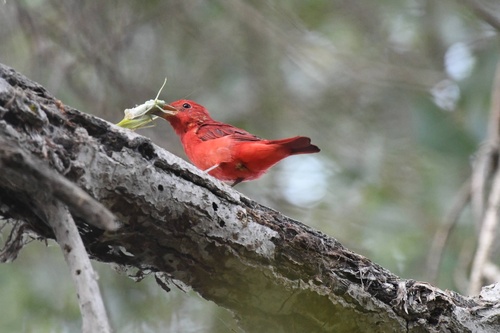 Summer Tanager
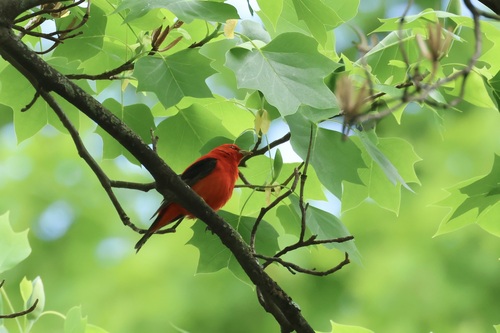 Scarlet Tanager
In short
The most reliable field mark between Summer and Scarlet Tanagers is the color of the wings and tail in adult males: Scarlet Tanager males have striking black wings and tail contrasting with their deep red body, while Summer Tanager males are entirely rose-red, with no black. Females and immatures are trickier, but Scarlet Tanager females are yellow-olive with yellow-olive wings and tail, whereas Summer Tanager females are orangish below, olive above, and have duller, olive-brown wings and tail. In flight or perched, check for black in the wings/tail (never present on Summer Tanager). Voice is also a useful backup: Scarlet Tanager gives a harsh 'chip-burr' call, while Summer Tanager's call is a sharper 'pi-tuk.' Size and structure are very similar, so focus on plumage and voice.
Identification tips
- Adult male wing and tail color: Scarlet Tanager males have jet black wings and tail contrasting with their red body; Summer Tanager males are entirely rose-red, including wings and tail. This is the single most reliable field mark for adult males in any season.
- Female and immature wing color: Scarlet Tanager females and nonbreeding/immature males have yellow-olive wings and tail, matching their olive upperparts. Summer Tanager females/immatures have duller, olive-brown wings and tail, not yellow-olive.
- Female underparts: Scarlet Tanager females are yellowish below; Summer Tanager females are more orangish below. This can be subtle and varies with light, but is useful in good views.
- Immature male pattern: Young male Scarlet Tanagers may show a patchwork of red and yellow-olive with blackish wings/tail; young Summer Tanagers may show patchy orange and olive, but never black in the wings or tail.
- Bill color and shape: Both species have stout, pointed bills. Scarlet Tanager's bill is pale, horn-colored and smooth-textured; Summer Tanager's bill is similar, but this is not a strong field mark.
- Song: Both have robin-like songs, but Scarlet Tanager's is hoarser and more burry, while Summer Tanager's is clearer and more monotonous. Use this as a secondary clue.
- Call notes: Scarlet Tanager's call is a harsh 'chip-burr' or 'chip-churr,' very different from Summer Tanager's sharper 'pi-tuk.' Calls are often the best clue when birds are hidden.
- Seasonal confusion: In fall and winter, male Scarlet Tanagers molt into a female-like plumage but retain darker wings/tail. Summer Tanager males remain reddish, with no black at any season.
- No wingbars: Neither species shows wingbars at any age; if you see bold white wingbars, consider Western Tanager or another species.
- Habitat: Scarlet Tanager prefers large, mature deciduous forests; Summer Tanager is more common in open woodlands and edges, but both can overlap, especially in migration.
- Size and structure: Both are similar in size and shape; do not rely on size for separation.
- Jizz in flight: No strong difference; both move through the canopy and sally for insects.
- Diet-related color variation: Both species' red and orange tones come from diet, so intensity may vary, but the presence or absence of black in the wings/tail is always reliable.
- Confusion with other Piranga: Scarlet Tanager is deeper red than Summer Tanager and Northern Cardinal, but only Scarlet has black wings/tail. Summer Tanager never shows black wings/tail.
- When in doubt: If you see a red bird with black wings/tail, it's a Scarlet Tanager. If the bird is entirely red or orange with no black, it's a Summer Tanager.
Size
Both species are medium-sized songbirds with very similar proportions and mass. Summer Tanager averages about 29 g, while Scarlet Tanager averages slightly less during breeding (25 g) but can reach similar or higher weights before migration. Length and wingspan overlap: Summer Tanager is about 17 cm long with a 28–30 cm wingspan, while Scarlet Tanager ranges from 16–19 cm in length and 25–30 cm in wingspan. In the field, size is not a reliable separator.
Plumage
- Adult males (breeding): Scarlet Tanager males are deep crimson-red with jet black wings and tail, a dramatic contrast. Summer Tanager males are entirely rose-red, including wings and tail, with no black at all.
- Females: Scarlet Tanager females are yellowish below and olive above, with yellow-olive wings and tail. Summer Tanager females are orangish below, olive above, and have duller, olive-brown wings and tail (not yellow-olive).
- Immatures and nonbreeding males: Scarlet Tanager nonbreeding/immature males resemble females but retain darker wings and tail, while Summer Tanager immatures are more uniformly brownish or olive, lacking the strong yellow or black contrasts. Young male Scarlet Tanagers may show a patchy mix of red and yellow-olive with blackish wings/tail, while young Summer Tanagers transition through patchy orange and olive, but never show black wings/tail.
- Wing pattern in flight: No distinctive upperwing pattern (such as bars or panels) is present in either species at any age, but the black wings/tail of Scarlet Tanager males stand out even in flight; Summer Tanager always lacks black.
Behaviour
Both species behave similarly, foraging in the canopy and often remaining hidden in foliage. They may sally for insects or move methodically through leaves. No strong behavioral distinction is noted in the sources.
Habitat
Both species breed in mature forests, but Scarlet Tanager is more closely associated with large tracts of deciduous forest in eastern North America, while Summer Tanager can be found in more open woodlands, especially with scattered trees or along forest edges. However, habitat overlap is common in migration, so habitat alone is not diagnostic.
Voice
Both species have robin-like songs, but Scarlet Tanager's song is hoarser and more burry, while Summer Tanager's is clearer and more monotonous. The calls are more distinctive: Scarlet Tanager gives a harsh, buzzy 'chip-burr' or 'chip-churr,' while Summer Tanager gives a sharper, agitated 'pi-tuk' or 'pik-i-tuk-i-tuk.' These calls are often the best clue when birds are hidden.