

Stripe-tailed Hummingbird vs Sapphire-throated Hummingbird
Eupherusa eximia versus Chrysuronia coeruleogularis
Play a quiz with Stripe-tailed Hummingbird and Sapphire-throated Hummingbird
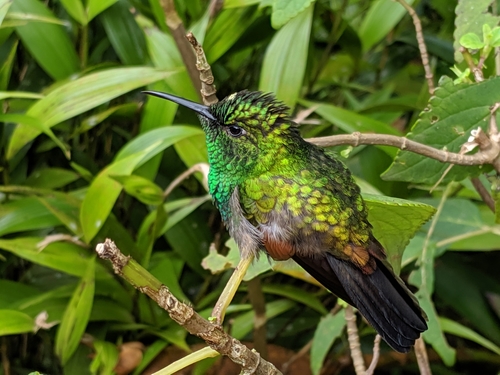 Stripe-tailed Hummingbird
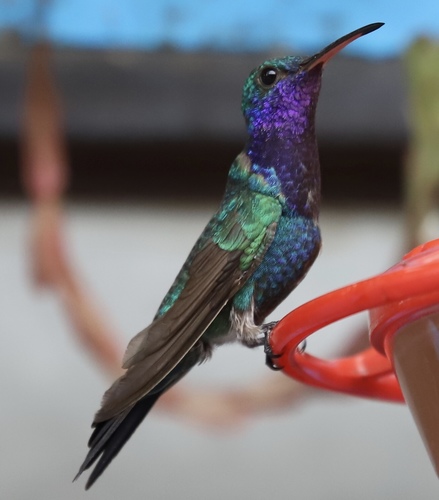 Sapphire-throated Hummingbird
In short
The most reliable field mark between Stripe-tailed and Sapphire-throated Hummingbird is the tail: Stripe-tailed shows bold white in the outer tail feathers (especially obvious in flight or when fanned), while Sapphire-throated has a deeply forked, dark tail with black tips and no white. Males are easily separated by throat color—Sapphire-throated males have a broad, glistening blue patch, while Stripe-tailed males have a uniform green throat. Females differ in underparts: Stripe-tailed females are brownish-gray below with green spots on the sides, while Sapphire-throated females are white below with green spots along the breast sides. Bill color and shape are similar, but Sapphire-throated males may show a pinkish lower mandible. Both are metallic green above, but context, tail, and throat are key for separation.
Identification tips
- Tail pattern in flight or fanned: Stripe-tailed Hummingbird always shows bold white in the outer tail feathers (both sexes, all ages), while Sapphire-throated Hummingbird has a deeply forked, dark tail with black tips and no white. This is the single most reliable field mark.
- Tail shape: Sapphire-throated's tail is distinctly forked and appears longer and more deeply notched, especially in flight. Stripe-tailed's tail is less deeply forked and shows the white stripes clearly when spread.
- Male throat color: Male Stripe-tailed is uniform metallic green below, while male Sapphire-throated shows a broad, glistening blue (violet-blue to turquoise, depending on subspecies) throat patch. This is obvious in good light.
- Female underparts: Female Stripe-tailed is brownish-gray below with green spots on the sides; female Sapphire-throated is white below from throat to vent, with green spots only along the breast sides. This difference is clear with a good view.
- Bill color: Both have straight, short bills, but Sapphire-throated males may show a pinkish lower mandible tipped black, while Stripe-tailed's bill is all black in both sexes. This is subtle and not always visible.
- Upperparts: Both are metallic green above, so this is not useful for separation.
- Tail pattern in perched birds: Even when perched, Stripe-tailed often shows white in the outer tail feathers, especially if the tail is slightly fanned. Sapphire-throated never shows white in the tail.
- Subspecies variation: Some Stripe-tailed subspecies (e.g., E. e. egregia) have less sharply defined black tail tips or more yellowish-green underparts, but the white in the tail is always present. Sapphire-throated subspecies differ mainly in throat color tone (from dark blue to turquoise), but all lack white in the tail.
- Habitat context: In montane forest interiors or high elevations, Stripe-tailed is more likely; in mangroves, open scrub, or lowland forest edge, Sapphire-throated is more likely. However, both can occur together in parts of Costa Rica and western Panama.
- Aggressive behavior: Stripe-tailed males may be seen actively defending flower patches, but this is not diagnostic.
- Voice: Not described in the notes; do not rely on vocalizations for separation.
- Juvenile/immature birds: No unique juvenile wing or upperwing pattern is described for either species; use tail and underparts for young birds as for adults.
- Perched vs. flight views: Tail pattern is best seen in flight or when the bird fans its tail, but can sometimes be glimpsed on perched birds. Throat color is best seen in good light and frontal views.
- Pitfalls: In poor light, both species can appear simply 'green', but Stripe-tailed's white tail flashes are hard to miss in flight. Beware of confusing female Stripe-tailed (brownish-gray below) with female Sapphire-throated (white below); the difference is subtle but consistent.
- Size: Both are similar in size and structure; do not use size for separation.
Size
Both species are similar in size, with Stripe-tailed Hummingbird measuring 9–10.5 cm and weighing 4–4.5 g, and Sapphire-throated Hummingbird at 8.5–9.5 cm and 4–4.5 g. In the field, size is not a reliable separator, as their measurements overlap almost completely. Structure is also similar, with both showing a straight, short bill.
Plumage
- Juvenile/Immature/Non-breeding: No specific juvenile or immature upperwing pattern is described for either species, so tail and underparts remain the best age-independent marks.
- Adult males: Stripe-tailed males are bright metallic grass green above and below, with a distinctive tail pattern—three inner tail pairs are bronze-green, but the outer two pairs have black outer webs and white inner webs with black tips, forming a bold white tail stripe. Sapphire-throated males are metallic green overall, but with a broad, glistening blue throat patch and a deeply notched, dark tail tipped black, lacking any white.
- Adult females: Stripe-tailed females are green above, brownish-gray below with metallic green spots on the sides, and have a tail similar to the male but with dusky to black tips on the inner feathers. Sapphire-throated females are green above, but have entirely white underparts from throat to vent, with green spots along the breast sides, and a deeply forked, dark tail with black tips and no white.
- Tail in flight: Stripe-tailed shows white in the outer tail feathers (both sexes, all ages), especially when the tail is spread. Sapphire-throated always shows a dark, deeply forked tail with black tips.
Behaviour
Both species are solitary and highly active, foraging for nectar at various heights. Stripe-tailed males often defend flower patches aggressively, while Sapphire-throated is noted for solitary habits and does not form flocks. Both require frequent feeding due to high metabolism, but behavior is not a reliable separator in the field.
Habitat
Stripe-tailed Hummingbird is found in humid montane, semi-deciduous, and pine-oak forests, often at elevations from near sea level up to 2,450 m, and is most common in the highlands from southeastern Mexico to western Panama. Sapphire-throated Hummingbird prefers mangroves, scrubs, and light forests, and is found from Panama and Colombia into Costa Rica, typically at lower elevations. Overlap is possible in Costa Rica and western Panama, but Stripe-tailed is more likely at higher elevations and forest interiors, while Sapphire-throated is more common in open, lowland, or edge habitats.
Stripe-tailed Hummingbird · Sapphire-throated Hummingbird · My Tricky Birds