

Stripe-breasted Starthroat vs Eastern Woodhaunter
Heliomaster squamosus versus Automolus subulatus
Play a quiz with Stripe-breasted Starthroat and Eastern Woodhaunter
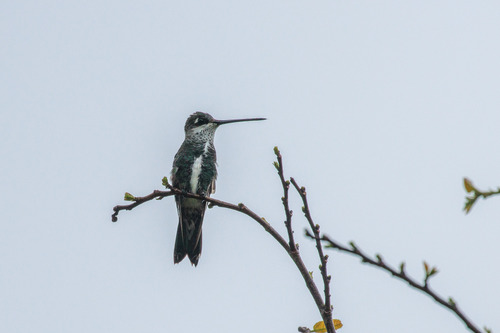 Stripe-breasted Starthroat
 Eastern Woodhaunter
In short
The most reliable way to separate Stripe-breasted Starthroat from Eastern Woodhaunter is by overall structure and plumage: the starthroat is a small, slender hummingbird with a long, slightly decurved bill and a glittering violet gorget (in breeding males), while the woodhaunter is a much larger, chunky ovenbird with a short, heavy bill and bold golden-buff streaks on the head and breast. The starthroat shows a distinctive white central stripe down the underparts and a white moustache, whereas the woodhaunter has a streaked face and breast but lacks any white central stripe. Tail shape also differs: the starthroat’s is forked (especially in males), while the woodhaunter’s is broad and rounded. These birds are extremely unlikely to be confused by size or behavior in the field, but confusion may occur in poor views or with immatures.
Identification tips
- Size and structure: The starthroat is tiny and slender, with a long, slightly decurved bill; the woodhaunter is large, chunky, and has a short, heavy bill. If you see a bird that looks like a sparrow or larger, it cannot be a starthroat.
- Bill shape: Starthroat’s bill is long, thin, and slightly downcurved (hummingbird-like); woodhaunter’s is short, thick, and straight or slightly decurved (ovenbird-like). Bill color also differs: starthroat’s is black, woodhaunter’s is blackish above and pale below.
- Tail shape: Starthroat males have a deeply forked tail, females less so; woodhaunter’s tail is broad, rounded, and chestnut in color. Forked tail in flight is a strong starthroat clue.
- White facial marks: Starthroat has a bold white streak behind the eye and a white moustache, visible in all ages and sexes. Woodhaunter has a pale eyering and post-ocular stripe, but these are less crisp and not moustache-like.
- Central underpart stripe: Starthroat of all ages and sexes shows a white stripe down the center of the underparts. Woodhaunter never shows this; its breast is streaked but the belly is solid tawny brown.
- Gorget/throat color: Breeding male starthroat has a glittering violet gorget with flared sides; after breeding, this molts to grayish with black spots. Females have blackish green throats with white edges. Woodhaunter’s throat is light buff brown with faint streaks, never iridescent or solidly colored.
- Upperpart color: Starthroat is bronzy green above with an iridescent crown; woodhaunter is dark brownish with golden-buff streaks on the crown and chestnut rump.
- Wing color: Starthroat’s wings are not described in detail but are typical hummingbird dark; woodhaunter’s wings are rufescent brown, matching its tail.
- Juvenile confusion: Juvenile woodhaunter is paler and less streaked but still lacks the starthroat’s white stripe and moustache. No described juvenile starthroat plumage, but all ages retain the white facial and underpart marks.
- Behavior: Hovering at flowers or rapid darting flight is diagnostic for starthroat. Creeping along branches, probing among leaves, or joining mixed flocks is woodhaunter.
- Habitat: Starthroat is likely in open, edge, or garden habitats; woodhaunter is deep in forest understory or mid-levels.
- Sex differences: Starthroat males in breeding plumage are most distinctive (violet gorget), but females and non-breeding males still show the white central stripe and moustache. Woodhaunter sexes are similar.
- Tail color: Starthroat’s tail is black and blue-green (male) or green with blue and white (female); woodhaunter’s is always chestnut.
- Face pattern: Starthroat’s white moustache and post-ocular streak are crisp and bright; woodhaunter’s face is streaked but with more diffuse golden-buff and brown.
- When in doubt: If you see a small, hovering bird with a white stripe down the belly and a forked tail, it is a starthroat. If the bird is large, perches or creeps along branches, and has a streaked face and chestnut tail, it is a woodhaunter.
Size
Stripe-breasted Starthroat is a tiny hummingbird, weighing about 5.7 g and measuring 11.2–12.4 cm in length [wikidata, wikipedia]. In contrast, Eastern Woodhaunter is much larger and heavier, at 17–18 cm and 25–38 g [wikipedia]. The woodhaunter is over three times heavier and nearly twice as long as the starthroat, with a bulkier, more robust body and a noticeably heavier bill. Even at a distance, the starthroat appears delicate and quick, while the woodhaunter is stocky and deliberate.
Plumage
- Juvenile/immature plumage: Juvenile Eastern Woodhaunter has less distinct streaking on the head and breast and paler underparts than adults, but still shows a streaked face and chestnut tail. No specific juvenile plumage is described for Stripe-breasted Starthroat, but both sexes and ages share the white moustache and central underpart stripe, with females and non-breeding males lacking the bright gorget.
- Adult males (breeding): Starthroat males have bronzy green upperparts, an iridescent green crown, a glittering violet gorget with flared sides, and a bold white stripe down the middle of the greenish-black underparts. Tail is forked, with central feathers black and others dark blue-green. After breeding, the throat molts to grayish with black spots.
- Adult females: Starthroat females resemble males above, but throat is blackish green with white edges, chest and belly are grayish with a white central stripe, and flanks are greenish. Tail is green with a steel blue band and white tips on outer feathers.
- Woodhaunter (all ages/sexes): Shows a dark brownish face with golden-buff streaks, pale eyering and post-ocular stripe, dark brownish crown with golden-buff streaks, chestnut rump and tail, and a breast with wide, blurry golden-buff streaks that fade before the rich tawny brown belly. No white central stripe or moustache. Subspecies A. s. lemae is more olivaceous and has a more yellowish chin.
Behaviour
Stripe-breasted Starthroat behaves like a typical hummingbird: it hovers at flowers, perches on exposed twigs, and is quick and agile in flight. The Eastern Woodhaunter forages methodically along branches and vines, often joining mixed-species flocks, and is usually seen creeping or probing among dead leaves and epiphytes. Its movements are slower and more deliberate, lacking any hovering. Starthroat is almost always seen alone or at flowers, while woodhaunter is often part of a flock and rarely visits flowers.
Habitat
Stripe-breasted Starthroat is endemic to Brazil and typically found in habitats suitable for hummingbirds, such as forest edges, clearings, and gardens. Eastern Woodhaunter has a much broader range, found in lowland and foothill forests across much of northern South America (Bolivia, Brazil, Colombia, Ecuador, Peru, Venezuela), and prefers dense forest understory and mid-levels. While both can occur in Brazil, starthroat is more likely in open or edge habitats, and woodhaunter deep in forest interiors.
Stripe-breasted Starthroat · Eastern Woodhaunter · My Tricky Birds