

Motmot

Striated Fieldwren vs Orange-bellied Flowerpecker

Calamanthus fuliginosus versus Dicaeum trigonostigma

Play a quiz with Striated Fieldwren and Orange-bellied Flowerpecker
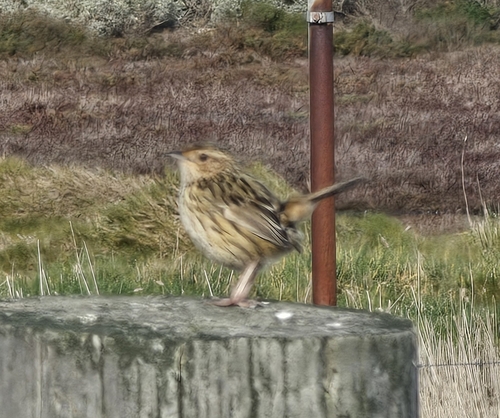
Striated Fieldwren (Calamanthus fuliginosus) Striated Fieldwren
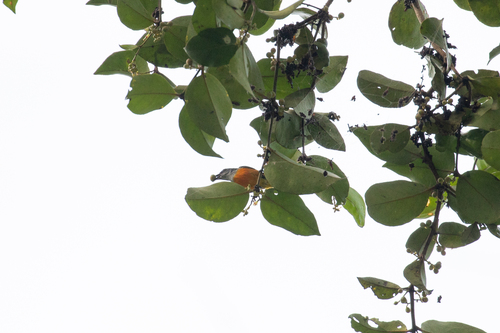
Orange-bellied Flowerpecker (Dicaeum trigonostigma) Orange-bellied Flowerpecker

Media

Loading…

In short

The most reliable field mark between Striated Fieldwren and Orange-bellied Flowerpecker is overall plumage: fieldwren shows heavy streaking and a cocked, streaked tail, while male flowerpecker is boldly colored with slaty-blue upperparts and a fiery orange belly, and female flowerpecker is plain olive-brown with a yellow belly. Juvenile or immature wing patterns are not described for either species, so focus on body and head coloration, tail shape, and bill structure. Fieldwrens are ground-dwelling, often skulking in dense vegetation, whereas flowerpeckers are active in the canopy or mid-levels. The flowerpecker is much smaller and more compact, with a short, slightly downcurved bill, compared to the fieldwren's longer, more slender appearance and straight bill.

Identification tips

  1. Streaking: Striated Fieldwren of all ages shows bold black and brown streaks on the body, especially on the underparts and tail; Orange-bellied Flowerpecker is never streaked, regardless of age or sex.
  2. Tail shape and behavior: Fieldwren has a long, cocked tail often flicked side to side, with streaks; flowerpecker has a short, straight tail, never cocked or streaked.
  3. Bill structure: Fieldwren has a straight, slender bill; flowerpecker's bill is short, stubby, and slightly downcurved at the tip—especially noticeable when seen in profile.
  4. Male flowerpecker coloration: Male flowerpecker is slaty-blue above with a large orange patch on the mantle and a fiery orange to yellow belly—no Australian fieldwren shows this color combination.
  5. Female flowerpecker coloration: Female flowerpecker is plain olive-brown with a yellow belly and pale orange rump, lacking any streaking or strong facial markings; fieldwren is always streaked and never this plain.
  6. Supercilium: Fieldwren has a distinct whitish line over the eye (supercilium); flowerpecker lacks any such facial marking.
  7. Habitat and foraging height: Fieldwren is always on or near the ground in dense cover; flowerpecker is in trees and shrubs, usually above eye level.
  8. Flight and movement: Fieldwren flushes low and drops quickly into cover; flowerpecker moves rapidly and directly between perches in the canopy.
  9. Size impression: Fieldwren is larger and longer; flowerpecker is tiny and compact, even compared to other small birds.
  10. Song: Fieldwren's loud, whirring 'whit whit chee...' song is distinctive in its habitat; flowerpecker's calls are not described, so do not rely on voice for separation unless the fieldwren is singing.
  11. Range: Fieldwren is only found in Australia; flowerpecker is never found in Australia, but across South and Southeast Asia—location alone can be diagnostic.
  12. Seasonal visibility: Fieldwren may be more visible and vocal in spring when singing from bush tops; flowerpecker is active year-round in its range, often seen feeding at flowers or fruit.
  13. Sex differences: Only male flowerpecker is brightly colored; female is dull but still lacks streaking. Fieldwren sexes are similar, both streaked.
  14. Plumage pitfalls: A dull female flowerpecker might be mistaken for a streakless fieldwren, but the absence of streaks and the yellow belly are key; fieldwren never shows a yellow belly or plain olive-brown upperparts.
  15. Juvenile confusion: No specific juvenile or immature wing patterns are described for either species, so rely on the above marks for all ages.

Size

Orange-bellied Flowerpecker is substantially smaller, with a body mass of about 7 grams [wikidata], while Striated Fieldwren is larger at about 140 mm in length [wikipedia] (no mass given, but clearly heavier and longer). The flowerpecker is compact and stubby, while the fieldwren is longer, with a more elongated body and tail. In the field, the flowerpecker will appear tiny and quick, whereas the fieldwren is noticeably larger and more elongated.

Plumage

No age-specific upperwing or flight pattern differences are described for either species. For all ages, Striated Fieldwren is light brown and olive above, with bold black streaks on the body and tail, a white belly, and a buff, streaked front. Its wings are brown and gray with bold streaks, but flight feathers have fine pale edges, not streaks. A whitish supercilium (eyebrow) is present. Orange-bellied Flowerpecker male is unmistakable: slaty-blue above (crown, nape, wings, tail), large orange patch on the mantle, and a gradient from fiery orange (lower breast) to yellow (vent) below. Female flowerpecker is much plainer: drab olive-brown overall, with a pale orange rump and yellow belly, lacking the fieldwren's streaking. Both sexes of flowerpecker lack any streaking or bold facial markings. In summary, fieldwren is streaky and earth-toned; flowerpecker is either strikingly blue-orange (male) or plain olive/yellow (female), never streaked.

Behaviour

Striated Fieldwren is typically secretive, foraging quietly on or near the ground in dense vegetation, often with its tail cocked and flicking side to side. When singing, it may perch up but still stays low. If flushed, it flies a short distance and drops back into cover. Orange-bellied Flowerpecker is much more active and visible, moving rapidly through bushes and trees, often in the mid- to upper canopy, and rarely on the ground. Its feeding is energetic, darting between flowers and fruit, and it does not cock its tail. The flowerpecker's jizz is compact and busy, while the fieldwren is elongated and more furtive.

Habitat

Striated Fieldwren is endemic to Australia and is found in thick ground vegetation, often in heathland, grassland, or coastal scrub. It is a ground specialist. Orange-bellied Flowerpecker is found across a wide range in South and Southeast Asia (Bangladesh, Brunei, Indonesia, Malaysia, Myanmar, the Philippines, Singapore, Thailand), and occupies forest edges, gardens, and secondary growth, usually in trees and shrubs well above the ground. Their ranges do not overlap, and their typical microhabitats are very different: fieldwren on the ground in dense cover, flowerpecker in the canopy or midstory.

Voice

Striated Fieldwren has a loud, whirring song described as 'whit whit chee whit whit pee chew,' often delivered from a bush top in spring and winter. Its song is strong and carries, but is variable. Orange-bellied Flowerpecker's vocalizations are not described in the provided notes, so cannot be reliably contrasted here.

Submit a better description

Use the same sections as the comparison. Your text is published immediately.

The most reliable field mark between Striated Fieldwren and Orange-bellied Flowerpecker is overall plumage: fieldwren shows heavy streaking and a cocked, streaked tail, while male flowerpecker is boldly colored with slaty-blue upperparts and a fiery orange belly, and female flowerpecker is plain olive-brown with a yellow belly. Juvenile or immature wing patterns are not described for either species, so focus on body and head coloration, tail shape, and bill structure. Fieldwrens are ground-dwelling, often skulking in dense vegetation, whereas flowerpeckers are active in the canopy or mid-levels. The flowerpecker is much smaller and more compact, with a short, slightly downcurved bill, compared to the fieldwren's longer, more slender appearance and straight bill.

  1. Streaking: Striated Fieldwren of all ages shows bold black and brown streaks on the body, especially on the underparts and tail; Orange-bellied Flowerpecker is never streaked, regardless of age or sex.
  2. Tail shape and behavior: Fieldwren has a long, cocked tail often flicked side to side, with streaks; flowerpecker has a short, straight tail, never cocked or streaked.
  3. Bill structure: Fieldwren has a straight, slender bill; flowerpecker's bill is short, stubby, and slightly downcurved at the tip—especially noticeable when seen in profile.
  4. Male flowerpecker coloration: Male flowerpecker is slaty-blue above with a large orange patch on the mantle and a fiery orange to yellow belly—no Australian fieldwren shows this color combination.
  5. Female flowerpecker coloration: Female flowerpecker is plain olive-brown with a yellow belly and pale orange rump, lacking any streaking or strong facial markings; fieldwren is always streaked and never this plain.
  6. Supercilium: Fieldwren has a distinct whitish line over the eye (supercilium); flowerpecker lacks any such facial marking.
  7. Habitat and foraging height: Fieldwren is always on or near the ground in dense cover; flowerpecker is in trees and shrubs, usually above eye level.
  8. Flight and movement: Fieldwren flushes low and drops quickly into cover; flowerpecker moves rapidly and directly between perches in the canopy.
  9. Size impression: Fieldwren is larger and longer; flowerpecker is tiny and compact, even compared to other small birds.
  10. Song: Fieldwren's loud, whirring 'whit whit chee...' song is distinctive in its habitat; flowerpecker's calls are not described, so do not rely on voice for separation unless the fieldwren is singing.
  11. Range: Fieldwren is only found in Australia; flowerpecker is never found in Australia, but across South and Southeast Asia—location alone can be diagnostic.
  12. Seasonal visibility: Fieldwren may be more visible and vocal in spring when singing from bush tops; flowerpecker is active year-round in its range, often seen feeding at flowers or fruit.
  13. Sex differences: Only male flowerpecker is brightly colored; female is dull but still lacks streaking. Fieldwren sexes are similar, both streaked.
  14. Plumage pitfalls: A dull female flowerpecker might be mistaken for a streakless fieldwren, but the absence of streaks and the yellow belly are key; fieldwren never shows a yellow belly or plain olive-brown upperparts.
  15. Juvenile confusion: No specific juvenile or immature wing patterns are described for either species, so rely on the above marks for all ages.

Orange-bellied Flowerpecker is substantially smaller, with a body mass of about 7 grams [wikidata], while Striated Fieldwren is larger at about 140 mm in length [wikipedia] (no mass given, but clearly heavier and longer). The flowerpecker is compact and stubby, while the fieldwren is longer, with a more elongated body and tail. In the field, the flowerpecker will appear tiny and quick, whereas the fieldwren is noticeably larger and more elongated.

No age-specific upperwing or flight pattern differences are described for either species. For all ages, Striated Fieldwren is light brown and olive above, with bold black streaks on the body and tail, a white belly, and a buff, streaked front. Its wings are brown and gray with bold streaks, but flight feathers have fine pale edges, not streaks. A whitish supercilium (eyebrow) is present. Orange-bellied Flowerpecker male is unmistakable: slaty-blue above (crown, nape, wings, tail), large orange patch on the mantle, and a gradient from fiery orange (lower breast) to yellow (vent) below. Female flowerpecker is much plainer: drab olive-brown overall, with a pale orange rump and yellow belly, lacking the fieldwren's streaking. Both sexes of flowerpecker lack any streaking or bold facial markings. In summary, fieldwren is streaky and earth-toned; flowerpecker is either strikingly blue-orange (male) or plain olive/yellow (female), never streaked.

Striated Fieldwren is typically secretive, foraging quietly on or near the ground in dense vegetation, often with its tail cocked and flicking side to side. When singing, it may perch up but still stays low. If flushed, it flies a short distance and drops back into cover. Orange-bellied Flowerpecker is much more active and visible, moving rapidly through bushes and trees, often in the mid- to upper canopy, and rarely on the ground. Its feeding is energetic, darting between flowers and fruit, and it does not cock its tail. The flowerpecker's jizz is compact and busy, while the fieldwren is elongated and more furtive.

Striated Fieldwren is endemic to Australia and is found in thick ground vegetation, often in heathland, grassland, or coastal scrub. It is a ground specialist. Orange-bellied Flowerpecker is found across a wide range in South and Southeast Asia (Bangladesh, Brunei, Indonesia, Malaysia, Myanmar, the Philippines, Singapore, Thailand), and occupies forest edges, gardens, and secondary growth, usually in trees and shrubs well above the ground. Their ranges do not overlap, and their typical microhabitats are very different: fieldwren on the ground in dense cover, flowerpecker in the canopy or midstory.

Striated Fieldwren has a loud, whirring song described as 'whit whit chee whit whit pee chew,' often delivered from a bush top in spring and winter. Its song is strong and carries, but is variable. Orange-bellied Flowerpecker's vocalizations are not described in the provided notes, so cannot be reliably contrasted here.

Discard your changes?

You have unsaved edits. If you leave now, those changes will be lost.

Striated Fieldwren · Orange-bellied Flowerpecker · My Tricky Birds