

Stone-curlew vs European Golden Plover
Burhinus oedicnemus versus Pluvialis apricaria
Play a quiz with Stone-curlew and European Golden Plover
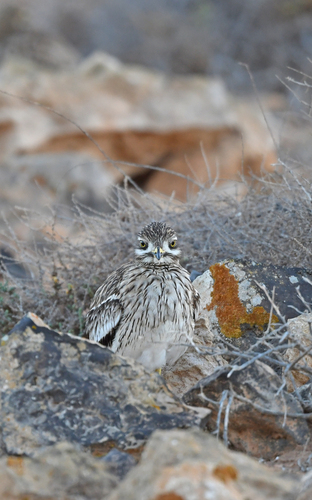 Stone-curlew
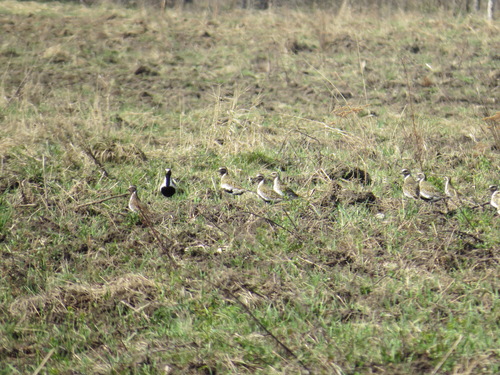 European Golden Plover
In short
The most reliable field mark to separate Stone-curlew from European Golden Plover is the Stone-curlew’s striking black-and-white wing pattern in flight, which is absent in the golden plover. Stone-curlew is a heavier, bulkier bird with a strong yellow-and-black bill and large, staring yellow eyes, while European Golden Plover is more compact, with a short bill and a distinctive white 'S'-shaped band on the face and flanks in breeding plumage. Both species can show cryptic, earth-toned plumage when perched, but their structure, flight style, and facial features are very different. Immature and non-breeding birds may be especially confusing at rest, so focus on flight views and structural cues.
Identification tips
- In flight, look for bold black-and-white wing markings: Stone-curlew shows strong black and white contrast on the wings, visible in all ages and seasons; European Golden Plover lacks this and has plain upperwings.
- Check the eyes: Stone-curlew has very large, staring yellow eyes, giving a 'goggle-eyed' look; Golden Plover’s eyes are dark and less prominent.
- Bill color and shape: Stone-curlew has a strong yellow-and-black bill, thicker and longer than the plover’s short, fine, all-dark bill.
- Facial pattern: In breeding plumage, European Golden Plover has a white 'S'-shaped band from forehead to flanks; Stone-curlew lacks this and has a more uniform, cryptic face with a pale supercilium.
- Legs and stance: Stone-curlew stands taller, with prominent thick 'knees' (tibiotarsal joints) and longer legs; Golden Plover is more compact and stands lower to the ground.
- Body shape: Stone-curlew is bulkier and longer-bodied; Golden Plover is thickset but smaller overall.
- Plumage above: Golden Plover shows golden-spangled upperparts in breeding plumage; Stone-curlew is plain brown and buff above, with no spangling.
- Underwing color: In flight, Golden Plover has white axillaries (armpits), but this is subtle and not as striking as Stone-curlew’s wing pattern.
- Behavior: Stone-curlew is often solitary or in small groups, motionless and cryptic by day, active at dusk/night; Golden Plover is more likely to be seen in flocks, active by day.
- Habitat: Stone-curlew is found on dry, stony or sandy ground; Golden Plover prefers open moorland or wet grassland.
- Voice: Stone-curlew’s call is loud and wailing, usually at night; Golden Plover gives a soft, descending 'tuu', usually by day.
- Size in mixed flocks: If seen together, Stone-curlew is much larger and heavier than Golden Plover.
- Juvenile confusion: Immature Golden Plovers lack the bold breeding face band and are duller, but still lack Stone-curlew’s yellow eye and wing pattern.
- Perched birds: If only seen at rest, focus on eye color, bill shape, and leg length; plumage alone can be misleading in dull light or at distance.
- When in doubt: Wait for flight views or vocalizations, as these are the most reliable for separation.
Size
Stone-curlew is significantly larger and heavier than European Golden Plover. Stone-curlew measures 38–46 cm in length with a wingspan of 76–88 cm and weighs 290–535 g [wikipedia], while European Golden Plover is smaller and lighter at around 175 g [wikidata]. In the field, Stone-curlew appears lankier and more robust, with longer legs and a bigger head, compared to the plover’s more compact, thickset build.
Plumage
-
Juvenile/immature and flight views: Stone-curlew of all ages shows bold black and white wing markings in flight, which are diagnostic and absent in European Golden Plover. Golden Plovers lack strong wing patterning; their underwing is pale, and adults have white axillaries, but the upperwing is plain.
-
Adults in breeding plumage: European Golden Plover is distinctive with a white 'S'-shaped band from forehead to flanks and golden-spangled upperparts. Stone-curlew is much plainer, with cryptic brown and buff plumage, and lacks any golden spangling or white facial band.
-
Non-breeding/immature birds: Both species become duller, but Stone-curlew retains its yellow eye and strong facial pattern, while Golden Plover loses the bold face band but remains more finely marked above and lacks the Stone-curlew’s strong bill and eye contrast.
Behaviour
Stone-curlew is often seen standing upright and motionless, relying on its cryptic plumage for camouflage, and is mostly active at dusk or night. It has a slow, deliberate walk and is less likely to be seen in large flocks. In flight, it shows slow, deep wingbeats and prominent black-and-white wing pattern. European Golden Plover is more active by day, often found in flocks, and has a rapid, powerful flight with regular wingbeats. On the ground, it appears more compact and is frequently seen running and pausing in open areas.
Habitat
Stone-curlew prefers dry, open, stony or sandy ground, often in heaths, fallow fields, or gravelly areas. It avoids wet grasslands and is rarely found on mudflats. European Golden Plover favors open moorland, tundra, and, outside the breeding season, wet grasslands, fields, and sometimes mudflats. Overlap is possible on open ground, but Stone-curlew is much more tied to dry, stony habitats.
Voice
Stone-curlew has a loud, wailing, and eerie call, often heard at night, which is very different from the European Golden Plover’s soft, descending, monosyllabic 'tuu'. The Stone-curlew’s call is more piercing and distinctive, while the plover’s is more plaintive and less far-carrying.