
Stock Dove vs Collared Dove
Columba oenas versus Streptopelia decaocto
Play a quiz with Stock Dove and Collared Dove
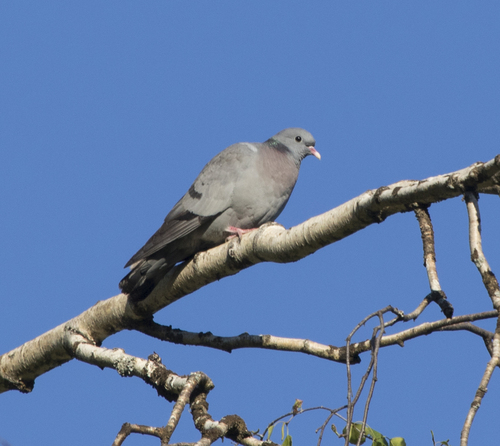 Stock Dove
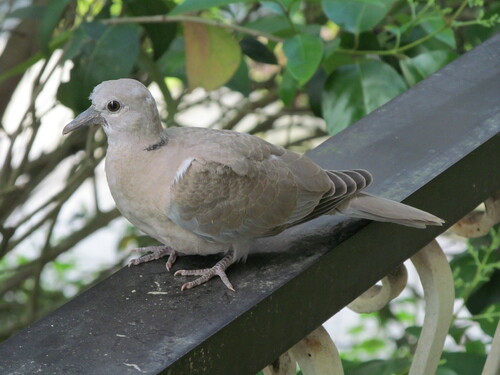 Collared Dove
In short
The most reliable field mark to separate Stock Dove from Collared Dove is the presence of a black half-collar on the nape of Collared Dove (adults and most juveniles), which Stock Dove entirely lacks. In flight, Stock Dove shows a dark trailing edge to the wing and a uniformly grey rump, while Collared Dove has a paler grey-buff body and a distinctive white-tipped tail. Juvenile Stock Doves lack the iridescent neck patch but still never show a collar. Both species are similar in size, but Stock Dove is heavier and bulkier, with a more blue-grey tone and two incomplete dark wingbars, while Collared Dove is slimmer, pinkish-grey, and has a more obvious pale tail tip. Voice is also distinctive: Stock Dove gives a deep, grunting 'Ooo-uu-ooh', while Collared Dove produces a rhythmic, modulated cooing.
Identification tips
- Check for the black half-collar: Collared Dove (adult and most juveniles) shows a black half-collar edged with white on the nape; Stock Dove never has this mark at any age.
- Look at the tail in flight: Collared Dove has a broad white tip to the tail (above and below), while Stock Dove's tail is tipped with a broad dark grey band and lacks any white.
- Rump color: Stock Dove has a uniform grey rump; Collared Dove's rump is not strongly marked but the tail pattern is more striking.
- Wingbars: Stock Dove shows two short, incomplete dark wingbars on the greater coverts and tertials; Collared Dove lacks any wingbars.
- Underwing color in flight: Stock Dove's underwing is dark grey; Collared Dove's underwing is paler with a blue-grey patch.
- Neck iridescence: Adult Stock Dove has an iridescent green or purple patch on the neck sides; Collared Dove does not, but has the black collar instead. Juvenile Stock Doves lack the iridescence but still never show a collar.
- Overall coloration: Stock Dove is blue-toned grey with a pinkish-purple suffused breast; Collared Dove is paler, more buff or pinkish-grey, and lacks the blue tone.
- Bill and eye color: Stock Dove has a pink bill with a yellow tip and dark eyes; Collared Dove has a black bill and a red iris (though eyes may look dark at a distance).
- Leg color: Collared Dove has red legs; Stock Dove's leg color is not distinctive in the field.
- Size and structure: Stock Dove is heavier and more deep-chested, with a broader wingspan; Collared Dove is slimmer and longer-tailed.
- Flight style: Stock Dove flies with quick, regular wingbeats and occasional sharp flicks; Collared Dove's flight is more direct and clipped, with display flights involving a steep climb and gliding descent.
- Perching behavior: Stock Dove is more likely to perch in trees or woodland edges; Collared Dove prefers wires, buildings, and gardens.
- Habitat: Stock Dove is typically found in rural or wooded areas, less often near humans; Collared Dove is almost always near human habitation.
- Voice: Stock Dove gives a deep, grunting 'Ooo-uu-ooh'; Collared Dove's song is a rhythmic, three-note cooing.
- Juvenile confusion: Juvenile Stock Dove lacks both the iridescent neck patch and the collar, but still shows the incomplete wingbars; juvenile Collared Dove may have a faint collar and always lacks wingbars.
Size
Stock Dove is the heavier and more robust of the two, with males weighing 303–365 g and females 286–290 g (no AVONET data, but these are from Wikipedia). Collared Dove is lighter, averaging 193 g (Wikidata), with a typical weight range of 125–240 g. Both species are similar in length (Stock Dove: 28–34 cm; Collared Dove: ~32 cm), but Stock Dove has a broader wingspan (60–66 cm vs. Collared Dove's 47–55 cm). In the field, Stock Dove appears more compact and deep-chested, while Collared Dove is slimmer and longer-tailed.
Plumage
-
Juvenile/immature birds: Juvenile Stock Doves lack the iridescent neck patch of adults but otherwise resemble them, with blue-grey plumage and incomplete dark wingbars; they never show a collar. Juvenile Collared Doves have a poorly developed black half-collar (sometimes faint or incomplete) and a brown iris, but otherwise resemble adults in overall pale grey-buff coloration and white-tipped tail.
-
Adults: Stock Dove is blue-toned grey with two short, incomplete dark wingbars on the greater coverts and tertials, a broad dark grey tail band, and a uniform grey rump. The breast is suffused pinkish-purple, and the neck sides have an iridescent green or purple patch (absent in juveniles). Collared Dove is grey-buff to pinkish-grey, slightly darker above, with a black half-collar edged in white on the nape, blue-grey underwing patch, and a tail that is dark grey below and tipped white (outer tail feathers also tipped whitish above). The rump is not strongly marked. In flight, Stock Dove's underwing is dark grey, while Collared Dove's is paler with a blue-grey patch and a striking white tail tip.
Behaviour
Stock Dove often perches in trees and is more likely to be seen in woodland or parkland, sometimes displaying by walking along branches with a swollen neck and fanned tail. Its flight is quick and regular, with occasional sharp flicks and, during display, audible wing cracks. Collared Dove is typically seen near human habitation, often perched on wires or buildings. Its display flight involves a rapid vertical climb followed by a long, gliding descent in a circle with wings held in an inverted 'V'. At other times, its flight is direct and fast, with clipped wingbeats and little gliding.
Habitat
Stock Dove favors woodland edges, parkland, and rural areas with mature trees, often nesting in hollow trees or old woodpecker holes. It is less closely associated with human habitation than Collared Dove. Collared Dove is strongly synanthropic, breeding and feeding close to buildings, gardens, and farms, almost always within 1 km of inhabited structures. It is rarely found far from human settlements, especially in its introduced range.
Voice
Stock Dove's call is a deep, grunting 'Ooo-uu-ooh', quite different from the rhythmic, modulated cooing of Collared Dove. The Collared Dove's song is a familiar, three-note 'coo-COO-coo', repeated persistently, and is higher-pitched and more musical than the Stock Dove's call.