

Spectacled Warbler vs Dartford Warbler
Curruca conspicillata versus Curruca undata
Play a quiz with Spectacled Warbler and Dartford Warbler
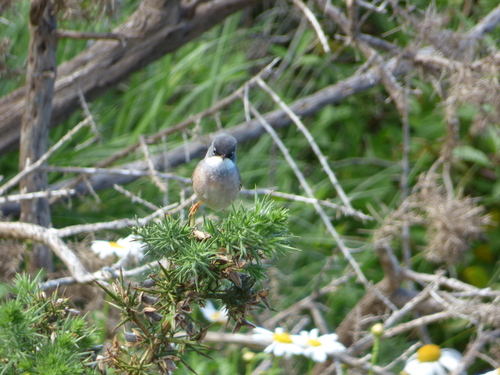 Spectacled Warbler
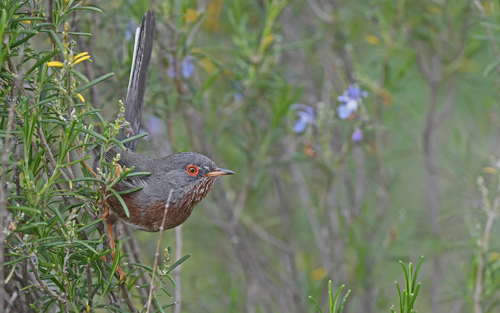 Dartford Warbler
In short
The most reliable field mark between Spectacled Warbler and Dartford Warbler is the presence of a bold white eye-ring on Spectacled Warbler, especially in adult males, versus the Dartford Warbler’s red eye and lack of a strong eye-ring. Dartford Warbler is also noticeably longer-tailed and darker overall, with reddish underparts and a spotted throat, while Spectacled Warbler is paler and more buff below with a white throat and chestnut wing patches. Immature Spectacled Warblers can be very tricky, as they lack the adult's strong head pattern and may closely resemble female or juvenile Dartford Warblers, but the tail length and eye color remain helpful. Both species overlap in range in southwestern Europe and northwest Africa, so careful attention to these details is needed.
Identification tips
- White eye-ring (Spectacled Warbler): Adult Spectacled Warbler males show a bold, clean white eye-ring, which is the single best mark. Females and immatures may have a faint pale eye-ring, but never as strong as in males.
- Red eye (Dartford Warbler): Dartford Warbler (both sexes and ages) has a red eye and no strong white eye-ring, which contrasts with Spectacled’s pale or white ring.
- Tail length: Dartford Warbler has a distinctly long, thin tail, often held cocked; Spectacled Warbler’s tail is shorter and less prominent. This is especially noticeable in flight or when perched upright.
- Head color (adult males): Spectacled Warbler males have a grey head, while Dartford males have a grey-brown or bluish-grey head and back. Females of both species are browner, but Dartford is always darker above.
- Throat pattern: Spectacled Warbler has a clean white throat (especially in males), while Dartford Warbler has a reddish throat with white spots (males) or a paler, less spotted throat (females).
- Underparts color: Dartford Warbler is dull reddish-brown below with a dirty white belly patch; Spectacled Warbler is buff below, never as richly reddish as Dartford.
- Wing patches: Spectacled Warbler shows chestnut wing patches, which can be visible at close range; Dartford Warbler’s wings are more uniformly muted and lack chestnut.
- Juvenile confusion: Immature Spectacled Warblers lack the adult’s grey head and strong eye-ring, making them very similar to Dartford Warbler juveniles. In these cases, tail length and eye color are the best clues.
- Plumage contrast: Spectacled Warbler is generally paler and more contrasting, while Dartford is darker, duller, and more blended with its habitat.
- Behavior: Dartford Warbler is more skulking and often flicks its long tail; Spectacled Warbler is more likely to perch up and show itself.
- Habitat: In overlapping ranges, Dartford prefers dense heath or gorse, while Spectacled is more often in open scrub or fields.
- Flight: Dartford’s long tail is obvious in flight; Spectacled’s shorter tail and chestnut wing patches may be seen at close range.
- Song: Spectacled’s song is a high, fast warble; Dartford’s is scratchier and more rattling, but this is subtle and not always reliable for separation.
- Sex differences: Dartford Warbler shows stronger sexual dimorphism, with males darker and more reddish below; Spectacled Warbler’s sexes are more similar, with only males showing the full grey head and strong eye-ring.
- Pitfalls: Beware of immature Spectacled Warblers, which can look very like Dartford Warbler, especially females. In these cases, rely on tail length, eye color, and habitat context.
Size
Dartford Warbler is slightly larger, measuring about 13 cm in length, and is especially distinctive for its long, thin tail, which is proportionally longer than on Spectacled Warbler. Spectacled Warbler is a very small warbler, intermediate in size between Common Whitethroat and Tristram’s Warbler, but always with a shorter tail than Dartford. Both species are small and slim, but Dartford’s longer tail and slightly bulkier structure can be apparent when perched or in flight. [wikipedia]
Plumage
-
Juvenile/Immature birds: Both species can be confusing in immature plumage, as both are generally brown above and paler below. However, Dartford Warbler juveniles are more uniformly brownish-grey above and have a duller, less contrasting appearance, with a hint of reddish below and a less marked throat. Spectacled Warbler immatures are buff below and brown above, lacking the adult’s grey head and strong eye-ring, but may show a faint pale eye-ring and paler throat.
-
Adult males: Spectacled Warbler males have a grey head, bold white eye-ring, chestnut wing patches, white throat, and buff underparts. Dartford Warbler males have a grey-brown (sometimes bluish-grey) head and back, a red eye, reddish underparts, a dirty white belly patch, and a reddish throat with white spots. Dartford’s plumage is overall darker and more muted, blending into heathland habitats.
-
Adult females: Dartford Warbler females are browner above and paler below than males, with a paler, less spotted throat and a red eye. Spectacled Warbler females are similar to immatures, lacking the strong grey head and eye-ring, but still paler and with a shorter tail than Dartford.
-
In flight: No distinctive upperwing or tail pattern is described for either species, but Dartford’s long tail is obvious in flight, while Spectacled Warbler’s chestnut wing patches may be visible at close range.
Behaviour
Dartford Warbler often perches with its long tail cocked and moves through low shrubs with a skulking, mouse-like motion. It is more likely to be seen flitting low over heathland or gorse, often with a weak, fluttery flight and frequent tail flicking. Spectacled Warbler is also active in low vegetation but is less skulking and may be more likely to perch up in open view. Both species are insectivorous and forage in similar ways, but Dartford’s longer tail and more secretive behavior can be distinctive.
Habitat
Both species occur in southwestern Europe and northwestern Africa, but Dartford Warbler is more tightly associated with dry heathland, gorse, and low scrub, especially in western Europe and the UK. Spectacled Warbler prefers dry, open habitats with scattered bushes, including coastal scrub, fallow fields, and Mediterranean maquis. Where their ranges overlap, Dartford is more likely in dense, mature heath or gorse, while Spectacled is more often in sparser, lower vegetation and open areas.
Voice
Spectacled Warbler’s song is a fast, high-pitched warble, typical of small warblers but not especially distinctive. Dartford Warbler’s song is not described in the notes, but is generally a scratchy, rattling warble. In the field, vocalizations may not be diagnostic without experience, as both are high-pitched and fast, but Spectacled’s is higher and more musical, while Dartford’s is rougher and more rattling.