

Speckled Mousebird vs Bar-throated Apalis
Colius striatus versus Apalis thoracica
Play a quiz with Speckled Mousebird and Bar-throated Apalis
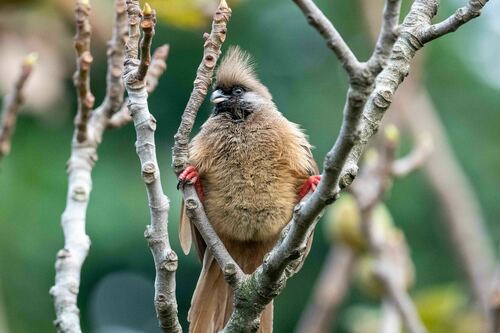 Speckled Mousebird
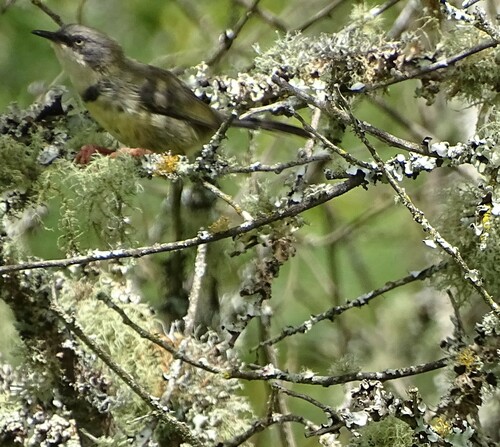 Bar-throated Apalis
In short
The most reliable field mark to separate Speckled Mousebird from Bar-throated Apalis is overall structure and tail: the mousebird is much larger, heavier-bodied, and has an extremely long, graduated tail making up half its length, while the apalis is a small, slender bird with a proportionally long but much shorter tail. Mousebirds are uniform dull brown with a prominent crest and dark upper bill, whereas apalises show contrasting plumage, including a narrow black breast band and white outer tail feathers. Juvenile apalises may lack a full breast band, but never resemble the plain, crested mousebird. In flight or perched, the mousebird’s size, shape, and muted tones stand out from the apalis’s trim, active jizz and crisp patterning.
Identification tips
- Size and shape: Mousebird is much larger and heavier than apalis, with a body mass over five times greater. Even without a direct comparison, the mousebird’s bulk and length are obvious.
- Tail length and shape: Mousebird’s tail is extraordinarily long and graduated, making up about half its total length, and is broad and rounded at the tip. Apalis has a long tail for its size, but it is much shorter, narrower, and features white outer feathers.
- Crest: Mousebird has a prominent, spiky crest visible both at rest and in motion. Apalis lacks any crest and has a smooth, rounded head profile.
- Bill structure and color: Mousebird’s bill is short, thick, and bicolored (black upper, pinkish lower). Apalis has a longer, slender, slightly decurved black bill.
- Plumage color: Mousebird is uniform dull brown above and below, with no strong contrasts. Apalis is always more contrasting, with grey or green upperparts, white or pale yellow underparts, and a distinct black breast band (though narrower in females and sometimes incomplete in juveniles).
- Breast band: Only apalis shows a black breast band (narrow in females, incomplete in juveniles). Mousebird never has a breast band.
- Tail pattern: Apalis has white outer tail feathers, visible both perched and in flight. Mousebird’s tail is plain brown with no white.
- Eye color: Apalis has a pale eye, often striking in good light. Mousebird’s eye is dark, and iris color varies by subspecies but is never pale.
- Jizz and movement: Mousebird moves slowly, often climbing or hanging in foliage, and is usually in groups. Apalis is quick, agile, and often flicks its tail, moving singly or in pairs.
- Flight style: Mousebird’s flight is weak, undulating, and rarely sustained. Apalis has a more direct, bounding flight.
- Juvenile confusion: Juvenile apalis may lack a full breast band and have buffer underparts, but still show white in the tail and a pale eye. Juvenile mousebirds are similar to adults: plain brown, crested, and long-tailed.
- Vocalizations: Mousebird gives low, warbling or sharp calls, not musical. Apalis is more vocal, with thin, high-pitched trills and calls.
- Habitat: Mousebird is common in gardens, open woodland, and scrub, often near people. Apalis prefers dense thickets and forest edge, rarely in open or urban settings.
- Social behavior: Mousebirds are gregarious, often in groups. Apalises are more solitary or in pairs.
- Bill use: Mousebirds often use their bill to manipulate food and climb, sometimes hanging upside down. Apalis forages more like a typical warbler, gleaning insects from foliage.
Size
Speckled Mousebird is dramatically larger and heavier: about 35 cm long (with the tail about half that length) and weighing around 57 g [wikipedia], compared to Bar-throated Apalis at just 11–13 cm and 10.5 g [wikidata]. The mousebird’s bulk, long tail, and overall presence are unmistakable against the delicate, lightweight apalis. Even at a distance, the difference in mass and length is striking.
Plumage
Juvenile Bar-throated Apalis can be confused with other small, pale-bellied birds, but not with the uniformly brown, crested mousebird. Juveniles have buffer underparts and may show an incomplete breast band, but always retain the white outer tail feathers and pale eye. Adults of both species are distinctive: Speckled Mousebird is dull mousy-brown all over, with a prominent crest and a black upper mandible contrasting a pinkish lower mandible. The apalis, by contrast, is always more crisply marked, with grey or green upperparts, white or pale yellow underparts, a narrow black breast band (narrower in females), white outer tail feathers, and a pale eye. The mousebird lacks any breast band, white in the tail, or pale eye. The apalis has a slender, slightly decurved black bill, while the mousebird’s bill is stubbier and bicolored. Subspecific variation in both is minor compared to these core differences.
Behaviour
Speckled Mousebirds are often seen clambering through foliage in small, social groups, moving with a slow, squirrel-like gait, sometimes hanging upside down. Their flight is weak and undulating, often over short distances. Bar-throated Apalis is much more active and agile, typically seen singly or in pairs, flitting rapidly through branches and foliage, often flicking its tail. Apalises are more likely to be encountered as part of mixed-species flocks and rarely show the mousebird’s social, lounging behavior.
Habitat
Both species occur in overlapping regions of eastern and southern Africa, but their habitat preferences differ. Speckled Mousebird is highly adaptable, found in a wide range of habitats including gardens, woodland, scrub, and savanna, often near human habitation. Bar-throated Apalis prefers forest edges, thickets, and dense bush, and is less likely in open or urban areas. If you see a bird in a manicured garden or open scrub, mousebird is more likely; dense, tangled thickets favor apalis.
Voice
Speckled Mousebird is not a songbird and is generally quiet, but gives a warbling "tsu-tsu" call in flight and a sharp "tisk-tisk" alarm. Bar-throated Apalis, as a cisticolid, is more vocal, typically giving a series of high-pitched, thin calls and trills. Mousebird calls are lower-pitched and less musical; if you hear a persistent, high, thin song, it is likely the apalis.