

Southern Tchagra vs Southern Boubou
Tchagra tchagra versus Laniarius ferrugineus
Play a quiz with Southern Tchagra and Southern Boubou
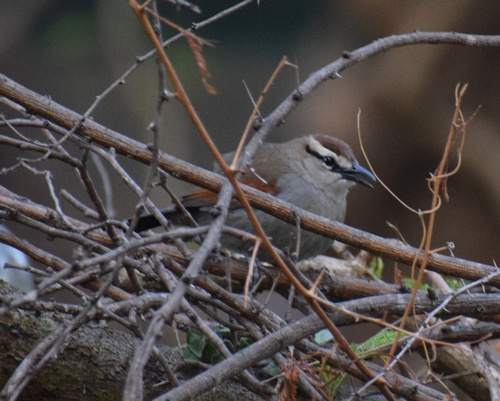 Southern Tchagra
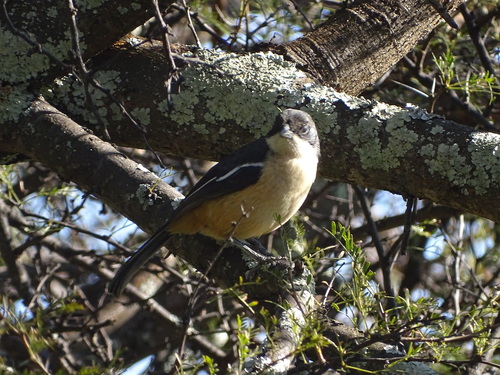 Southern Boubou
In short
The most reliable field mark to separate Southern Tchagra from Southern Boubou is the head pattern: Southern Tchagra shows a brown crown with a bold white supercilium and black eye-stripe, while Southern Boubou has a uniformly dark (black or dark grey) head without a strong supercilium. In flight or perched, Southern Boubou’s white wing stripe and rufous flanks are distinctive, whereas Southern Tchagra has chestnut wings and pale underparts. Juveniles can be confusing, but the Tchagra’s buff eye-stripe and duller tones contrast with the Boubou’s barred and mottled pattern. Structure and size also help: Southern Boubou is heavier, bulkier, and has a more robust bill. Both species prefer dense cover, but their behavior and vocalizations differ, with Boubou being shyer and more skulking.
Identification tips
- Head pattern (all ages): Southern Tchagra has a brown crown, bold white supercilium, and black eye-stripe—this is the quickest way to separate it from Southern Boubou, which has a uniformly dark (black or dark grey) head and no strong supercilium.
- Crown color (adults): Tchagra’s crown is brown (except in some subspecies with reddish-brown), while Boubou’s head and back are black (male) or dark grey (female).
- Supercilium (all ages): Tchagra always shows a broad white supercilium; Boubou lacks this feature entirely.
- Wing pattern (adults): Southern Boubou has a bold white wing stripe, visible when perched or in flight; Tchagra’s folded wings are chestnut without a white wing stripe.
- Tail pattern (adults): Both have black tails with white, but Boubou’s tail is longer and has white outer feathers, while Tchagra’s tail is tipped white.
- Underparts (adults): Tchagra is pale grey below; Boubou is white below, shading to rufous on the lower belly, flanks, and undertail (especially in males and females, less so in juveniles).
- Juvenile/immature marks: Young Boubou is mottled buff-brown above, with a buffy wing bar and strong barring below—never shown by Tchagra. Juvenile Tchagra is duller than adult, with a buff eye-stripe, but never barred or mottled below.
- Bill structure: Boubou’s bill is stouter and heavier; Tchagra’s is longish and black, but slimmer.
- Size and bulk: Boubou is heavier and bulkier (~58 g vs ~47 g), with a longer tail and more robust appearance. This is subtle unless both are seen together.
- Behavior: Boubou is shy, skulking, and forages low in dense vegetation; Tchagra is more likely to perch in the open, especially when singing or displaying.
- Song: Tchagra’s song is a descending whistle, often from a perch or in display flight; Boubou’s duet is more complex, liquid, and variable, with ooo-whee-ooo phrases.
- Sex differences: Boubou females are dark grey above with a rufous wash to the breast; Tchagra sexes are similar, but young birds are duller.
- Habitat overlap: Both prefer dense scrub, but Tchagra is more coastal in range, while Boubou is more widespread in southeastern Africa.
- Common pitfalls: Juvenile Boubou’s mottling and barring can be mistaken for a dull Tchagra, but the lack of a strong supercilium and presence of barring are key. Juvenile Black-crowned Tchagra (not in this pair) can also show a brown crown, but is larger and has a shorter bill than Southern Tchagra.
- Context clues: If the bird is singing a duet or foraging very low and hidden, suspect Boubou; if perched openly and giving a descending whistle, suspect Tchagra.
Size
Southern Boubou is noticeably larger and heavier (body mass ~58 g) compared to Southern Tchagra (~47 g). Boubou measures 20–22 cm in length, while Tchagra is slightly smaller at 17–21 cm. Boubou appears bulkier and more robust, with a relatively longer tail and stouter bill. In the field, this size difference is most apparent when both species are seen side by side, but can be subtle when seen alone.
Plumage
- Juvenile/immature birds: Southern Tchagra juveniles are duller than adults, with a buff stripe through the eye, and lack strong barring or mottling. Southern Boubou juveniles are mottled buff-brown above, have a buff wash to the wing bar, and are barred below—this barring is a key mark for young Boubous and never shown by Tchagra.
- Adults: Southern Tchagra shows a brown crown, black eye-stripe, broad white supercilium, pale grey underparts, pale brown upperparts, chestnut folded wings, and a black tail with white tip. Southern Boubou adult males are black above (head to tail), with a striking white wing stripe, long black tail with white outer feathers, and white underparts shading to rufous on the lower belly, undertail, and flanks. Females are similar but dark grey above and have a rufous wash to the breast. Tchagra never shows the Boubou’s white wing stripe or rufous flanks, and Boubou never shows Tchagra’s strong supercilium or chestnut wings.
Behaviour
Southern Boubou is notably shy and skulking, foraging low in dense vegetation and rarely perching conspicuously. Southern Tchagra, while also favoring dense scrub, is more likely to be seen perched in the open, especially during display. Boubou’s foraging is mostly on or near the ground, creeping through bushes, while Tchagra may be more active and visible during song flights or territorial displays.
Habitat
Both species occur in dense scrub and bush, but Southern Tchagra is more closely associated with coastal bush and dense scrub in southern and southeastern South Africa and Eswatini. Southern Boubou ranges more widely in southeastern Africa, including southeastern Zimbabwe, eastern Botswana, Mozambique, and southern/eastern South Africa. Both prefer thick cover, but Boubou may be found in a broader range of dense habitats.
Voice
Southern Tchagra’s male song is a descending whistle (ttttrtr te te te teuuu), often given from a perch or in display flight; the female responds with a trilled tzerrrrrrrr. Southern Boubou is best known for its duetted calls: a liquid ooo-whee-ooo, followed by a whistled ooo-ooo-wheee or wheee-wheee followed by ooo-whee-ooo, with many variations. Boubou’s duet is more complex and can be confused with black-headed oriole, while Tchagra’s song is simpler and more descending.