

Southern Red Bishop vs Yellow Bishop
Euplectes orix versus Euplectes capensis
Play a quiz with Southern Red Bishop and Yellow Bishop
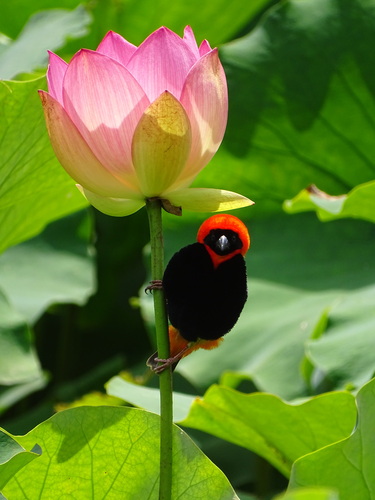 Southern Red Bishop
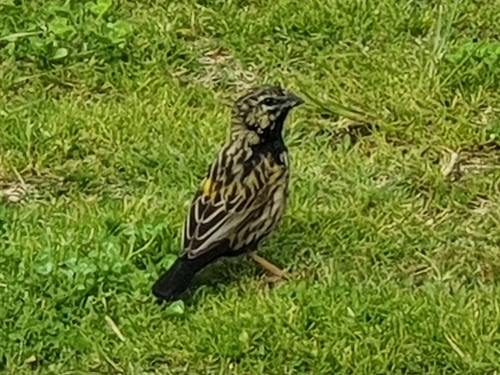 Yellow Bishop
In short
The most reliable field mark between Southern Red Bishop and Yellow Bishop is the presence of bright yellow patches on the lower back, rump, and shoulders of the Yellow Bishop, which are never shown by Southern Red Bishop. Breeding male Southern Red Bishops are strikingly red and black, while Yellow Bishops are mostly black with yellow highlights. Non-breeding and female birds of both species can be confusingly streaky brown, but the Yellow Bishop’s yellow rump and shoulder patches persist even in non-breeding plumage, providing a crucial separation point. Size and structure also help: Yellow Bishop is noticeably larger and bulkier, with a short crest and a stouter bill, while Southern Red Bishop is smaller and more compact.
Identification tips
- Look for yellow patches: Yellow Bishop of any age or sex (except possibly the youngest juveniles) shows yellow on the lower back, rump, and shoulders. Southern Red Bishop never shows yellow anywhere.
- Red vs yellow/black: Breeding male Southern Red Bishop is bright red and black, with red on the head, upperparts, and underparts, and black on the face, throat, and belly. Yellow Bishop breeding male is black with yellow patches, never red.
- Size and build: Yellow Bishop is noticeably larger and bulkier (about 34g, 15 cm), with a thicker, often larger bill, and a short crest. Southern Red Bishop is smaller (about 23g, 10–11 cm), more compact, and lacks a crest.
- Bill color and shape: Both have thick conical bills, but Yellow Bishop’s bill can be especially large and varies between races; in non-breeding plumage, it becomes pale. Southern Red Bishop’s bill is thick but smaller and does not show as much variation.
- Non-breeding and female confusion: Both species’ females and non-breeding males are streaky brown above and paler below. In Yellow Bishop, non-breeding males retain yellow patches, while females do not. Southern Red Bishop females and non-breeding males never show yellow.
- Juvenile challenge: Juvenile and female Yellow Bishops are notoriously difficult to separate from other bishops and widowbirds, but yellow rump/shoulder patches (if present) are diagnostic. Southern Red Bishop juveniles are streaky brown and lack yellow.
- Wing and tail: Both have brown wings and tails, but Yellow Bishop’s wings have brown edging and the tail is relatively short. Southern Red Bishop’s wings and tail are simply brown, with no yellow or special markings.
- Crest: Yellow Bishop breeding males have a short crest, which Southern Red Bishop lacks. This can be subtle but is useful in close views.
- Behavior in flocks: In non-breeding season, Yellow Bishop often joins mixed flocks with other Euplectes species. Southern Red Bishop is also social but less specifically noted for mixed flocking.
- Habitat hints: Southern Red Bishop prefers wetlands and grasslands, while Yellow Bishop is more likely in upland, less arid, or fynbos habitats.
- Flight views: In flight, look for flashes of yellow on the rump and shoulders for Yellow Bishop; Southern Red Bishop will not show these.
- Context: If you see a bright red and black bishop in southern Africa, it is a Southern Red Bishop. If the bird is black and yellow, it is a Yellow Bishop.
- Seasonal context: During the breeding season, males are easy to separate by color. In non-breeding season, rely on yellow patches for Yellow Bishop and overall smaller size for Southern Red Bishop.
- Pitfalls: Do not rely on streaky brown plumage alone for identification; always check for yellow patches and size/structure.
- Voice: Calls are not diagnostic between these two species based on available notes.
Size
Yellow Bishop is substantially heavier (about 34g) and longer (15 cm) than Southern Red Bishop (about 23g, 10–11 cm). This difference is often visible in the field, with Yellow Bishop appearing stockier and more robust, while Southern Red Bishop looks smaller and more delicate. Bill size is also more variable and generally larger in Yellow Bishop, especially in some races, compared to the consistently thick but smaller bill of Southern Red Bishop.
Plumage
- Juveniles and non-breeding birds: Both species are streaky brown and can be very similar, but Yellow Bishop (all ages and sexes) shows yellow on the lower back, rump, and shoulders, which Southern Red Bishop never does. This yellow is the most reliable mark for all but the youngest juveniles.
- Breeding males: Southern Red Bishop males are vivid red with a black face, throat, and belly, and brown wings/tail. Yellow Bishop males are black with bright yellow lower back, rump, and shoulder patches, and brown-edged wings. Southern Red Bishop never shows yellow, and Yellow Bishop never shows extensive red.
- Females: Both are streaky brown and paler below, but Yellow Bishop females lack the yellow patches seen in males, making them especially tricky. However, Southern Red Bishop females are smaller and lack any yellow.
- Non-breeding males: Both look similar to females, but Yellow Bishop males retain yellow patches, while Southern Red Bishop males do not.
Behaviour
Yellow Bishop is often solitary or in pairs during the breeding season, but becomes gregarious and forms mixed flocks with other Euplectes species in the non-breeding season. Southern Red Bishop is also social, but the notes do not specify flocking behavior as clearly. Both species feed on seeds and insects, but Yellow Bishop is noted for joining mixed-species flocks outside the breeding season.
Habitat
Southern Red Bishop is common in wetlands and grasslands south of the Equator, while Yellow Bishop prefers less arid, vegetated habitats such as fynbos, moist grassland, and bracken-covered valleys, often at higher altitudes from sea level to the Ethiopian Highlands. Overlap is possible in moist grasslands, but Yellow Bishop is more likely in upland or montane areas and less arid zones.
Voice
Southern Red Bishop has various twittering calls, a nasal contact call, and a buzzing song. No specific vocalizations are described for Yellow Bishop in the notes, so calls are not a reliable field mark for separation.