

Sooty Shearwater vs Christmas Shearwater
Ardenna grisea versus Puffinus nativitatis
Play a quiz with Sooty Shearwater and Christmas Shearwater
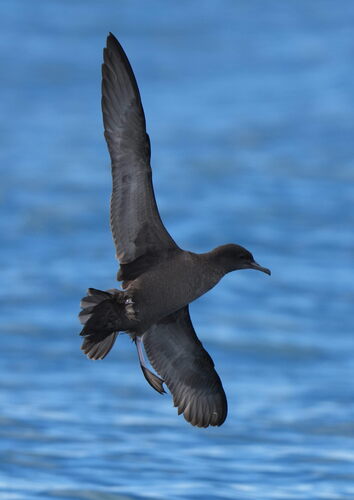 Sooty Shearwater
 Christmas Shearwater
In short
The most reliable field mark to separate Sooty Shearwater from Christmas Shearwater is the underwing pattern: Sooty Shearwater (all ages) shows a distinct silvery stripe along the center of the underwing, while Christmas Shearwater's underwings are uniformly dark brown without any pale panel. Size is also a strong clue: Sooty Shearwater is significantly larger and longer-winged. In good light, Sooty Shearwater appears dark chocolate-brown, whereas Christmas Shearwater is more blackish-grey with a rusty tinge and subtle pale fringes on the upperwing coverts. Flight style and tail shape offer further clues, but the underwing is the best single separator in the field.
Identification tips
- Underwing pattern: In flight, look for the broad, silvery stripe along the center of the underwing in Sooty Shearwater (all ages); Christmas Shearwater's underwing is uniformly dark brown. This is the single most reliable mark.
- Size and structure: Sooty Shearwater is much larger and longer-winged than Christmas Shearwater. If you have a sense of scale (with other seabirds or by direct comparison), this is a strong clue.
- Upperwing and body color: Sooty Shearwater is dark chocolate-brown, sometimes appearing black, with a glossy, uniform look. Christmas Shearwater is blackish-grey with a rusty-brown tinge and may show pale fringes to the upperwing coverts, giving a slightly scaly or worn look at close range.
- Tail shape in flight: Christmas Shearwater's tail usually tapers to a point, with the feet extending beyond the tail tip, while Sooty Shearwater's tail is less pointed and the feet are less obvious.
- Flight style: Sooty Shearwater flies with stiff, straight wings, rarely flapping, and makes long, powerful glides. Christmas Shearwater often uses slower, more leisurely wingbeats and can resemble a petrel in flight.
- White under chin: Christmas Shearwater may show a small patch of white under the chin, but this is subtle and not always visible; Sooty Shearwater lacks this mark.
- Bill and head: Both species have dark bills and eyes, but Christmas Shearwater has a more slender, delicate bill and a slightly bulbous head compared to Sooty Shearwater's more robust profile.
- Feet color: Christmas Shearwater has brown-grey feet, but this is rarely visible in the field; Sooty Shearwater's feet are not distinctive in this context.
- Group size: Sooty Shearwater is often seen in large, fast-moving flocks, especially on migration; Christmas Shearwater is more solitary or in small groups.
- Geographic context: If seen in the tropical central Pacific, Christmas Shearwater is more likely; Sooty Shearwater is more likely in temperate or subarctic waters, especially outside the breeding season.
- Habitat: Sooty Shearwater is highly pelagic and migratory, while Christmas Shearwater is more localized to breeding islands in the central Pacific.
- Voice: Not a useful field mark at sea for either species.
- Age-specific marks: Both species have similar juvenile and adult plumage, so age is not a major separator except for the consistent underwing pattern.
- Lighting conditions: In poor light, both species can appear all-dark, but the silvery underwing stripe of Sooty Shearwater may still flash in strong side light.
- Potential confusion: Both species can be confused with other all-dark shearwaters in their respective ranges, but the underwing pattern is the best separator between these two.
Size
Sooty Shearwater is a much larger bird, measuring 40–51 cm in length with a wingspan of 94–110 cm [wikipedia]. Christmas Shearwater is noticeably smaller and more slender, at about 36 cm long with a 75 cm wingspan [wikipedia]. This size difference is often apparent if both species are seen together or with familiar seabirds for scale. Sooty Shearwater is also heavier and more robust, while Christmas Shearwater is lighter and more delicate in build.
Plumage
The key plumage difference is the underwing: Sooty Shearwater (all ages) shows a broad, silvery stripe running along the center of the underwing, visible in good light and especially in flight. Christmas Shearwater's underwing is uniformly dark brown, lacking any pale panel or stripe. On the upperparts, Sooty Shearwater is overall dark chocolate-brown, sometimes appearing almost black in poor light, while Christmas Shearwater is blackish-grey with a rusty-brown tinge and subtle pale fringes to the upperwing coverts. Christmas Shearwater may show a small area of white under the chin, but this is not always visible. Both species are all-dark overall, but Sooty Shearwater is glossier and more uniform, while Christmas Shearwater can look slightly paler below and more worn or rusty, especially at close range. Juvenile and adult plumages are similar in both species, with no strong age-specific marks except the underwing pattern, which is consistent at all ages.
Behaviour
Sooty Shearwater typically flies with stiff, straight wings, rarely flapping and often gliding low over the water in a powerful, direct manner, reminiscent of a small albatross. Its flight is fast and purposeful, with deep, shearing arcs. Christmas Shearwater, while capable of the classic 'shearing' flight, more often uses a slower, more leisurely wingbeat, sometimes resembling a petrel. In flight, Christmas Shearwater's tail usually appears pointed, with the feet extending beyond the tail tip, while Sooty Shearwater's tail is less prominent. Sooty Shearwater is more likely to be seen in large, fast-moving flocks, while Christmas Shearwater is usually encountered singly or in small groups.
Habitat
Sooty Shearwater is a long-distance migrant, breeding in the southern hemisphere and ranging widely across both the Pacific and Atlantic Oceans, often seen far offshore in temperate and subarctic waters. Christmas Shearwater is restricted to the tropical central Pacific, breeding on remote islands and rarely straying far from these areas. Thus, location and season can be helpful: Sooty Shearwater is unlikely in strictly tropical waters, while Christmas Shearwater is rarely seen outside the central Pacific tropics.
Voice
Sooty Shearwater is vocal at night on breeding grounds, producing loud coos and croaks, but is usually silent at sea except when feeding in large groups. Christmas Shearwater's vocalizations are not described in detail, but at sea it is also generally silent. Thus, voice is not a reliable separator in most field situations.