

Sooty Shearwater vs Barolo Shearwater
Ardenna grisea versus Puffinus baroli
Play a quiz with Sooty Shearwater and Barolo Shearwater
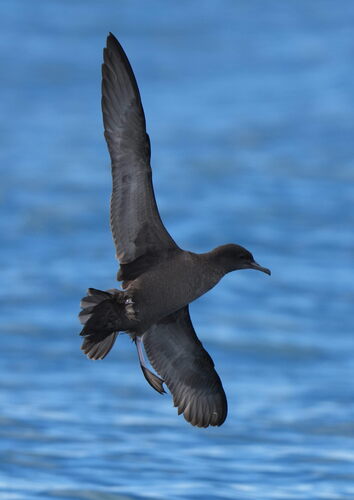 Sooty Shearwater
 Barolo Shearwater
In short
The most reliable way to separate Sooty Shearwater from Barolo Shearwater is by overall size and structure: Sooty is a much larger, longer-winged bird, appearing dark chocolate-brown all over with a silvery underwing stripe, while Barolo is compact, pale-faced, and shows a contrasting silvery upperwing panel. In flight, Sooty’s wings are long, narrow, and held stiff, giving a powerful, straight flight reminiscent of a small albatross, whereas Barolo’s wings are shorter, more rounded, and its flight is quicker and more fluttery. Barolo’s pale face and blue feet are unique among North Atlantic shearwaters, while Sooty always looks dark and lacks any pale facial features. Even at a distance, the size and darkness of Sooty versus the smaller, paler, and more patterned Barolo are usually clear with good views.
Identification tips
- Size is the first check: Sooty Shearwater is much larger and longer-winged than Barolo; if the bird looks big and albatross-like, it's Sooty.
- Underwing pattern: Sooty shows a silvery stripe along the center of the underwing in all plumages; Barolo does not. If you see a pale underwing stripe on an otherwise dark bird, it's Sooty.
- Upperwing panel: Barolo has a silvery panel on the upperwing, visible in flight; Sooty’s upperwing is uniformly dark. Look for this contrast in good light.
- Facial color: Barolo has a pale face with a dark, contrasting eye; Sooty is dark-faced with no pale areas. A pale face rules out Sooty.
- Overall color: Sooty is dark chocolate-brown to blackish all over; Barolo is much paler, especially on the face and underparts.
- Flight style: Sooty glides on stiff, straight wings with few flaps; Barolo flaps more frequently, with a quicker, more fluttery flight and shorter glides.
- Wing shape: Sooty’s wings are long and narrow; Barolo’s are shorter and more rounded.
- Feet color: Barolo has blue feet, which can be seen at close range; Sooty’s feet are not blue.
- Bill and head shape: Sooty has a heavier, more robust bill and head; Barolo’s bill is finer and the head looks more delicate.
- Flock size: Sooty is often seen in large flocks, especially during migration; Barolo is more likely to be seen singly or in small groups.
- Geographic context: Sooty is found in both the Pacific and Atlantic, often far from land; Barolo is restricted to the North Atlantic, especially near Macaronesia.
- Habitat: Barolo breeds only in the Azores and Canaries; Sooty breeds in the southern hemisphere.
- Voice: Not a reliable field mark at sea; both are generally silent away from breeding grounds.
- Pitfalls: In poor light, Sooty can look all-black and Barolo can appear darker than it is, but the size and structure differences remain.
- Age/season: No age-specific wing patterns are noted for either species, so all ages show the main field marks described above.
Size
Sooty Shearwater is a medium-large shearwater, 40–51 cm in length with a 94–110 cm wingspan [wikipedia]. Barolo Shearwater is much smaller, described as a 'small shearwater' [wikipedia], and is significantly more compact and delicate in build. Even at a distance, Sooty appears long-winged and heavy-bodied, while Barolo is noticeably smaller, with shorter, rounder wings and a stubbier overall appearance.
Plumage
Age-specific wing pattern is not detailed for either species in the sources, but adults and immatures of Sooty Shearwater are uniformly dark chocolate-brown, appearing almost black in poor light, with a diagnostic silvery stripe along the center of the underwing. This pale underwing stripe is visible in all plumages and is a key field mark. In contrast, Barolo Shearwater is much paler overall, with a pale face, a dark contrasting eye, and a distinctive silvery panel on the upperwing (not underwing), visible in flight. Barolo’s upperparts are dark but not as uniformly sooty as Sooty Shearwater, and the pale face is unique among North Atlantic shearwaters. Sooty never shows a pale face or upperwing panel. Barolo also has blue feet, which are rarely visible in the field but can be diagnostic at close range.
Behaviour
Sooty Shearwater flies with stiff, straight wings, rarely flapping, and often glides low over the water in a powerful, direct manner, reminiscent of a small albatross. It is often seen in large flocks, especially during migration. Barolo Shearwater, being smaller, has a quicker, more fluttery flight with frequent flapping and shorter glides. Its wings appear more rounded and it often looks more buoyant and agile over the waves. Sooty is usually silent at sea, while Barolo’s behavior at sea is less documented but not noted as especially vocal.
Habitat
Sooty Shearwater breeds on southern hemisphere islands (New Zealand, Australia, Falklands, etc.) and migrates long distances, appearing in both the Pacific and Atlantic Oceans, sometimes in huge flocks. Barolo Shearwater breeds in the Azores and Canaries (Macaronesia) in the North Atlantic and is a strictly North Atlantic species, never found in the Pacific. Thus, context and location can help: a small pale-faced shearwater in Macaronesia is Barolo, while a large, all-dark shearwater in temperate or subarctic waters of either ocean is likely Sooty.
Voice
Sooty Shearwater is vocal at night on breeding grounds, with loud coos and croaks, but is usually silent at sea except when competing for food. No distinctive at-sea calls are noted for Barolo Shearwater in the sources. Voice is not a reliable field mark for separating these two at sea.