

Motmot

Solitary Sandpiper vs Wandering Tattler

Tringa solitaria versus Tringa incana

Play a quiz with Solitary Sandpiper and Wandering Tattler
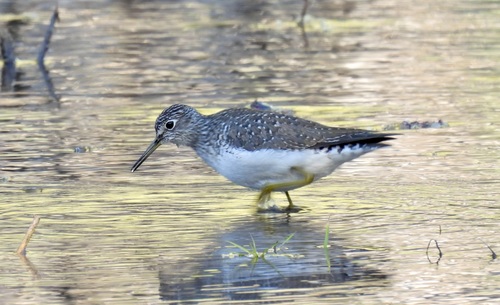
Solitary Sandpiper (Tringa solitaria) Solitary Sandpiper
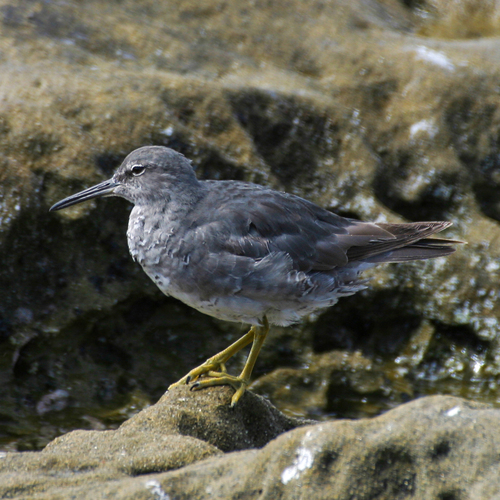
Wandering Tattler (Tringa incana) Wandering Tattler

Media

Loading…

In short

The most reliable field mark to separate Solitary Sandpiper from Wandering Tattler is the pattern of the upperparts and flight feathers: Solitary Sandpiper shows a dark back with small light spots and a distinctly dark rump and tail center in flight, while Wandering Tattler has unpatterned, plain gray upperparts and wings, lacking any spotting, and does not show a contrasting rump. Solitary Sandpiper is smaller and dumpier, with a more delicate look, while Wandering Tattler is heavier-bodied and longer-winged. Underparts also differ: Solitary Sandpiper has a white belly with a grayish breast, while Wandering Tattler in breeding plumage shows heavy barring or scaling extending onto the belly. Both species can show a supercilium, but it is more prominent in Wandering Tattler. These differences are visible with binoculars both at rest and in flight.

Identification tips

  1. Upperwing and back pattern (all ages): Solitary Sandpiper shows small pale spots on a dark greenish back and wings, while Wandering Tattler's upperparts and wings are plain, unpatterned gray. This is most obvious in flight or at rest with good light.
  2. Rump and tail in flight: Solitary Sandpiper has a distinctly dark rump and tail center, contrasting with the rest of the body. Wandering Tattler lacks this contrast, with the rump blending into the back.
  3. Underparts (breeding plumage): Wandering Tattler in breeding plumage has heavy, dark barring or scaling extending from the breast onto the belly. Solitary Sandpiper always has a clean white belly with only a grayish breast and neck.
  4. Supercilium: Both species can show a supercilium, but Wandering Tattler's is more prominent, especially in breeding plumage. Solitary Sandpiper's is more delicate and less striking.
  5. Body shape and size: Solitary Sandpiper is smaller, dumpier, and more delicate; Wandering Tattler is bulkier and longer-winged. If you see both together, the size difference is obvious.
  6. Leg color: Wandering Tattler has short, dark yellow legs; Solitary Sandpiper's legs are greenish, but this is subtle and not always reliable in the field.
  7. Bill: Wandering Tattler has a dark gray bill, proportionally heavier than the Solitary Sandpiper's more delicate bill.
  8. Face and neck: Wandering Tattler's face and neck are gray, matching the upperparts, while Solitary Sandpiper's are more contrasted, with a grayish head and white underparts.
  9. Flight style: Solitary Sandpiper often appears more fluttery and buoyant in flight, while Wandering Tattler is steadier and more direct.
  10. Habitat: Solitary Sandpiper is usually found in freshwater, wooded, or inland habitats; Wandering Tattler prefers rocky coastlines and is rarely far from the sea except during migration.
  11. Behavior: Solitary Sandpiper often bobs its tail while foraging; Wandering Tattler is more likely to walk steadily among rocks.
  12. Vocalizations: Listen for Solitary Sandpiper's clear three-note whistle versus Wandering Tattler's rapid, staccato trill. Calls are especially useful if the bird flushes.
  13. Context: If you encounter a solitary wader inland, especially in wooded or marshy settings, Solitary Sandpiper is more likely. On rocky coasts, especially in the Pacific, Wandering Tattler is expected.
  14. Pitfalls: Immature and non-breeding Wandering Tattlers lack the heavy barring but still have plain gray upperparts, which is the best mark to separate from the spotted Solitary Sandpiper.
  15. When marks fail: In poor light or at great distance, rely on size, structure, and habitat as backup clues, but prioritize upperwing pattern and rump/tail contrast whenever possible.

Size

Solitary Sandpiper is distinctly smaller and lighter, with an average body mass of 48.6 g, compared to Wandering Tattler's 108.5 g. Solitary Sandpiper measures 18–23 cm in length with a wingspan up to 50 cm, while Wandering Tattler is 26–30 cm long with a wingspan of 50–55 cm. In the field, Solitary Sandpiper appears more compact and dumpy, whereas Wandering Tattler is bulkier and more robust, with longer wings and a heavier build.

Plumage

Juvenile and non-breeding Solitary Sandpipers show a dark greenish-brown back with small, pale spots and a dark rump and tail center, which is visible in flight and is a key mark at all ages. Wandering Tattler, regardless of age, has plain, unpatterned gray upperparts and wings, lacking any spots or mottling. In breeding plumage, Wandering Tattler develops heavy, dark barring or scaling across the breast and extending onto the belly, while Solitary Sandpiper always has a clean white belly with only a grayish breast and neck. Both can show a supercilium, but it is more pronounced in Wandering Tattler, especially in breeding plumage. The underwing and face of Wandering Tattler are also gray, matching the upperparts, while Solitary Sandpiper has more contrast between the darker upperparts and white underparts.

Behaviour

Both species are often seen singly or in small groups, but Solitary Sandpiper is especially known for its solitary habits, as its name suggests. Solitary Sandpiper often bobs its tail and forages along the edges of freshwater habitats. Wandering Tattler tends to be more robust in movement and can be seen foraging on rocky shorelines or coastal habitats, often walking steadily and probing among rocks.

Habitat

Solitary Sandpiper is typically found along the edges of freshwater ponds, streams, and marshes, often away from the coast. Wandering Tattler is more likely to be found in coastal habitats, especially rocky shorelines, but can also occur along riverbanks during migration. If the bird is foraging on rocks by the sea, Wandering Tattler is more likely; if it is in a wooded or inland freshwater setting, Solitary Sandpiper is favored.

Voice

Solitary Sandpiper gives a distinctive three-note whistle in flight. Wandering Tattler's call is a rapid trill of accelerating, staccato notes, sometimes with three or four beats per call. The vocalizations are quite different in rhythm and tone, with Solitary Sandpiper's call being more spaced and Wandering Tattler's more rapid and mechanical.

Submit a better description

Use the same sections as the comparison. Your text is published immediately.

The most reliable field mark to separate Solitary Sandpiper from Wandering Tattler is the pattern of the upperparts and flight feathers: Solitary Sandpiper shows a dark back with small light spots and a distinctly dark rump and tail center in flight, while Wandering Tattler has unpatterned, plain gray upperparts and wings, lacking any spotting, and does not show a contrasting rump. Solitary Sandpiper is smaller and dumpier, with a more delicate look, while Wandering Tattler is heavier-bodied and longer-winged. Underparts also differ: Solitary Sandpiper has a white belly with a grayish breast, while Wandering Tattler in breeding plumage shows heavy barring or scaling extending onto the belly. Both species can show a supercilium, but it is more prominent in Wandering Tattler. These differences are visible with binoculars both at rest and in flight.

  1. Upperwing and back pattern (all ages): Solitary Sandpiper shows small pale spots on a dark greenish back and wings, while Wandering Tattler's upperparts and wings are plain, unpatterned gray. This is most obvious in flight or at rest with good light.
  2. Rump and tail in flight: Solitary Sandpiper has a distinctly dark rump and tail center, contrasting with the rest of the body. Wandering Tattler lacks this contrast, with the rump blending into the back.
  3. Underparts (breeding plumage): Wandering Tattler in breeding plumage has heavy, dark barring or scaling extending from the breast onto the belly. Solitary Sandpiper always has a clean white belly with only a grayish breast and neck.
  4. Supercilium: Both species can show a supercilium, but Wandering Tattler's is more prominent, especially in breeding plumage. Solitary Sandpiper's is more delicate and less striking.
  5. Body shape and size: Solitary Sandpiper is smaller, dumpier, and more delicate; Wandering Tattler is bulkier and longer-winged. If you see both together, the size difference is obvious.
  6. Leg color: Wandering Tattler has short, dark yellow legs; Solitary Sandpiper's legs are greenish, but this is subtle and not always reliable in the field.
  7. Bill: Wandering Tattler has a dark gray bill, proportionally heavier than the Solitary Sandpiper's more delicate bill.
  8. Face and neck: Wandering Tattler's face and neck are gray, matching the upperparts, while Solitary Sandpiper's are more contrasted, with a grayish head and white underparts.
  9. Flight style: Solitary Sandpiper often appears more fluttery and buoyant in flight, while Wandering Tattler is steadier and more direct.
  10. Habitat: Solitary Sandpiper is usually found in freshwater, wooded, or inland habitats; Wandering Tattler prefers rocky coastlines and is rarely far from the sea except during migration.
  11. Behavior: Solitary Sandpiper often bobs its tail while foraging; Wandering Tattler is more likely to walk steadily among rocks.
  12. Vocalizations: Listen for Solitary Sandpiper's clear three-note whistle versus Wandering Tattler's rapid, staccato trill. Calls are especially useful if the bird flushes.
  13. Context: If you encounter a solitary wader inland, especially in wooded or marshy settings, Solitary Sandpiper is more likely. On rocky coasts, especially in the Pacific, Wandering Tattler is expected.
  14. Pitfalls: Immature and non-breeding Wandering Tattlers lack the heavy barring but still have plain gray upperparts, which is the best mark to separate from the spotted Solitary Sandpiper.
  15. When marks fail: In poor light or at great distance, rely on size, structure, and habitat as backup clues, but prioritize upperwing pattern and rump/tail contrast whenever possible.

Solitary Sandpiper is distinctly smaller and lighter, with an average body mass of 48.6 g, compared to Wandering Tattler's 108.5 g. Solitary Sandpiper measures 18–23 cm in length with a wingspan up to 50 cm, while Wandering Tattler is 26–30 cm long with a wingspan of 50–55 cm. In the field, Solitary Sandpiper appears more compact and dumpy, whereas Wandering Tattler is bulkier and more robust, with longer wings and a heavier build.

Juvenile and non-breeding Solitary Sandpipers show a dark greenish-brown back with small, pale spots and a dark rump and tail center, which is visible in flight and is a key mark at all ages. Wandering Tattler, regardless of age, has plain, unpatterned gray upperparts and wings, lacking any spots or mottling. In breeding plumage, Wandering Tattler develops heavy, dark barring or scaling across the breast and extending onto the belly, while Solitary Sandpiper always has a clean white belly with only a grayish breast and neck. Both can show a supercilium, but it is more pronounced in Wandering Tattler, especially in breeding plumage. The underwing and face of Wandering Tattler are also gray, matching the upperparts, while Solitary Sandpiper has more contrast between the darker upperparts and white underparts.

Both species are often seen singly or in small groups, but Solitary Sandpiper is especially known for its solitary habits, as its name suggests. Solitary Sandpiper often bobs its tail and forages along the edges of freshwater habitats. Wandering Tattler tends to be more robust in movement and can be seen foraging on rocky shorelines or coastal habitats, often walking steadily and probing among rocks.

Solitary Sandpiper is typically found along the edges of freshwater ponds, streams, and marshes, often away from the coast. Wandering Tattler is more likely to be found in coastal habitats, especially rocky shorelines, but can also occur along riverbanks during migration. If the bird is foraging on rocks by the sea, Wandering Tattler is more likely; if it is in a wooded or inland freshwater setting, Solitary Sandpiper is favored.

Solitary Sandpiper gives a distinctive three-note whistle in flight. Wandering Tattler's call is a rapid trill of accelerating, staccato notes, sometimes with three or four beats per call. The vocalizations are quite different in rhythm and tone, with Solitary Sandpiper's call being more spaced and Wandering Tattler's more rapid and mechanical.

Discard your changes?

You have unsaved edits. If you leave now, those changes will be lost.

Solitary Sandpiper · Wandering Tattler · My Tricky Birds