

Snail Kite vs Double-toothed Kite
Rostrhamus sociabilis versus Harpagus bidentatus
Play a quiz with Snail Kite and Double-toothed Kite
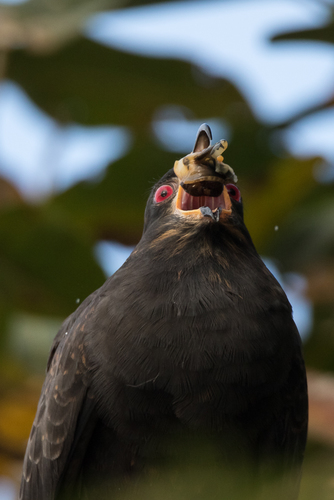 Snail Kite
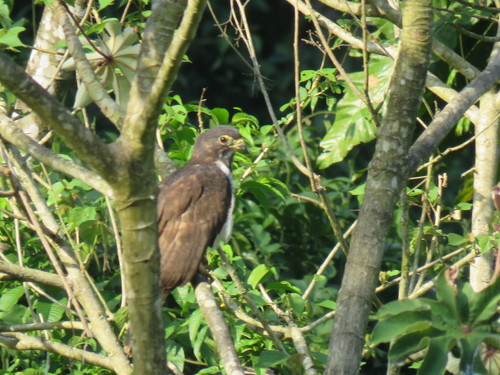 Double-toothed Kite
In short
Juvenile plumage is the most reliable separator: Juvenile Snail Kites and Double-toothed Kites both show brown upperparts and streaked underparts, but differ in face pattern and tail. Snail Kites (all ages) have a long, broad, rounded wing and a white rump and undertail, while Double-toothed Kites show a more compact, accipiter-like shape and a banded tail. Adult males are easy: Snail Kite is dark blue-gray with a red cere and legs, Double-toothed Kite is gray-headed with a white throat stripe and rufous underparts. Snail Kite is much larger and bulkier, with a deeply hooked bill, and is always found near wetlands, while Double-toothed Kite is a forest species. If you see a kite flying low over marshes with a white rump, it's a Snail Kite; a small, banded-tailed raptor in forest is Double-toothed.
Identification tips
- Juvenile/immature separation: Juvenile Snail Kites have a streaked crown, whitish face with dark markings, and a prominent white rump and undertail coverts visible in flight; Double-toothed Kite immatures have a darker brown upperpart, white to buff underparts with bold vertical brown streaks, and lack the white rump.
- Adult male plumage: Snail Kite adult males are dark blue-gray with darker flight feathers, red legs and cere, and a white rump; Double-toothed Kite males are gray-headed with a white throat stripe, rufous underparts with gray/white barring, and a blackish tail with gray bands.
- Adult female plumage: Snail Kite females are dark brown above, heavily streaked below, with a whitish face and yellow/orange legs/cere; Double-toothed Kite females are similar to males but with richer colors and the same banded tail.
- Tail pattern: Snail Kite has a long, rounded tail with a white rump and undertail coverts; Double-toothed Kite has a shorter, banded tail (three grayish bands, gray tip) and no white rump.
- Bill structure: Snail Kite has a long, deeply hooked, dark bill adapted for extracting snails; Double-toothed Kite has a much smaller, less hooked bill with subtle tooth-like notches (not visible at a distance).
- Leg and cere color: Adult male Snail Kite has red legs and cere; adult female has yellow/orange. Double-toothed Kite has yellow legs and greenish-yellow cere in both sexes.
- Flight shape: Snail Kite shows long, broad, rounded wings and a long tail, giving a buoyant, slow flight; Double-toothed Kite is more compact, with shorter, rounded wings and quick, agile flight.
- Size: Snail Kite is much larger and bulkier (420 g vs 195 g), with a noticeably longer wingspan and tail; Double-toothed Kite is small and accipiter-like.
- Habitat: Snail Kite is always in or near marshes, lakes, or wetlands with apple snails; Double-toothed Kite is found in humid forests or at forest edges, rarely near open water.
- Behavior: Snail Kite often seen flying low over marshes with head down; Double-toothed Kite perches quietly in forest or follows monkey troops.
- Face pattern: Snail Kite juveniles have a pale face with dark markings; Double-toothed Kite immatures have a less contrasting face.
- Eye color: Both have red eyes as adults, but juveniles of Snail Kite have dark brown eyes.
- Perched posture: Snail Kite appears long-legged and upright; Double-toothed Kite is more compact and horizontal when perched.
- Sexual dimorphism: Both species show limited sexual dimorphism, but in Snail Kite, females are only slightly larger and differ mainly in plumage color; in Double-toothed Kite, females are richer in color but otherwise similar.
- Context clues: If the bird is in a group or roosting in marshes, it's likely Snail Kite; if solitary in forest, Double-toothed Kite.
Size
Snail Kite is dramatically larger and heavier (average 420 g vs 195 g) and longer (36–48 cm vs 29–35 cm). Its wingspan is also much greater (99–120 cm vs 60–72 cm). In the field, Snail Kite appears broad-winged and long-tailed, with a noticeably heavy, hooked bill. Double-toothed Kite is much more compact, with a shorter tail and smaller, accipiter-like frame. Even at a distance, the size gap is striking, especially if both are seen perched or in flight.
Plumage
-
Juveniles/immatures: Both species have brown upperparts and streaked underparts, but Snail Kite juveniles have a streaked crown and a whitish face with dark markings above/behind the eye, plus a white rump and undertail coverts visible in flight. Double-toothed Kite immatures have a darker brown upperpart, a white to buff underpart with bold vertical brown streaks, and lack the white rump; their face is less contrasting.
-
Adult males: Snail Kite is dark blue-gray overall with darker flight feathers, red legs and cere, and a white rump. Double-toothed Kite has a dark gray head, white throat with a central dark stripe, lighter gray upperparts, a blackish tail with three grayish bands and a gray tip, and rufous underparts with barring. Eyes are red in both, but cere and legs are red in Snail Kite, yellowish in Double-toothed.
-
Adult females: Snail Kite females are dark brown above, heavily streaked pale below, with a whitish face and yellow/orange legs/cere. Double-toothed Kite females are similar to males but with richer colors, and show the same banded tail and rufous underparts. Both sexes of Double-toothed Kite have a white undertail covert patch, but not a full white rump.
-
Tail: Snail Kite has a long, rounded tail with a white rump and undertail coverts; Double-toothed Kite has a shorter, blackish tail with three grayish bands and a gray tip.
Behaviour
Snail Kite is gregarious, often seen in groups or large winter roosts, flying slowly and low over marshes with its head down searching for snails. Its flight is buoyant and steady, with broad, rounded wings and a long tail. Double-toothed Kite is typically solitary or in pairs, often perching quietly in forest midstory or following monkey troops to catch disturbed prey. Its flight is more accipiter-like: quick, agile, and direct, with shorter, rounded wings and a banded tail. Snail Kite rarely perches in trees except near water, while Double-toothed Kite is almost always in or near forest canopy.
Habitat
Snail Kite is strictly tied to freshwater wetlands, marshes, and lakes with abundant apple snails, rarely straying far from open water and marsh vegetation. It is absent from forest interiors. Double-toothed Kite is a forest specialist, found in humid lowland and foothill forests, forest edges, and sometimes tall second growth, but almost never in open wetlands. If you see a raptor in dense forest, it's almost certainly Double-toothed Kite; if in open marsh, it's Snail Kite.