

Motmot

Smooth-billed Ani vs Blue-black Grassquit

Crotophaga ani versus Volatinia jacarina

Play a quiz with Smooth-billed Ani and Blue-black Grassquit
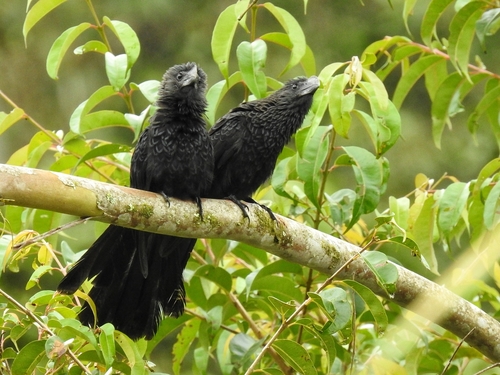
Smooth-billed Ani (Crotophaga ani) Smooth-billed Ani
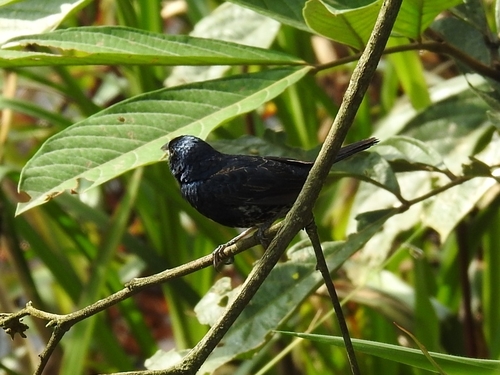
Blue-black Grassquit (Volatinia jacarina) Blue-black Grassquit

Media

Loading…

In short

The most reliable field mark to separate Smooth-billed Ani from Blue-black Grassquit is size and structure: the ani is a large, lanky, long-tailed bird with a massive, deeply ridged bill, while the grassquit is a tiny, compact, finch-like bird with a short, conical bill. In flight, only the grassquit shows a white underwing patch (visible in males and some females/juveniles), while the ani is uniformly glossy black without wing flashes. Female and immature grassquits are brown and streaky, never glossy black, so confusion is most likely with adult male grassquits. Both species can be found in open country, but the ani is always in noisy groups and often seen running on the ground, while the grassquit is solitary or in small flocks and perches upright on grass stems. Calls and song are also quite different.

Identification tips

  1. Size is the most immediate clue: Smooth-billed Ani is huge compared to the tiny Blue-black Grassquit. If the bird looks robin-sized or larger, it's an ani; if sparrow-sized or smaller, it's a grassquit.
  2. Bill shape is diagnostic: Ani has a massive, deep, ridged bill that looks almost parrot-like; grassquit has a short, conical, finch-like bill. This is visible even at a distance.
  3. Tail length and shape: Ani has a very long, broad tail, often held low or fanned; grassquit's tail is short and square.
  4. Plumage in flight: Only male grassquits show a white underwing patch (axillaries and base of remiges) in flight; ani is uniformly glossy black with no white anywhere, in any age or sex.
  5. Female and juvenile grassquits: These are brown above with streaking, buffy below, and show faint wing bars and buff tertial edges. Ani is always glossy black, never brown or streaky.
  6. Iris color: Both have brown irises, so this is not helpful for separation.
  7. Social behavior: Ani is always in noisy, tight groups, often running on the ground or perching together. Grassquits are solitary or in small loose groups, rarely on the ground.
  8. Foraging style: Ani often forages on the ground, sometimes near cattle, and runs well; grassquit perches upright on grass stems or low shrubs, rarely seen running.
  9. Flight style: Ani's flight is weak and wobbly; grassquit is quick and direct, sometimes performing short display flights.
  10. Vocalizations: Ani gives a nasal, whining 'ooo-leeek' call, often repeated by the group. Grassquit does not give this call.
  11. Habitat context: Both can be in open country, but ani prefers areas with scattered trees and is often near livestock; grassquit is more in grassy fields and weedy patches.
  12. Sexual dimorphism: Only male grassquits are all-dark; females and juveniles are brown and streaky, so confusion is only possible with adult male grassquits.
  13. Wing bars and tertial edges: Present in female/juvenile grassquits, absent in ani.
  14. Group size: Ani is almost never alone; grassquit is often alone or in pairs/small flocks.
  15. If in doubt: Look for the combination of size, bill shape, tail length, and group behavior—these together are nearly foolproof for separating these two species.

Size

Smooth-billed Ani is dramatically larger: about 35 cm (14 in) long and weighing around 97 g, compared to the Blue-black Grassquit's 8.7–10.9 cm (3.4–4.3 in) and 8–12 g. The ani is nearly four times the length and over eight times the mass of the grassquit. The ani's long tail and large, heavy bill are obvious even at a distance, while the grassquit is a tiny, stubby bird with a short tail and small, finch-like bill. Size alone is usually enough to separate them if seen together.

Plumage

Juvenile and female Blue-black Grassquits are brown above with streaking and buffy underparts, never glossy black, so confusion is only likely with adult males. Adult male grassquits are black with a blue sheen, but have a flat black tail and flight feathers, and in flight show a diagnostic white patch on the underwing (axillaries, underwing coverts, and base of remiges), which is absent in the ani. The ani is glossy black all over, with no white anywhere, and a brown iris. The ani's bill is massive and deeply ridged, while the grassquit's is short and conical. Female and juvenile grassquits have faint wing bars and buffy edges on the tertials, which anis never show. In summary: only male grassquits are all-dark, but they are much smaller, lack the ani's bill, and show white in the wing when flying.

Behaviour

Smooth-billed Ani is always in noisy, gregarious groups, often running on the ground or perching together in trees. Its flight is weak and wobbly. The ani is usually seen foraging on the ground, sometimes near cattle, and is conspicuous in its social behavior. Blue-black Grassquit is usually solitary or in small loose flocks, perching upright on grass stems or low shrubs, and is rarely seen running on the ground. Grassquits often perform short display flights, especially males, and are not as conspicuously social as anis. Ani's group behavior and ground foraging are strong behavioral clues.

Habitat

Both species occur in open country, weedy fields, and agricultural areas, but Smooth-billed Ani is more likely in semi-open areas with scattered trees or shrubs, often near cattle or in disturbed areas. Blue-black Grassquit prefers grassy fields, weedy patches, and field edges, and is less likely to be seen in groups in trees. While their habitats overlap, the ani's preference for perching in trees and foraging on the ground in groups is distinctive.

Voice

Smooth-billed Ani gives a distinctive whining 'ooo-leeek' call, often repeated by several birds in a group, making their presence obvious. Blue-black Grassquit's vocalizations are not described in the provided notes, but they do not give the ani's whining calls. If you hear a group of birds making repeated, nasal, whining calls, you are likely hearing anis.

Submit a better description

Use the same sections as the comparison. Your text is published immediately.

The most reliable field mark to separate Smooth-billed Ani from Blue-black Grassquit is size and structure: the ani is a large, lanky, long-tailed bird with a massive, deeply ridged bill, while the grassquit is a tiny, compact, finch-like bird with a short, conical bill. In flight, only the grassquit shows a white underwing patch (visible in males and some females/juveniles), while the ani is uniformly glossy black without wing flashes. Female and immature grassquits are brown and streaky, never glossy black, so confusion is most likely with adult male grassquits. Both species can be found in open country, but the ani is always in noisy groups and often seen running on the ground, while the grassquit is solitary or in small flocks and perches upright on grass stems. Calls and song are also quite different.

  1. Size is the most immediate clue: Smooth-billed Ani is huge compared to the tiny Blue-black Grassquit. If the bird looks robin-sized or larger, it's an ani; if sparrow-sized or smaller, it's a grassquit.
  2. Bill shape is diagnostic: Ani has a massive, deep, ridged bill that looks almost parrot-like; grassquit has a short, conical, finch-like bill. This is visible even at a distance.
  3. Tail length and shape: Ani has a very long, broad tail, often held low or fanned; grassquit's tail is short and square.
  4. Plumage in flight: Only male grassquits show a white underwing patch (axillaries and base of remiges) in flight; ani is uniformly glossy black with no white anywhere, in any age or sex.
  5. Female and juvenile grassquits: These are brown above with streaking, buffy below, and show faint wing bars and buff tertial edges. Ani is always glossy black, never brown or streaky.
  6. Iris color: Both have brown irises, so this is not helpful for separation.
  7. Social behavior: Ani is always in noisy, tight groups, often running on the ground or perching together. Grassquits are solitary or in small loose groups, rarely on the ground.
  8. Foraging style: Ani often forages on the ground, sometimes near cattle, and runs well; grassquit perches upright on grass stems or low shrubs, rarely seen running.
  9. Flight style: Ani's flight is weak and wobbly; grassquit is quick and direct, sometimes performing short display flights.
  10. Vocalizations: Ani gives a nasal, whining 'ooo-leeek' call, often repeated by the group. Grassquit does not give this call.
  11. Habitat context: Both can be in open country, but ani prefers areas with scattered trees and is often near livestock; grassquit is more in grassy fields and weedy patches.
  12. Sexual dimorphism: Only male grassquits are all-dark; females and juveniles are brown and streaky, so confusion is only possible with adult male grassquits.
  13. Wing bars and tertial edges: Present in female/juvenile grassquits, absent in ani.
  14. Group size: Ani is almost never alone; grassquit is often alone or in pairs/small flocks.
  15. If in doubt: Look for the combination of size, bill shape, tail length, and group behavior—these together are nearly foolproof for separating these two species.

Smooth-billed Ani is dramatically larger: about 35 cm (14 in) long and weighing around 97 g, compared to the Blue-black Grassquit's 8.7–10.9 cm (3.4–4.3 in) and 8–12 g. The ani is nearly four times the length and over eight times the mass of the grassquit. The ani's long tail and large, heavy bill are obvious even at a distance, while the grassquit is a tiny, stubby bird with a short tail and small, finch-like bill. Size alone is usually enough to separate them if seen together.

Juvenile and female Blue-black Grassquits are brown above with streaking and buffy underparts, never glossy black, so confusion is only likely with adult males. Adult male grassquits are black with a blue sheen, but have a flat black tail and flight feathers, and in flight show a diagnostic white patch on the underwing (axillaries, underwing coverts, and base of remiges), which is absent in the ani. The ani is glossy black all over, with no white anywhere, and a brown iris. The ani's bill is massive and deeply ridged, while the grassquit's is short and conical. Female and juvenile grassquits have faint wing bars and buffy edges on the tertials, which anis never show. In summary: only male grassquits are all-dark, but they are much smaller, lack the ani's bill, and show white in the wing when flying.

Smooth-billed Ani is always in noisy, gregarious groups, often running on the ground or perching together in trees. Its flight is weak and wobbly. The ani is usually seen foraging on the ground, sometimes near cattle, and is conspicuous in its social behavior. Blue-black Grassquit is usually solitary or in small loose flocks, perching upright on grass stems or low shrubs, and is rarely seen running on the ground. Grassquits often perform short display flights, especially males, and are not as conspicuously social as anis. Ani's group behavior and ground foraging are strong behavioral clues.

Both species occur in open country, weedy fields, and agricultural areas, but Smooth-billed Ani is more likely in semi-open areas with scattered trees or shrubs, often near cattle or in disturbed areas. Blue-black Grassquit prefers grassy fields, weedy patches, and field edges, and is less likely to be seen in groups in trees. While their habitats overlap, the ani's preference for perching in trees and foraging on the ground in groups is distinctive.

Smooth-billed Ani gives a distinctive whining 'ooo-leeek' call, often repeated by several birds in a group, making their presence obvious. Blue-black Grassquit's vocalizations are not described in the provided notes, but they do not give the ani's whining calls. If you hear a group of birds making repeated, nasal, whining calls, you are likely hearing anis.

Discard your changes?

You have unsaved edits. If you leave now, those changes will be lost.

Smooth-billed Ani · Blue-black Grassquit · My Tricky Birds