

Silver-beaked Tanager vs Blue-black Grassquit
Ramphocelus carbo versus Volatinia jacarina
Play a quiz with Silver-beaked Tanager and Blue-black Grassquit
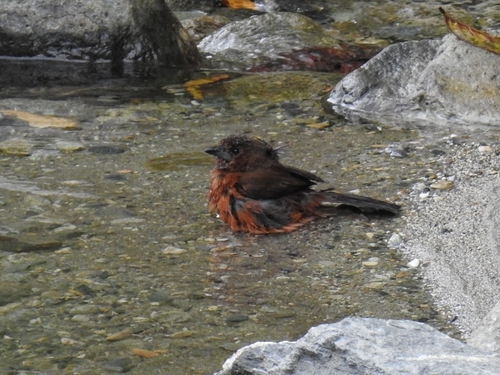 Silver-beaked Tanager
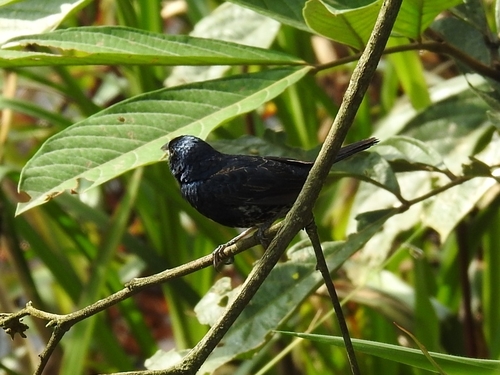 Blue-black Grassquit
In short
The most reliable field mark for separating Silver-beaked Tanager from Blue-black Grassquit is overall size and bill structure: Silver-beaked Tanager is much larger and has a thick, heavy, pale-based bill, while Blue-black Grassquit is tiny, with a short, conical bill. For immature or female birds, focus on the wing and underpart patterns: female/immature tanagers are rich reddish-brown with plain dusky wings, while female/immature grassquits are warm brown with streaked underparts and faint wing bars. In flight, adult male grassquits show a white underwing patch, absent in tanagers. Both species are sexually dimorphic, but only the grassquit male is glossy blue-black; tanager males are plush deep red to blackish with a striking silvery bill. Size and structure are often enough for separation even at a distance.
Identification tips
- Size: Silver-beaked Tanager is nearly twice as long and much heavier than Blue-black Grassquit. If you see a chunky, robin-sized bird, it's the tanager; a sparrow-sized bird is the grassquit. This works for all ages and sexes.
- Bill shape and color: Tanager has a thick, deep-based bill with a silvery lower mandible (male) or dusky brown (female); grassquit has a small, sharply conical bill, blackish above and pale below. Bill color is most useful on adult males, but shape is always helpful.
- Adult male plumage: Tanager males are plush deep red to blackish with a velvety look and a striking silvery bill; grassquit males are glossy blue-black, never red or plush, and lack a pale bill.
- Female and immature plumage: Female/immature tanagers are rich reddish-brown above and below, plain-winged, and lack streaks or wing bars. Female/immature grassquits are warm brown with streaked crowns and backs, two faint wing bars, and a streaked breast and flanks. Look for the streaky underparts and wing bars on grassquits.
- Juvenile grassquit: Shows even more streaking below and darker wings/tail than adult female; tanager juveniles are plain reddish-brown and never streaked.
- Wing pattern in flight (adult male grassquit): Blue-black Grassquit males show a white patch at the base of the underwing, visible in flight. Silver-beaked Tanager never shows white in the wing.
- Tail: Grassquit tail is short and brown (female/immature) or black (male), sometimes with buff tips that wear off. Tanager tail is longer, dusky black (male) or dusky (female), with no pale tips.
- Leg color: Both have dark legs; not useful.
- Iris color: Both have brown to reddish-brown irises; not useful.
- Behavior: Grassquits often perch upright on grass stems or wires and make short, bouncing flights; tanagers move more slowly through shrubs and are less likely to be seen in open grass.
- Habitat: Grassquits favor open, grassy or weedy fields; tanagers prefer denser shrubbery and forest edge. Use as supporting context.
- Sexual dimorphism: Both species are sexually dimorphic, but only the grassquit male is glossy blue-black; only the tanager male is plush deep red with a silvery bill.
- Subspecies variation: Most field marks apply across subspecies, but note that some tanager subspecies are paler or darker; always check for bill shape and size regardless of color variation.
- Mixed flocks: If you see both species together, the size and structure difference is striking.
- Voice: Not diagnostic from the provided notes.
Size
Silver-beaked Tanager is much larger (16–17 cm, 21–37.5 g) than Blue-black Grassquit (8.7–10.9 cm, 8–12 g) [wikipedia]. The tanager is nearly twice the length and at least double the mass. The tanager also has a noticeably heavier, broader bill, while the grassquit's bill is small and conical. Even in the field, this size difference is usually obvious, especially if both species are seen in the same habitat.
Plumage
-
Juvenile and female/immature birds: Silver-beaked Tanager females and immatures are rich reddish-brown above and below, with plain dusky wings and no wing bars or streaks. Blue-black Grassquit females and juveniles are warm brown above with faint darker streaks on the crown and back, brown wings with two faint wing bars, and buffy edges on the tertials. Their underparts are buff with a cinnamon wash and a band of darker streaks across the breast and flanks. Juvenile grassquits are even more streaked below and have darker wings and tail than adult females.
-
Adult males: Silver-beaked Tanager males are deep plush carmine to blackish with a velvety appearance, and a striking silvery-white lower mandible. Their wings and tail are dusky black with no blue gloss or white patches. Blue-black Grassquit males are glossy blue-black all over, with a small white patch at the base of the underwing (visible in flight only), and a blackish bill with a pale gray to horn-colored lower mandible. Their wings and tail are flat black, lacking the plush or velvety texture of the tanager.
-
Bill color: Male tanagers have a two-toned bill (dark blue-gray above, silvery white below with a black tip); female tanagers have a uniformly brownish dusky bill. Grassquits have a blackish upper mandible and a pale gray to horn-colored lower mandible in both sexes.
-
Iris and legs: Both species have brown to reddish-brown irises and dark legs, not useful for separation.
Behaviour
Blue-black Grassquit is highly active, often seen making short, bouncing flights and displaying with rapid wing-flicks, especially males. They often perch upright on exposed grass stems or wires, sometimes in loose groups. Silver-beaked Tanager is more deliberate, moving slowly through shrubs or low trees, often in pairs or small groups. They are less likely to display in open grass or make repeated short flights. In flight, tanagers appear bulkier and less agile than the grassquit.
Habitat
Both species overlap widely in range and can occur in similar edge and second-growth habitats. However, Blue-black Grassquit is more closely tied to open grassy fields, weedy patches, pastures, and roadsides, often in low vegetation. Silver-beaked Tanager prefers shrubby edges, forest borders, and denser vegetation, and is less likely to be found in open grassland or agricultural fields. Habitat alone is not diagnostic but can support identification when combined with other marks.
Silver-beaked Tanager · Blue-black Grassquit · My Tricky Birds