

Shining Bronze-Cuckoo vs Little Bronze-Cuckoo
Chalcites lucidus versus Chalcites minutillus
Play a quiz with Shining Bronze-Cuckoo and Little Bronze-Cuckoo
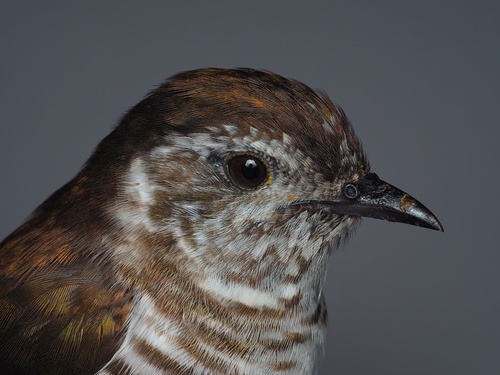 Shining Bronze-Cuckoo
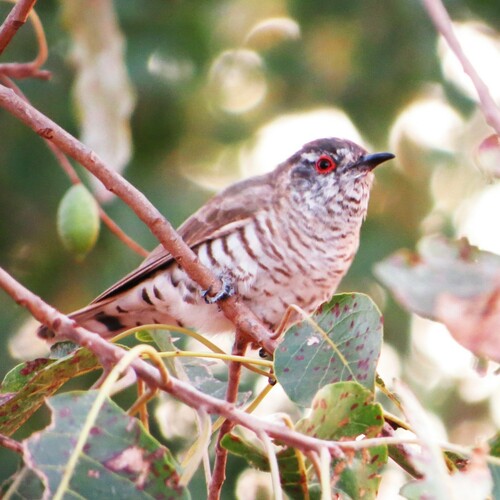 Little Bronze-Cuckoo
In short
The most reliable field mark to separate Shining Bronze-Cuckoo from Little Bronze-Cuckoo is the presence of a bold white spot behind the eye on Little Bronze-Cuckoo, which is lacking in Shining Bronze-Cuckoo. Both species show metallic green upperparts and white underparts with dark barring, but Shining Bronze-Cuckoo is slightly larger and has a coppery or golden sheen, while Little Bronze-Cuckoo is more bronze-green and notably more petite and slender. Females and immatures of both can be tricky, but the white cheek and more extensive barring on Shining Bronze-Cuckoo, versus the white post-ocular spot and slimmer build of Little Bronze-Cuckoo, are key. In flight or perched, look for the combination of structure and face pattern before relying on subtle color differences.
Identification tips
- White post-ocular spot: Little Bronze-Cuckoo always shows a distinct white spot behind the eye, visible in all ages and sexes. Shining Bronze-Cuckoo lacks this mark entirely.
- Face pattern: Shining Bronze-Cuckoo has white cheeks and a more uniform face without a post-ocular spot. Little Bronze-Cuckoo's face is plainer except for the white spot.
- Upperparts color: Shining Bronze-Cuckoo is metallic golden or coppery green above, especially in good light. Little Bronze-Cuckoo is bronze-green, lacking the golden or coppery tones.
- Underparts barring: Both have white underparts with dark barring, but Shining Bronze-Cuckoo's barring is dark green and can be bronzer-tinged in females. Little Bronze-Cuckoo's barring is dark but the underparts are less bright overall, especially in juveniles.
- Size and structure: Shining Bronze-Cuckoo is larger and bulkier, with a longer wingspan and heavier build. Little Bronze-Cuckoo is noticeably smaller, lighter, and more slender, with a proportionally longer tail.
- Bill and feet: Both have dark bills, but Shining Bronze-Cuckoo has yellow undersides to the feet (rarely visible in the field). Bill shape is not a strong separator.
- Male orbital ring: Adult male Little Bronze-Cuckoo has a red orbital ring, which is absent in Shining Bronze-Cuckoo. This is subtle and may not be visible at distance.
- Crown and nape sheen (females): Female Shining Bronze-Cuckoo may show a purplish sheen on the crown and nape, and bronzer-tinged barring below. Little Bronze-Cuckoo females are similar to males but slightly larger.
- Juvenile brightness: Juvenile Little Bronze-Cuckoo is duller and may lack flank mottling, but still has the white post-ocular spot. Juvenile Shining Bronze-Cuckoo is brighter below and lacks the spot.
- Flight style: Little Bronze-Cuckoo is more agile and undulating in flight, reflecting its smaller, lighter build. Shining Bronze-Cuckoo is more direct and less fluttery.
- Host context: Both parasitize Gerygone nests, so context is not diagnostic, but Shining Bronze-Cuckoo is more likely in New Zealand and some Pacific islands.
- Geographic overlap: If observed in New Zealand, it is almost certainly Shining Bronze-Cuckoo. In northern Australia and New Guinea, both are possible.
- Habitat: Both prefer wooded areas with dense foliage, so habitat is not a strong separator.
- Plumage pitfalls: Both can appear similar in poor light or at distance, but the white post-ocular spot on Little Bronze-Cuckoo is the most reliable field mark. Do not rely on subtle differences in barring or sheen unless the face is clearly visible.
- Sex differences: Only male Little Bronze-Cuckoo shows a red orbital ring. Female and juvenile differences are subtle and best separated by the white spot and overall size/structure.
Size
Shining Bronze-Cuckoo is the larger of the two, measuring 13–18 cm in length and weighing around 25 g, with a wingspan of 25–32 cm. Little Bronze-Cuckoo is the world's smallest cuckoo, at 15–16 cm and 14.5–17 g. While their length ranges overlap, Shining Bronze-Cuckoo is generally bulkier and longer-winged, whereas Little Bronze-Cuckoo is distinctly lighter and more slender, with a proportionally longer tail for its size. Females of Little Bronze-Cuckoo can be slightly larger than males, but still smaller than Shining Bronze-Cuckoo overall.
Plumage
- Juveniles/Immatures: Both species have white underparts with dark barring, but Little Bronze-Cuckoo juveniles are less bright overall and may lack mottling on the flanks. The key difference is the white spot behind the eye in Little Bronze-Cuckoo of all ages, which Shining Bronze-Cuckoo never shows. No distinctive age-specific upperwing patterns are described for either species, so rely on face and body plumage.
- Adults: Shining Bronze-Cuckoo has metallic golden or coppery green upperparts, white cheeks, and dark green barring below. Females have a purplish sheen to the crown and nape and bronzer-tinged barring. Little Bronze-Cuckoo adults are bronze-green above, with a white post-ocular spot, white underparts with dark barring, and a red orbital ring in males. Both have dark bills and legs, but Shining Bronze-Cuckoo's feet have yellow undersides. The overall impression is that Shining Bronze-Cuckoo is brighter and more coppery, while Little Bronze-Cuckoo is duller and greener.
Behaviour
Both species are secretive and often easier to hear than see, moving quickly through dense foliage. Little Bronze-Cuckoo, being smaller and more slender, is especially agile and described as maneuvering swiftly through vegetation with a direct but subtly undulating flight. Shining Bronze-Cuckoo is also active but appears slightly bulkier and less delicate in movement. Both parasitize dome-shaped nests of small passerines, especially Gerygone species, and are typically found alone or in pairs rather than flocks.
Habitat
Both species overlap in much of their range, especially in Australia and New Guinea, and both favor wooded habitats where their host species nest. Shining Bronze-Cuckoo has a broader distribution, reaching New Zealand, New Caledonia, Vanuatu, and the Solomon Islands, while Little Bronze-Cuckoo is more restricted but still widespread in Australasia. Both are associated with habitats where Gerygone and other small insectivorous hosts are common. Habitat alone is not diagnostic between the two.
Shining Bronze-Cuckoo · Little Bronze-Cuckoo · My Tricky Birds