

Seychelles White-eye vs Malagasy White-eye
Zosterops modestus versus Zosterops maderaspatanus
Play a quiz with Seychelles White-eye and Malagasy White-eye
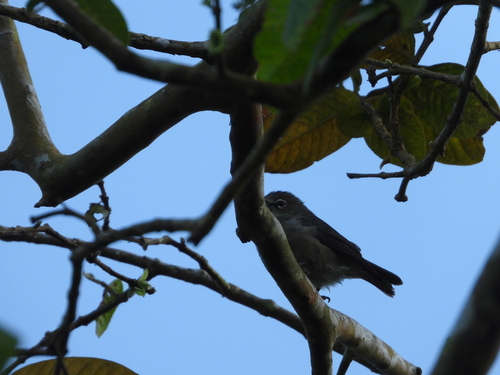 Seychelles White-eye
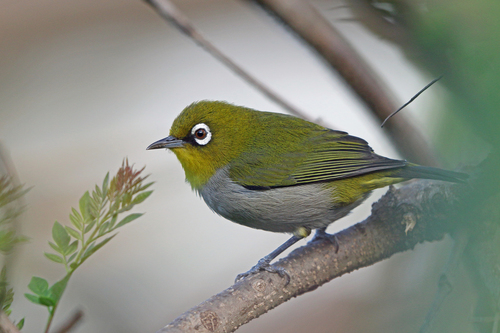 Malagasy White-eye
In short
The most reliable field mark between Seychelles White-eye and Malagasy White-eye is the underpart coloration: Seychelles White-eye has dull, uniformly colored underparts, while Malagasy White-eye shows a distinct yellow throat and pale grey belly. Both species have olive-toned upperparts and a white eye-ring, but the eye-ring is complete and narrow in Seychelles White-eye, and incomplete (broken at the front) in Malagasy White-eye. Structural differences are subtle, but the Seychelles White-eye is slightly heavier and has a longer, darker tail. Habitat and abundance are also key: Seychelles White-eye is rare and local in the Seychelles canopy, while Malagasy White-eye is widespread in Madagascar and the Seychelles, often in a variety of wooded habitats.
Identification tips
- Underpart color: Seychelles White-eye has uniformly dull underparts, while Malagasy White-eye shows a clear yellow throat and pale grey belly. This is the most visible difference in good light.
- Eye-ring: Seychelles White-eye's eye-ring is narrow and complete, fully encircling the eye. Malagasy White-eye's is incomplete, broken at the front (especially obvious at close range or in photos).
- Throat color: Only Malagasy White-eye has a yellow throat; Seychelles White-eye's throat is dull and matches the rest of the underparts.
- Upperparts: Both are olive above, but Malagasy White-eye is described as darker olive-green, while Seychelles White-eye is olive-grey. This is subtle and may be affected by lighting.
- Tail: Seychelles White-eye has a rather long, dark-grey tail, which may appear more prominent when perched or flicked.
- Bill color: Malagasy White-eye shows a bicolored bill (black upper, grey lower), while Seychelles White-eye's bill is not distinctly bicolored in the available descriptions.
- Eye color: Malagasy White-eye has a reddish-brown eye, which may be visible at close range; Seychelles White-eye's eye color is not specified but is not noted as reddish.
- Habitat and range: If seen in Madagascar, it is Malagasy White-eye. In the Seychelles, check habitat: Seychelles White-eye is rare, local, and prefers high canopy; Malagasy White-eye is common and found in a variety of wooded habitats.
- Abundance: Seychelles White-eye is very rare and difficult to find; Malagasy White-eye is widespread and common in suitable habitat.
- Behavior: Seychelles White-eye is secretive and forages high in the canopy; Malagasy White-eye is more adaptable and often easier to observe.
- Song: If a complex, melodious, nasal song is heard, consider Seychelles White-eye, but lack of song is not diagnostic.
- Cooperative breeding: Only Seychelles White-eye is known for complex cooperative breeding, but this is not a field mark.
- Juvenile/immature birds: No distinctive age-specific marks are described for either species; use adult plumage features for all ages.
- In flight: No diagnostic flight or wing pattern differences are described; focus on underpart color and eye-ring if visible.
- Pitfalls: Poor light can obscure the yellow throat and incomplete eye-ring of Malagasy White-eye, making it appear more like Seychelles White-eye. Always try for multiple views and note context.
Size
Both species are very similar in size, with Seychelles White-eye averaging 12.0 g and Malagasy White-eye 11.2 g [wikidata]. Length is nearly identical, around 10–11 cm. In the field, these differences are negligible and unlikely to be useful for separation. Any perceived size difference is more likely due to posture or viewing angle.
Plumage
- Juvenile/immature plumage: No age-specific upperwing or flight pattern differences are described for either species; both lack distinctive juvenile wing marks in the available sources.
- Adult plumage: Seychelles White-eye has olive-grey upperparts and dull underparts, with a narrow, complete white eye-ring and a rather long, dark-grey tail. Malagasy White-eye is darker olive-green above, with a yellow throat and pale grey breast and belly. Its white eye-ring is incomplete, broken at the front, and the eye itself is reddish-brown. The bill of Malagasy White-eye is bicolored (black upper mandible, grey lower), while Seychelles White-eye's bill is described as small and sharp but not specifically bicolored. Seychelles White-eye's underparts are more uniformly dull, lacking the yellow throat and pale belly contrast of Malagasy White-eye.
Behaviour
Seychelles White-eye is difficult to observe, often foraging high in the canopy and exhibiting complex cooperative breeding behavior unique among white-eyes. Malagasy White-eye is more adaptable, found in a range of wooded habitats, and is generally easier to see. Both are active, warbler-like birds, but Seychelles White-eye's secretive habits and rarity make it much less likely to be encountered except in specific localities.
Habitat
Seychelles White-eye is endemic and extremely local in the Seychelles, preferring high canopy in forested areas. Malagasy White-eye is widespread in Madagascar and also occurs in the Seychelles, occupying a broad range of wooded habitats including dry forests, moist lowland and montane forests, and mangroves. If the bird is seen outside the Seychelles or in a habitat other than dense forest canopy, it is almost certainly Malagasy White-eye.
Voice
Seychelles White-eye has a melodious, complex song with nasal tones. No specific vocal description is given for Malagasy White-eye in the available sources. Voice is unlikely to be diagnostic unless the Seychelles White-eye's song is heard and recognized, but in practice, most field separation will rely on plumage and context.