

Scott's Oriole vs Varied Bunting
Icterus parisorum versus Passerina versicolor
Play a quiz with Scott's Oriole and Varied Bunting
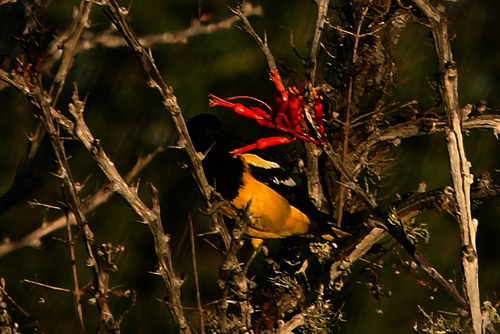 Scott's Oriole
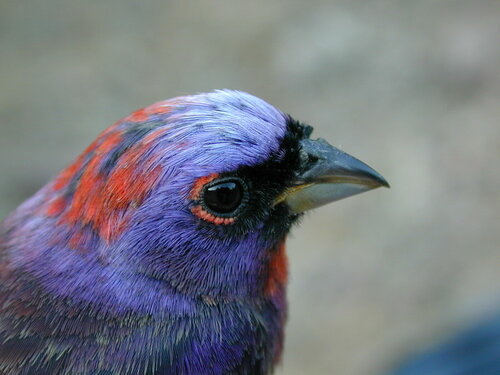 Varied Bunting
In short
The most reliable field mark to separate Scott's Oriole from Varied Bunting is size and structure: Scott's Oriole is much larger and more elongated, with a long tail and pointed bill, while Varied Bunting is a small, stocky, short-tailed finch-like bird. Adult male Scott's Orioles are strikingly black and yellow, whereas male Varied Buntings are purple-red with a red nape patch. Females of both species are duller, but Scott's Oriole females show olive and yellow tones with streaking, while Varied Bunting females are plain brown without streaking. In flight or perched, focus on size, shape, and wing pattern for the quickest separation.
Identification tips
- Size and shape: Scott's Oriole is much larger and more elongated, with a long tail and pointed bill. Varied Bunting is small, stocky, short-tailed, and has a rounded, finch-like bill. This is often obvious even at a distance or in flight (all ages).
- Wing bars: Scott's Oriole (both sexes, all ages) shows two prominent white wing bars on a dark wing, plus pale yellow epaulets in males. Varied Bunting never shows wing bars—its wings are plain and dark (all ages).
- Yellow vs. purple/red: Adult male Scott's Oriole is black and lemon yellow, with yellow on the underparts and rump. Male Varied Bunting is purple-red with a red nape, never yellow. This is diagnostic for adult males in breeding plumage.
- Female plumage: Female Scott's Oriole is grayish olive above with streaking and yellowish underparts; it often shows a dark throat and wing bars. Female Varied Bunting is plain light brown, with no streaking, no wing bars, and no yellow tones.
- Tail pattern: Scott's Oriole has a mostly black (male) or olive (female) tail with yellowish bases and white tips, especially on outer feathers. Varied Bunting's tail is short and plain, lacking contrasting bases or tips.
- Bill color and shape: Scott's Oriole has a black or bluish-black, slender, pointed bill with a gray base. Varied Bunting has a short, thick, conical bill typical of buntings and finches, and is never as sharply pointed.
- Perching behavior: Scott's Oriole often perches high and conspicuously, especially on yucca or open branches. Varied Bunting is more likely to skulk low in dense brush and is rarely as exposed.
- Habitat context: If the bird is in open desert with yucca or agave, Scott's Oriole is more likely. In dense, thorny brush or near water, Varied Bunting is favored.
- Flight profile: Scott's Oriole in flight looks long and slim with a long tail; Varied Bunting is compact and short-tailed.
- Seasonal male color: Male Varied Bunting becomes browner in fall, but still lacks yellow and wing bars. Scott's Oriole males remain black and yellow.
- Streaking: Female Scott's Oriole shows subtle streaking above; female Varied Bunting is unstreaked.
- Iris and leg color: Both have dark irises and grayish legs, not useful for separation.
- Voice: Not described in the notes; do not rely on song for separation here.
- Juvenile/immature marks: No distinctive juvenile or immature upperwing pattern is described for either species; rely on size, structure, and wing bars for young birds.
- Common pitfalls: Female and immature Scott's Orioles may be mistaken for drab buntings, but always check for wing bars and yellowish tones. Varied Buntings are never yellow or wing-barred.
Size
Scott's Oriole is substantially larger, about 23 cm (9.1 in) long with a 32 cm (13 in) wingspan and weighing 32–41 g. In contrast, Varied Bunting is much smaller and lighter, at 11–14 cm (4.3–5.5 in) long, a 21 cm (8.3 in) wingspan, and only 11–13 g in mass [wikipedia][wikidata]. The oriole's long tail and slender body are obvious even at a distance, while the bunting is compact, short-tailed, and noticeably lighter.
Plumage
No distinctive juvenile or immature upperwing pattern is described for either species, so focus on adult and female plumages.
Adult male Scott's Oriole is unmistakable: black head, back, throat, and breast, with bright lemon yellow underparts, rump, and uppertail coverts. The wings are black with pale yellow epaulets (lesser and median coverts) and two white wing bars from white-tipped greater and median coverts. The tail is mostly black with yellow bases and white tips, especially towards the outer feathers.
Adult male Varied Bunting is deep purple-red overall, with a bright red nape patch, and lacks wing bars or epaulets; the color becomes browner in fall.
Female Scott's Oriole is grayish olive above with darker streaks, a black chin/throat/upper breast, and pale olive-yellow underparts. The wings are blackish brown with olive/yellowish edges and two white wing bars. The tail is olive with yellowish bases.
Female Varied Bunting is plain light brown overall, lacking streaking or any wing bars, and resembles a washed-out female Indigo Bunting.
In summary: Scott's Oriole of both sexes shows wing bars and some yellow or olive, while Varied Bunting is always plain-winged and never yellowish.
Behaviour
Scott's Oriole often perches conspicuously on yuccas or open branches, moving with a slow, deliberate manner typical of orioles. It may be seen foraging for insects or nectar in open woodland or desert edges. Varied Bunting is more secretive, foraging low in dense, thorny brush or thickets, and tends to skulk rather than perch in the open. Its movements are more finch-like and less elongated than the oriole.
Habitat
Scott's Oriole prefers open woodlands and desert slopes, especially where yucca or agave are present, and is often found in the southwestern U.S. and Mexico [wikipedia]. Varied Bunting is more closely tied to dense, thorny brush, thorn forests, and scrubby woodlands, often near water, and is generally found in similar southwestern regions but with a preference for denser, brushier habitats [wikipedia]. While ranges overlap, Scott's Oriole is more likely in open, arid landscapes, and Varied Bunting in dense, low vegetation.