

Scaly-naped Pigeon vs Red-billed Pigeon
Patagioenas squamosa versus Patagioenas flavirostris
Play a quiz with Scaly-naped Pigeon and Red-billed Pigeon
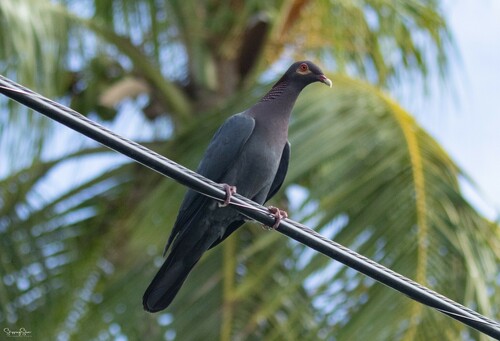 Scaly-naped Pigeon
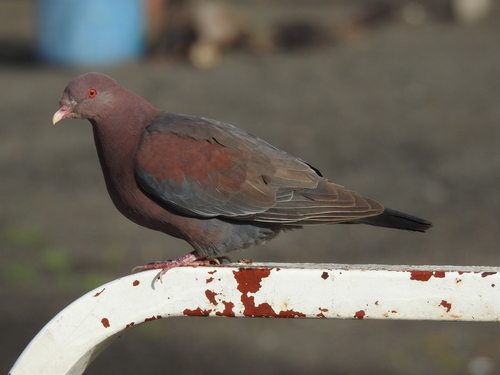 Red-billed Pigeon
In short
The most reliable field mark between Scaly-naped Pigeon and Red-billed Pigeon is the presence of a scaly-looking nape and a bare reddish or yellowish eye-ring in Scaly-naped, versus a smoother maroon head and neck with a distinct orange orbital ring in Red-billed. Both are large, robust pigeons with similar overall structure and slate-gray bodies, but subtle differences in head, neck, and bare part coloration are key. Juvenile Red-billed Pigeons are duller and browner, which can cause confusion with Scaly-naped, but the scaly nape and red eye skin of Scaly-naped remain distinctive. Bill color and pattern, as well as subtle differences in belly and tail covert coloration, also help separate them. Habitat can be a clue, but is not always reliable due to overlap in some regions.
Identification tips
- Scaly nape (Scaly-naped only): Look for the scaly or checkered appearance on the nape—this is absent in Red-billed of all ages.
- Bare eye skin color: Scaly-naped shows a bare patch of skin around the eye, reddish in males and yellowish in females; Red-billed has an orange orbital ring but not the same bare patch effect.
- Head and neck color: Red-billed has a maroon to purple head and neck that is smooth and lacks iridescence or scaliness; Scaly-naped's maroon is more restricted to the neck and is accompanied by the scaly nape.
- Bill color and pattern: Both have red at the base of the bill, but Red-billed has a yellow tip, while Scaly-naped's bill is red at the base and light-colored (not yellow) at the tip.
- Belly and tail coverts: Red-billed shows blue-gray belly and tail coverts, contrasting with the maroon head and neck; Scaly-naped is more uniformly slate-gray below.
- Juvenile confusion: Juvenile Red-billed Pigeons are duller and browner, with dusky shoulders, but still lack the scaly nape and bare eye skin of Scaly-naped. Immature Scaly-naped should retain the scaly nape and bare eye skin.
- Sex differences: Female Scaly-naped has a more yellowish eye ring, while female Red-billed is just duller overall.
- Flight views: No distinctive upperwing or flight pattern differences are described for either species, so rely on head, neck, and bare part coloration even in flight.
- Habitat and range: If seen in the Caribbean (except Jamaica and the Bahamas), Scaly-naped is expected; if on the mainland from southern Texas to Costa Rica, Red-billed is likely. Overlap is minimal.
- Voice: If you hear a long, high-pitched call with a drawn-out 'coooo' and three 'cuk-c'-c'-coo' notes, it's Red-billed. Scaly-naped's vocalizations are not described here.
- Leg color: Scaly-naped has red legs; Red-billed leg color is not specified, but is not a primary separator.
- Back color: Red-billed is less brown on the back than similar species, but this is not a strong separator from Scaly-naped.
- Group behavior: Both species are usually solitary or in small groups; this does not help with separation.
- Bill structure: Both are robust pigeons with similar bill shape; structure is not a reliable separator.
- Seasonal context: Red-billed is rare in winter in most of its range, while Scaly-naped is resident in the Caribbean year-round.
Size
Both species are large pigeons. Scaly-naped Pigeon averages about 312 g in body mass [wikidata], while Red-billed Pigeon has a reported range of 230–425 g [wikipedia], so there is considerable overlap. Both are similar in length (Scaly-naped: 14–16 in; Red-billed: 12–15 in). In the field, size alone is not a reliable separator.
Plumage
- Juveniles/immatures: Juvenile Red-billed Pigeons are noticeably duller than adults, with dark, dusky shoulders and a browner mantle and wings. This can make them resemble Scaly-naped Pigeon, but they still lack the scaly nape pattern and the bare red/yellow eye skin of Scaly-naped. Juvenile Scaly-naped Pigeons are not described in detail, but the scaly nape and bare eye skin are consistent features.
- Adults: Scaly-naped Pigeon shows a maroon patch around the neck and a distinctly scaly appearance on the nape. The bare skin around the eye is red in males, yellowish in females. The bill is red at the base with a pale tip. Red-billed Pigeon has a maroon to purple head, neck, and wing coverts, with a blue-gray belly and tail coverts. Its orbital ring is orange, and the bill is red with a yellow tip. Red-billed lacks the scaly nape and has a smoother, less brown back than similar species. Both species are largely slate-gray, but Scaly-naped is more uniform, while Red-billed shows more contrast between the maroon/purple head and blue-gray belly.
Behaviour
Both species are typically seen alone or in small groups. Scaly-naped Pigeon is wary and quick to flush, often feeding both in trees and on the ground. Red-billed Pigeon is also robust and wary, with a distinctive wing-clapping sound on takeoff. There is no strong behavioral separator between the two in the field.
Habitat
Scaly-naped Pigeon is found throughout the Caribbean, especially in rainforests but also in drier woodlands and near settlements. Red-billed Pigeon occurs from southern Texas through Mexico to Costa Rica, favoring dry forests and riverside woodlands, especially in coastal and lowland areas. While both can occur in a range of wooded habitats, Scaly-naped is strictly Caribbean, while Red-billed is continental (Mexico/Central America). Thus, location is a strong clue: Caribbean islands point to Scaly-naped, mainland Central America and Mexico to Red-billed.
Voice
Red-billed Pigeon has a distinctive, long, high-pitched call: a drawn-out 'coooo' followed by three 'cuk-c'-c'-coo' notes, often ascending. Its wings make a clapping noise on takeoff. No specific vocalization is described for Scaly-naped Pigeon in the provided notes, so voice is only a separator if the Red-billed's unique call is heard.