
Scaly-naped Pigeon vs Common Ground Dove
Patagioenas squamosa versus Columbina passerina
Play a quiz with Scaly-naped Pigeon and Common Ground Dove
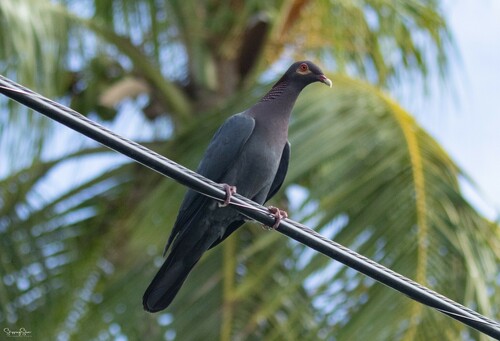 Scaly-naped Pigeon
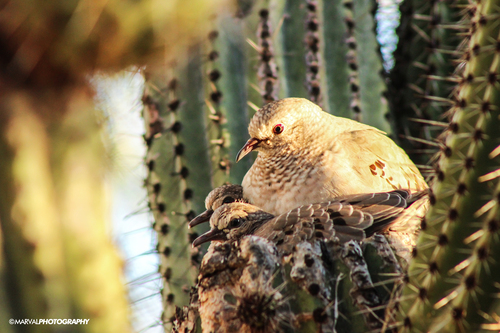 Common Ground Dove
In short
The most reliable field mark between Scaly-naped Pigeon and Common Ground Dove is overall size and structure: Scaly-naped Pigeon is a massive, heavy-bodied pigeon with a slate-grey and maroon neck, while Common Ground Dove is tiny, short-tailed, and brownish, with chestnut in the wings visible in flight. If you see a dove with a scaly nape and red bare skin around the eye, it is Scaly-naped; if you see a small, ground-foraging bird with a scaly head and chestnut wing flashes in flight, it's Common Ground Dove. Immature and adult Common Ground Doves both show chestnut primaries in flight, which Scaly-naped never shows. Bill color, tail length, and behavior (arboreal vs terrestrial) are also strong clues.
Identification tips
- Size is the fastest separator: Scaly-naped Pigeon is huge (pigeon-sized), Common Ground Dove is tiny (sparrow-sized). If you are unsure, compare to nearby doves or common birds for scale.
- Flight pattern and wing color: In flight, Common Ground Dove of all ages shows chestnut primaries and wing borders—look for a flash of rufous in the wings. Scaly-naped Pigeon never shows chestnut in the wing.
- Tail shape and length: Scaly-naped Pigeon has a long tail, while Common Ground Dove's tail is very short and barely extends past the body.
- Bill color: Scaly-naped Pigeon has a red base to the bill with a pale tip; Common Ground Dove has a yellow bill with a black tip.
- Eye skin: Scaly-naped Pigeon has a bare patch of skin around the eye (red in males, yellowish in females); Common Ground Dove lacks this feature.
- Head and neck pattern: Scaly-naped Pigeon has a scaly-looking nape and maroon neck; Common Ground Dove has a scaly pattern on the head and upper breast, but not on the nape.
- Leg color: Scaly-naped Pigeon has red legs; Common Ground Dove's leg color is not distinctive in the notes.
- Perched posture: Scaly-naped Pigeon perches upright in trees, often high; Common Ground Dove is almost always on the ground, crouched and walking.
- Plumage color: Scaly-naped Pigeon is slate-grey with maroon; Common Ground Dove is brown above, with pinkish face and scaly head.
- Sexual dimorphism: Male Common Ground Doves have a slate-gray crown and pink-gray belly; females are grayer and more uniform. Scaly-naped Pigeon shows subtle sexual differences only in the color of the bare eye skin.
- Habitat context: If seen in forest canopy or feeding in trees, it's almost certainly Scaly-naped; if on open ground, likely Common Ground Dove.
- Vocalization: If you hear a soft, rising 'whoop' call, it's Common Ground Dove; Scaly-naped Pigeon's call is not described here.
- Group size: Scaly-naped Pigeon is usually alone or in small groups; Common Ground Dove may be in pairs or small flocks on the ground.
- Behavior when flushed: Scaly-naped Pigeon flushes powerfully into trees; Common Ground Dove flies low and quickly drops back to the ground.
- Pitfalls: Immature Common Ground Doves might look dull and scaly-headed, but will always show chestnut in the wing in flight. Scaly-naped Pigeon never shows this, regardless of age.
Size
Size is the most immediate separator: Scaly-naped Pigeon is a large pigeon, weighing about 312 g and measuring 14–16 inches in length, making it several times larger than Common Ground Dove. Common Ground Dove is the smallest dove in the United States, only 15–18 cm (5.9–7.1 in) long and weighing 26–40 g. In the field, Scaly-naped Pigeon appears bulky and long-tailed, while Common Ground Dove is tiny, compact, and short-tailed, often described as 'sparrow-sized.' Even at a distance, the size gap is unmistakable.
Plumage
-
Juvenile/immature/flight marks: Common Ground Dove of all ages shows chestnut primaries and wing borders in flight, a unique feature not found in Scaly-naped Pigeon. Scaly-naped Pigeon in all ages lacks chestnut in the wing and instead is uniform slate-grey with maroon neck.
-
Adult plumage: Scaly-naped Pigeon is slate-grey overall with a maroon neck and a distinctive scaly pattern on the nape. It has a red bare patch around the eye (more reddish in males, more yellow in females), and red legs and bill base. Common Ground Dove is brown above, with a scaly appearance on the head and upper breast, and a very short tail. Its bill is yellow with a black tip, and the face is pinkish. Males have a slate-gray crown and pink-gray belly, while females are grayer and more evenly colored. The wings are brown with black spots when perched, but in flight, the chestnut primaries are diagnostic.
Behaviour
Scaly-naped Pigeon is typically seen perched in trees or feeding on fruit in the canopy, often alone or in small groups, and is wary—quick to flush if disturbed. Common Ground Dove is almost always seen on the ground, walking or feeding in open areas, and only takes flight when approached closely. Its flight is low and direct, quickly dropping back to the ground. If you see a pigeon-sized bird up in a tree, it's almost certainly Scaly-naped; a small dove walking on open ground is Common Ground Dove.
Habitat
Both species occur in the Caribbean, but their preferred habitats differ. Scaly-naped Pigeon is most often found in rainforests and wooded areas, sometimes near human settlements, and is generally associated with trees. Common Ground Dove prefers open, dry areas, fields, roadsides, and scrub, and is rarely found in dense forest. In overlap zones, habitat context can help: a large pigeon in the canopy is Scaly-naped, a tiny dove in open ground is Common Ground Dove.
Voice
Common Ground Dove gives a soft, repetitive 'whoop' call that rises in pitch and is quite distinct. Scaly-naped Pigeon's vocalizations are not described in the provided notes, so voice is only diagnostic for Common Ground Dove: if you hear the 'whoop' call, it's not Scaly-naped.