

Saffron-cowled Blackbird vs Brown-and-yellow Marshbird
Xanthopsar flavus versus Pseudoleistes virescens
Play a quiz with Saffron-cowled Blackbird and Brown-and-yellow Marshbird
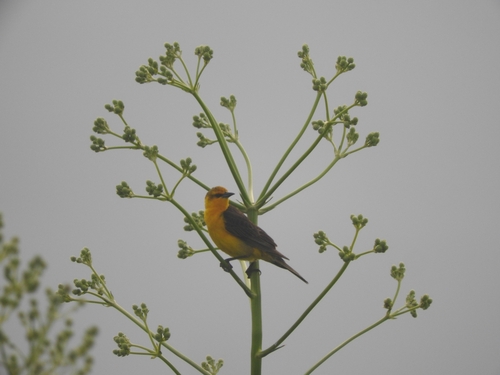 Saffron-cowled Blackbird
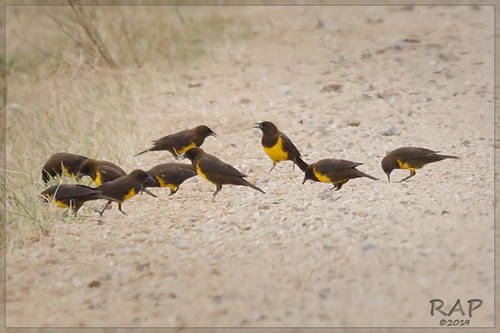 Brown-and-yellow Marshbird
In short
The most reliable field mark between Saffron-cowled Blackbird and Brown-and-yellow Marshbird is the distribution and intensity of yellow on the body and wings, especially in flight and among juveniles. Saffron-cowled Blackbird males show striking yellow-orange on the head, underparts, and rump, with a sharp contrast against black upperparts and a yellow shoulder patch; females and juveniles are duller but still show a yellow rump. In contrast, Brown-and-yellow Marshbird is overall deep brown with rich yellow restricted to the lower breast, belly, and a concealed yellow wing patch that is most visible in flight. The Marshbird is also much larger and heavier, and both sexes look alike. Juvenile plumages differ in the pattern and extent of yellow, especially on the breast and throat. Both species can occur in similar open country, but the Blackbird is much rarer and more localized.
Identification tips
- Juvenile rump color: Saffron-cowled Blackbird juveniles show a distinctive lemon-yellow rump, lacking in Marshbird juveniles, which instead have a yellowish throat and a streaked yellow-brown breast.
- Adult male head and underparts: Saffron-cowled Blackbird males have a bright yellow-orange head, underparts, and rump, sharply set off against black upperparts and tail. Marshbird adults are never this bright or contrasting.
- Female/immature confusion: Female Saffron-cowled Blackbird is duller but still shows a yellow underside and rump, with brownish-gray upperparts and a pale belly. Marshbird females are identical to males and lack any bright yellow on the head or rump.
- Wing pattern in flight: Saffron-cowled Blackbird shows yellow epaulets (marginal and lesser coverts) and a yellow rump in flight. Brown-and-yellow Marshbird flashes a rich yellow patch at the bend of the wing (upperwing coverts) and yellow belly, but the rest of the wing and back remain brown.
- Bill and head structure: Marshbird is bulkier with a heavier, more robust bill and head; Saffron-cowled Blackbird is more slender and delicate overall.
- Sexual dimorphism: Saffron-cowled Blackbird is sexually dimorphic (males much brighter than females); Marshbird sexes are identical.
- Body size: Marshbird is much larger and heavier (24 cm, ~80 g) than Saffron-cowled Blackbird (20 cm, ~41 g). Use this when both species are present or when size is apparent against known species.
- Iris color: Saffron-cowled Blackbird has an orange-brown to deep red-brown iris; Marshbird's iris is brown. This is subtle and may not be visible in the field.
- Leg and bill color: Both species have blackish bills and legs, so this is not helpful for separation.
- Plumage on back and tail: Saffron-cowled Blackbird males have black upperparts and tail; Marshbird is brown to olive-brown above and on the tail.
- Yellow on belly: Marshbird's yellow is mostly restricted to the lower breast and belly, not extending to the head or rump as in Saffron-cowled Blackbird.
- Habitat context: Saffron-cowled Blackbird is rare and local, favoring open grassland with scattered wet areas; Marshbird is more common in marshes and pampas.
- Flock composition: Saffron-cowled Blackbird often joins mixed flocks with other open-country birds; Marshbird may be in small colonies, sometimes with helpers at nests.
- Perched vs. flight views: Saffron-cowled Blackbird's yellow epaulet is visible even when perched; Marshbird's yellow wing patch is mostly concealed at rest and best seen in flight.
- Pitfalls: Female and juvenile Saffron-cowled Blackbirds can be confused with Marshbird due to duller plumage, but always check for yellow on the rump (Blackbird) vs. yellow only on belly and wing patch (Marshbird).
Size
Brown-and-yellow Marshbird is significantly larger, averaging 24 cm in length and nearly double the mass of Saffron-cowled Blackbird (adult males ~80 g vs. ~42.5 g). Saffron-cowled Blackbird is more compact at 20 cm and 41 g. In the field, Marshbird will appear bulkier and longer-bodied, with a heavier build and proportionally larger head and bill. Saffron-cowled Blackbird is noticeably more slender and delicate, especially when seen side by side.
Plumage
- Juveniles: Saffron-cowled Blackbird juveniles resemble adult females but have a distinctive lemon-yellow rump. Brown-and-yellow Marshbird juveniles have a yellowish throat, a yellow and brownish striped breast, and a yellowish lower mandible, lacking the clean yellow rump of the Blackbird.
- Adult males: Saffron-cowled Blackbird males are sharply marked: black upperparts (hindcrown, nape, back, tail), black lores, and a vivid yellow-orange head, rump, and underparts, with black undertail coverts tipped yellow. Their wings are mostly black but show a yellow epaulet (marginal and lesser coverts) even when perched. Brown-and-yellow Marshbird adults of both sexes are deep brown to olive-brown overall, with rich yellow only on the lower breast and belly, and a yellow wing patch (upperwing coverts and bend) that is mostly hidden when perched but flashes in flight.
- Adult females: Saffron-cowled Blackbird females are much duller, with brownish-gray upperparts and a yellow underside, palest on the belly, and a brownish-gray eye-stripe. Still, they retain more yellow overall than Marshbird, especially on the rump. Marshbird females look identical to males.
- In flight: Saffron-cowled Blackbird shows yellow epaulets and rump; Marshbird shows a broad yellow patch at the bend of the wing and yellow belly, but the rest of the upperparts remain brown.
Behaviour
Saffron-cowled Blackbird forages in rolling flocks, often with other open-country species, and is more likely to be seen probing the ground for insects and spiders. Brown-and-yellow Marshbird is also a flocking species, sometimes nesting colonially and exhibiting cooperative breeding. Both species forage on the ground or in low vegetation, but the Marshbird is more likely to be seen in or near marshy grasslands and pampas, sometimes in small groups with helpers at nests. Saffron-cowled Blackbird is more likely to be in drier open grassland or lightly marshy areas, often in mixed-species flocks.
Habitat
Both species overlap in range (Argentina, Brazil, Uruguay, and Paraguay), but Saffron-cowled Blackbird is much rarer and more localized, preferring open grasslands and lightly marshy areas, sometimes near water but not deep marsh. Brown-and-yellow Marshbird is more widespread and common, favoring marshes, pampas grasslands, and wet meadows, often in denser or wetter vegetation than the Blackbird. If you are in a true marsh or pampas, Marshbird is more likely; in drier or patchy grassland, especially in southern Brazil or Uruguay, check carefully for Saffron-cowled Blackbird.
Saffron-cowled Blackbird · Brown-and-yellow Marshbird · My Tricky Birds