

Russet-naped Wood-Rail vs Grey-cowled Wood-Rail
Aramides albiventris versus Aramides cajaneus
Play a quiz with Russet-naped Wood-Rail and Grey-cowled Wood-Rail
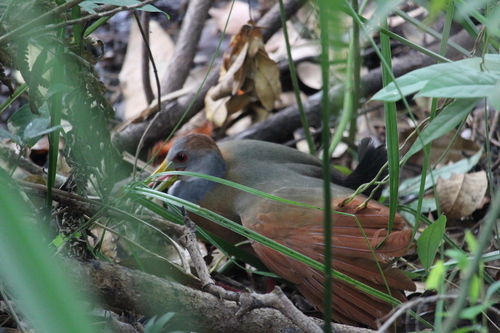 Russet-naped Wood-Rail
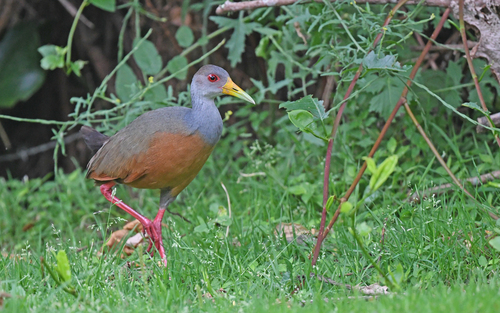 Grey-cowled Wood-Rail
In short
The most reliable field mark between Russet-naped and Grey-cowled Wood-Rails is the color and extent of the nape patch: Russet-naped shows a distinct chestnut (russet) patch on the back of the head and nape, while Grey-cowled has a brown patch that is often duller or even absent in some subspecies. Both species are similar in size and structure, but subtle differences in bill color and the precise tone of the upperparts and underparts can help. Juveniles are tricky, but leg and bill color, as well as belly pattern, offer clues. Always check the nape and head pattern first, especially in perched birds.
Identification tips
- Nape Patch (Adults): Russet-naped always shows a distinct chestnut (russet) patch on the nape and hindneck, sharply set off from the slate gray crown and neck. Grey-cowled has a brown nape patch, often duller, and in some subspecies (A. c. avicenniae) this patch is reduced or absent. Always check the nape in good light.
- Head and Neck Color: Russet-naped has a slate gray crown, forehead, and hindneck, contrasting with the chestnut nape. Grey-cowled's head and neck are medium-grey, blending more smoothly into the brown nape patch (if present).
- Chin and Throat: Russet-naped shows a white chin and upper throat, contrasting with the gray neck and tawny breast. Grey-cowled lacks this white chin; its throat is grey, blending into the rufous chest.
- Bill Color: Russet-naped has a thick, dark yellow bill with a light green tip. Grey-cowled's bill is a brighter greenish-yellow overall. This is subtle and best used in close views.
- Leg and Eye Color (Adults): Both have red eyes and red or coral-red legs, but Grey-cowled's are often brighter. Juvenile Grey-cowled have dusky legs and brownish eyes, while adult Russet-naped have pink to red legs and deep red eyes.
- Upperparts: Russet-naped's back is grayish olive, while Grey-cowled's is olive-green to dark brown. This is subtle and variable, but can help in good light.
- Breast and Flank Color: Russet-naped's breast and flanks are pale tawny cinnamon, separated from the black lower belly by a pale band. Grey-cowled's chest and flanks are rufous, but the transition to the black belly is less sharply marked.
- Belly and Undertail: Both have black lower belly, vent, and undertail coverts, but in juveniles, Russet-naped is dark gray with tawny flecks, while Grey-cowled is sooty-black with buff flecks.
- Juvenile Bill and Leg Color: Juvenile Grey-cowled have dusky (dark) bills and legs, and brownish eyes. Juvenile Russet-naped's bill and legs are not described as dusky, and their eyes are deep red as in adults.
- Subspecies Pitfall: If you encounter a Grey-cowled of subspecies A. c. avicenniae, the nape patch may be very reduced or absent, making it resemble Russet-naped less. In these cases, rely more on throat color and bill tone.
- Flight Views: No distinctive upperwing or flight pattern differences are described for either species, so perched views are more reliable for separation.
- Range: If you are north of Costa Rica, Russet-naped is the expected species. In South America, only Grey-cowled occurs. In overlap zones (Central America), use plumage and structure.
- Sex and Season: Both species are sexually monomorphic and do not show strong seasonal plumage changes, so these are not useful for separation.
- Behavioral Context: Both species forage in dense cover but may come into the open at water edges. Behavior is not a reliable separator.
- Voice: No diagnostic vocal differences are described in the sources provided; do not rely on voice for separation.
Size
Both species are similar in length (33–40 cm) and are large for wood-rails. Russet-naped tends to be heavier (450–600 g) than Grey-cowled (320–465 g), but this is not discernible in the field. Subspecies of Grey-cowled (notably A. c. avicenniae) can be slightly smaller, but overlap is extensive. Size is not a reliable separation point in the field.
Plumage
- Juveniles: Both species' juveniles are duller than adults, but Russet-naped lacks white on the belly and has dark gray underparts with tawny flecks, while Grey-cowled juveniles have a sooty-black belly flecked with buff. Juvenile Grey-cowled also show dusky bills and legs, and brownish eyes, compared to the red or pink legs and red eyes of adult Russet-naped.
- Adults: Russet-naped has a prominent chestnut patch on the nape, slate gray crown and hindneck, and a white chin and upper throat. Its upperparts are grayish olive, with a pale tawny cinnamon breast and flanks, and a black lower belly and undertail. Grey-cowled adults have a medium-grey head and neck, a brown (sometimes reduced) nape patch, olive-green to dark brown upperparts, rufous chest and flanks, and a black belly, rump, and tail. The bill is bright greenish-yellow in Grey-cowled, but dark yellow with a light green tip in Russet-naped. Both have red eyes and coral-red to pink legs, but these are brighter in Grey-cowled.
Behaviour
Both species are secretive and prefer dense vegetation, but will feed in the open along water edges or grassy areas. No consistent behavioral differences are noted in the sources that would help separate them in the field.
Habitat
Russet-naped is found from Mexico to Costa Rica, while Grey-cowled ranges from Central to South America, including forests, mangroves, and swamps. Their ranges overlap in Central America, so habitat alone is not diagnostic. Both prefer wet, dense habitats but Grey-cowled is more likely in South America.
Russet-naped Wood-Rail · Grey-cowled Wood-Rail · My Tricky Birds