

Russet-backed Oropendola vs Crested Oropendola
Psarocolius angustifrons versus Psarocolius decumanus
Play a quiz with Russet-backed Oropendola and Crested Oropendola
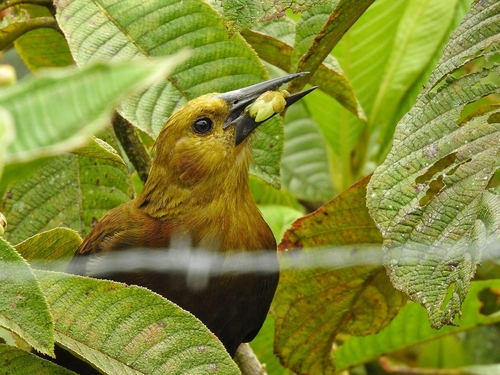 Russet-backed Oropendola
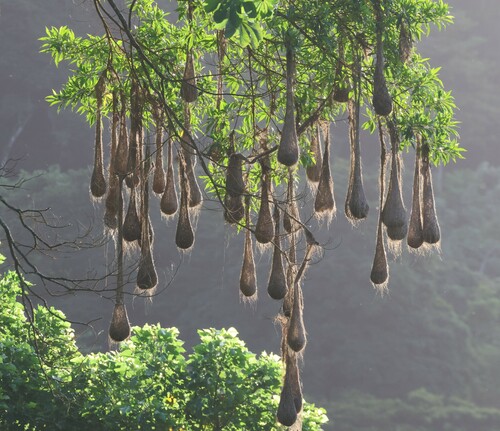 Crested Oropendola
In short
The most reliable field mark to separate Russet-backed Oropendola from Crested Oropendola is overall color: Russet-backed is mostly brown or olive-brown with a russet or paler rump, while Crested is glossy black with a rich chestnut rump and uppertail coverts. In all plumages, Crested Oropendola shows a much paler, swollen bill (ivory to pale yellow) and blue iris in adults, while Russet-backed's bill is usually blackish and its iris dark. Juvenile and female Crested Oropendolas are duller but still blackish-brown, never as brown or olive as Russet-backed. Both species have yellow tails, but Crested's central tail feathers are black, while Russet-backed's are dusky brown. Structure and size overlap, but Crested is on average slightly larger and bulkier. Voice and habitat can help, but plumage and bill color are the most practical field marks.
Identification tips
- Overall color: Russet-backed is brown or olive-brown overall, with a russet or paler rump; Crested is glossy black with a rich chestnut rump and uppertail coverts. This is the most immediate field mark in all ages and sexes.
- Bill color and shape: Crested Oropendola always has a large, swollen, ivory to pale yellow bill (even in juveniles, though tinged brownish); Russet-backed's bill is blackish (except in some subspecies, which may show yellowish or greenish bills, but never as pale or swollen as Crested's). Bill color is visible even at a distance.
- Iris color: Adult Crested Oropendolas have a striking blue iris; Russet-backed's iris is dark brown (except in some subspecies, which may show blue, but this is rare and regional).
- Tail pattern: Both species have yellow tails, but Crested's central tail feathers are black, while Russet-backed's are dusky brown. The yellow is brighter and more sharply defined in Crested.
- Head and crest: Both males have long nape feathers forming a crest, but Crested's is more prominent and both sexes show a more obvious crest due to the bill and head shape. Female and juvenile Crested Oropendolas have a minimal crest, but are still blackish-brown, not brown or olive.
- Sex and age differences: Female and juvenile Crested Oropendolas are duller than males but still blackish-brown, never as brown or olive as Russet-backed. Juvenile Russet-backed birds are browner with a yellower head and duller yellow tail.
- Size and structure: Crested is slightly larger and bulkier, especially in the bill and head, but size overlaps and is not reliable alone.
- Flight and jizz: Both are long-tailed and strong-flying, but Crested appears heavier and more robust, especially in the head and bill. No distinctive upperwing pattern is noted for either species in any age.
- Habitat and range: In Amazonia and Andean foothills, both may occur, but Crested is much more widespread and common, especially in open areas and disturbed habitats. Russet-backed is more restricted to the western Amazon and foothills.
- Voice: Both have complex, variable songs, but Crested's is more elaborate and includes high, rapid flutes and a rattling crescendo. Russet-backed's song is simpler, with a liquid trill and hollow calls. Use voice only if you know the local repertoire.
- Subspecies confusion: Some Russet-backed subspecies (e.g., P. a. salmoni, P. a. neglectus) have yellowish or greenish bills and blue eyes, but their overall color is still brown or olive, not blackish. Always check overall plumage and bill shape, not just color.
- Perched vs. in flight: Both species show yellow tails in flight, but Crested's black central tail feathers and glossy black body contrast with Russet-backed's brown tones. Perched, bill and iris color are often visible.
- Pitfalls: Do not rely on size or tail length alone; overlap is considerable. Bill color and overall plumage are more reliable. Beware of subspecies with atypical bill or eye color.
- Sexing: Only males show a full, long nape crest; females have a minimal crest in both species, but color differences remain diagnostic.
- Colony size: Crested Oropendola often breeds in larger colonies, especially in Trinidad, but this is not a reliable field mark outside breeding season.
Size
Both species are large, long-tailed oropendolas, but Crested Oropendola is slightly larger on average. Adult male Crested Oropendolas reach about 47 cm and 285 g, with females at 37 cm and 160 g. Russet-backed males are 44–48 cm and 250–470 g, with females at 34–38 cm and 170–230 g. The size overlap is considerable, but Crested Oropendola is typically bulkier, especially in the bill and head. In the field, size alone is rarely diagnostic due to this overlap and the effect of posture.
Plumage
- Juveniles and females: Both are duller than adult males, but Crested Oropendola juveniles and females are still blackish-brown overall, never as brown or olive as Russet-backed. Juvenile Crested Oropendolas have a dark brownish eye and a bill with a brown tinge, but retain the pale, swollen bill shape. Russet-backed juveniles are browner, with a yellower head and duller yellow tail than adults.
- Adult males: Russet-backed is mostly olivaceous-brown with a russet tinge, paler rump, and blackish bill; Crested is glossy black with a rich chestnut rump and uppertail coverts, and a large ivory to pale yellow bill with a prominent casque. Both have long nape feathers forming a crest, but this is more pronounced in Crested.
- Tail: Both have yellow tails, but Crested's central tail feathers are black, while Russet-backed's are dusky brown; the rest of the tail is yellow in both, but the yellow is brighter and more sharply demarcated in Crested.
- Bill and iris: Crested Oropendola always shows a pale, swollen bill and blue iris in adults (dark in juveniles); Russet-backed has a blackish bill and dark iris (except in some subspecies).
Behaviour
Both species are social, foraging and nesting in groups, and both display by bowing, raising the tail, and flapping wings while singing. Crested Oropendola is noted as the commonest and most widespread oropendola, often breeding in larger colonies (especially in Trinidad). Both species weave hanging nests, but Crested's colonies can be larger. In flight, both are strong and direct, but Crested may appear bulkier and more robust due to its larger bill and head.
Habitat
Russet-backed Oropendola is found mainly in the western Amazon and Andean foothills (Bolivia, Brazil, Colombia, Ecuador, Peru, Venezuela), while Crested Oropendola is widespread across most of South America (except Chile and Uruguay), reaching as far north as Costa Rica and Trinidad. Where ranges overlap (e.g., Amazonia), Crested is much more widespread and common. Both use forest edges, clearings, and riverine habitats, but Crested is more likely in open country and disturbed areas.
Voice
Both species have complex display songs given by males during bowing displays. Russet-backed's song starts with low notes and rises to a crescendo, with calls described as liquid trills, hollow clacks, and mewing notes. Crested's song is even more complex, starting with low liquid notes, accelerating into a rattling crescendo, and ending with rhythmic wing-flaps; it includes high, rapid, staccato flutes and liquid curls. Crested's song is often described as more variable and elaborate, but in the field, voice is rarely diagnostic unless you know the repertoire well.
Russet-backed Oropendola · Crested Oropendola · My Tricky Birds