

Rufous-cheeked Nightjar vs Freckled Nightjar
Caprimulgus rufigena versus Caprimulgus tristigma
Play a quiz with Rufous-cheeked Nightjar and Freckled Nightjar
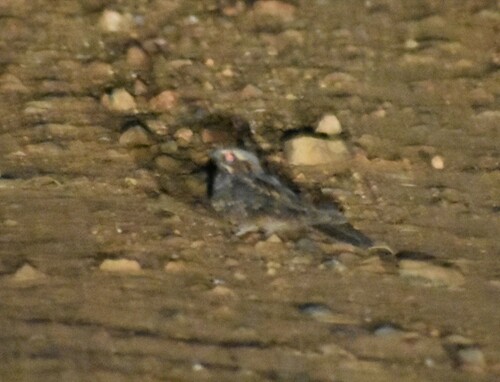 Rufous-cheeked Nightjar
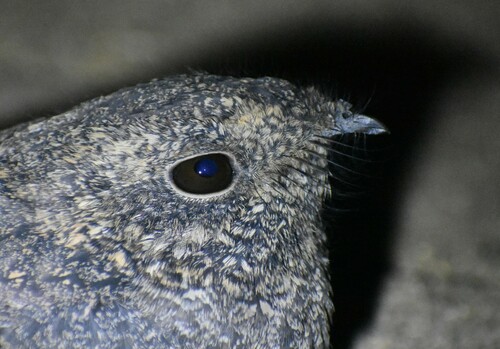 Freckled Nightjar
In short
The most reliable field mark between Rufous-cheeked Nightjar and Freckled Nightjar is the pattern of white in the wings and tail of adults in flight: male Rufous-cheeked Nightjars show extensive white on the primaries and some on the tail corners, while Freckled Nightjar males have only small white spots on the outer primaries and white tips on the outer tail feathers. Females of both species have less white, but Freckled Nightjar females lack white on the tail entirely. Structurally, Freckled Nightjar is noticeably larger and more robust, with longer wings and a shorter tail, and appears much darker and less distinctly marked at a distance. Both species are well camouflaged, but Freckled Nightjar blends into rocky substrates, while Rufous-cheeked Nightjar is paler with rufous spotting and a less distinct collar. Habitat and context can help: Freckled Nightjar is strongly associated with rocky outcrops, while Rufous-cheeked Nightjar favors open ground and is a migrant in much of its range.
Identification tips
- Male in flight: Look for the extent of white in the primaries and tail. Rufous-cheeked Nightjar males have more extensive white in the primaries and some in the tail corners; Freckled Nightjar males have only small white spots in the four outer primaries and white tips on the two outer tail feathers.
- Female in flight: Freckled Nightjar females have 3–4 small white spots on the outer primaries and no white in the tail; Rufous-cheeked Nightjar females have buff (not white) marks, but less extensive than in Freckled.
- Perched birds: At rest, both species hide their white wing/tail spots, but overall color differs: Rufous-cheeked Nightjar is paler with rufous spotting and a less distinct collar, while Freckled Nightjar is dark gray or nearly black with fine pale freckling only visible up close.
- General jizz: Freckled Nightjar is bulkier, with longer wings and a shorter tail, and sits more upright on rocks. Rufous-cheeked Nightjar is smaller and more compact.
- Habitat: Freckled Nightjar is almost always found on rocky outcrops, boulders, or stony ground; Rufous-cheeked Nightjar prefers open, sandy, or grassy ground and avoids rocky areas.
- Camouflage: Freckled Nightjar's plumage is tailored to rocky substrates, making it nearly invisible on stone; Rufous-cheeked Nightjar blends into leaf litter or sandy soil.
- Underparts: Freckled Nightjar has dark brown underparts with whitish/cinnamon barring; Rufous-cheeked Nightjar is paler and more rufous below.
- Size: If seen together or with experience, Freckled Nightjar is noticeably larger and heavier than Rufous-cheeked Nightjar.
- Sexual dimorphism: Both species show more white in the wings/tail of males, but the pattern and extent differ as above; check for white in the tail to separate males.
- Juveniles: No distinctive flight marks described for immatures; both species' chicks are extremely well camouflaged, but habitat and adult association are better clues.
- Vocalization: Only Rufous-cheeked Nightjar's song is described (long churring at night); lack of song is not diagnostic for Freckled.
- Season: Rufous-cheeked Nightjar is migratory and may be absent from southern Africa outside the breeding season; Freckled Nightjar is resident with strong site fidelity.
- Behavior: Freckled Nightjar often perches on exposed rocks and glides back to the same spot after foraging; Rufous-cheeked Nightjar is more likely to flush from open ground.
- Distance view: At a distance, Freckled Nightjar appears much darker and less patterned than Rufous-cheeked Nightjar.
- Pitfall: White in the primaries is present in both, but the amount and presence/absence in the tail is key—always try to see both wing and tail pattern in flight for confident ID.
Size
Freckled Nightjar is significantly heavier (adult mass ~79g [wikidata]) and is described as large and powerfully built, with long wings and a relatively short tail. Rufous-cheeked Nightjar is smaller (male 48–65g, female 46–66g [wikipedia]), with a more typical nightjar silhouette. In the field, Freckled Nightjar will look bulkier and longer-winged, especially in flight, while Rufous-cheeked Nightjar is more compact.
Plumage
- Adults in flight: Male Rufous-cheeked Nightjar shows more extensive white in the primaries and some white in the tail corners; female has buff instead of white, but less extensive than in Freckled. Freckled Nightjar males have only small white spots on the four outer primaries and white tips on the two outer tail feathers; females have 3–4 small white spots on the outer primaries and no white in the tail. When perched, white spots are generally hidden in both species.
- General coloration: Rufous-cheeked Nightjar is paler, with a dark brown body and rufous spots, and a less distinct rufous collar. Freckled Nightjar appears dark gray or nearly black at a distance, with fine white, cinnamon, and pale buff freckling visible only at close range. Underparts of Freckled Nightjar are dark brown with whitish and cinnamon barring, while Rufous-cheeked Nightjar is overall paler and more rufous-toned.
- Juveniles: Both species' chicks are extremely well camouflaged, but Rufous-cheeked Nightjar juveniles have disruptive counter-shading down, while Freckled Nightjar chicks blend in with rocks. No distinctive juvenile upperwing pattern is described for either species.
- Sexual dimorphism: Both species show more white in the wings/tail of males, but the pattern and extent differ as above.
Behaviour
Freckled Nightjar is strongly associated with rocky perches and is often seen sitting on boulders or rocky banks, foraging with short sallies for insects and gliding back to its perch. It is more likely to be seen in open, rocky landscapes, and is less active in winter. Rufous-cheeked Nightjar is an intra-African migrant, breeding in southern parts of its range, and is more likely to be encountered on open ground rather than rocks. Both species are crepuscular/nocturnal and feed on flying insects, but Freckled Nightjar's foraging style is more tied to rocky terrain.
Habitat
Freckled Nightjar is a specialist of rocky outcrops, boulder fields, and stony hillsides, where its plumage provides excellent camouflage. It is rarely found away from such habitats. Rufous-cheeked Nightjar prefers open ground and is not tied to rocky areas; it breeds in southern Africa and migrates north in the non-breeding season. Habitat context is often a strong clue: a nightjar on a bare rocky outcrop is more likely Freckled, while one on open sandy or grassy ground is more likely Rufous-cheeked.
Voice
Rufous-cheeked Nightjar males deliver a long, continuous churring song at night during the breeding season, which stops when the moon is obscured or during nest exchanges. Freckled Nightjar's vocalizations are not described in the provided notes, so voice is not a reliable separator based on available information.
Rufous-cheeked Nightjar · Freckled Nightjar · My Tricky Birds