

Rufous-breasted Sparrowhawk vs Black Kite
Accipiter rufiventris versus Milvus migrans
Play a quiz with Rufous-breasted Sparrowhawk and Black Kite
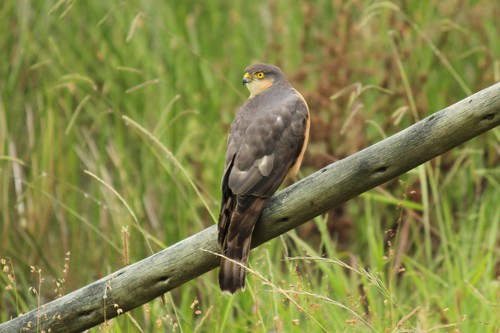 Rufous-breasted Sparrowhawk
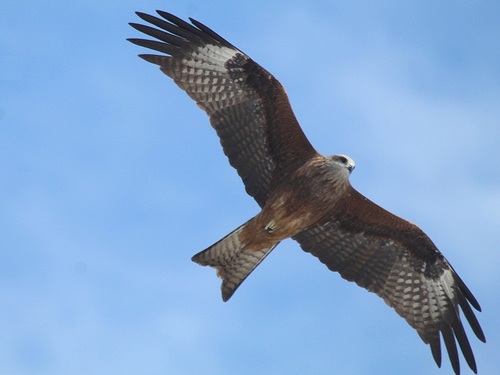 Black Kite
In short
The most reliable field mark between these two is size and shape: Black Kite is much larger, with long, broad wings and a shallowly forked tail, while Rufous-breasted Sparrowhawk is a small, compact accipiter with short, rounded wings and a straight or slightly rounded tail. In flight, the sparrowhawk shows bold bars on both wings and tail, and adults have distinctive rufous underparts, while the kite is overall dark brown with paler head and underparts, lacking any rufous. Juvenile sparrowhawks can be streaked below but never show the kite’s long-winged silhouette or forked tail. If you see a small, fast, barrel-chested raptor with rufous or streaked underparts and no forked tail, it’s the sparrowhawk; a large, soaring, dark raptor with a shallow forked tail is the kite.
Identification tips
- Size and Structure: Black Kite is much larger and longer-winged than Rufous-breasted Sparrowhawk. If the bird looks big, with a wingspan over a meter, it’s the kite.
- Tail Shape in Flight: Black Kite always shows a shallowly forked tail, especially when soaring; Rufous-breasted Sparrowhawk has a straight or slightly rounded tail, never forked.
- Wing Shape: Kites have long, broad wings with a slight dihedral (V-shape) in glide; sparrowhawks have short, rounded wings suited for rapid flapping and maneuvering through trees.
- Flight Style: Black Kite soars and glides effortlessly, often circling high; sparrowhawk flies with rapid wingbeats and short glides, rarely soaring for long.
- Underpart Color: Adult Rufous-breasted Sparrowhawk has rich rufous underparts; Black Kite is pale brown below, never rufous. Juvenile sparrowhawks are streaked but still show some rufous or white, not uniform pale brown.
- Upperpart Color: Sparrowhawk is dark slate-grey above; kite is brown with a paler head and neck.
- Wing and Tail Barring: Sparrowhawk (all ages) shows bold bars on wings and tail, visible in flight; kite’s wings and tail are more uniformly brown with some crossbars but never as bold.
- Facial Pattern: Black Kite has a darker patch behind the eye and a paler head; sparrowhawk lacks a dark eye patch or white eyebrow.
- Eye Color: Sparrowhawk’s eyes are yellow at all ages; kite’s cere and gape are yellow, but eye color is not highlighted as distinctive.
- Bill and Legs: Both have black bills and yellow legs, not useful for separation.
- Habitat Context: Kites are common over open areas, cities, and water; sparrowhawks stick to woodland edges and gardens.
- Behavior: Kites often seen in groups, soaring or scavenging; sparrowhawks are solitary or in pairs, hunting by surprise.
- Vocalization: If you hear a shrill whistle and whinny, it’s the kite; sparrowhawk is usually silent or gives high-pitched calls not described here.
- Perched Posture: Kites perch upright and look large and long-tailed; sparrowhawks are compact, barrel-chested, and often perch in cover.
- Pitfalls: Juvenile sparrowhawks may look streaked below, but always check for size, tail shape, and flight style—kites are never small, never dash through cover, and never show rufous.
Size
Black Kite is dramatically larger, averaging 828 g in body mass and a wingspan around 150 cm, compared to the Rufous-breasted Sparrowhawk’s 195 g and 72 cm wingspan. The kite’s size is obvious in direct comparison, but even alone, its long, broad wings and long tail stand out. The sparrowhawk is a small, compact raptor, closer in size to a pigeon, while the kite is almost four times heavier and much longer-winged.
Plumage
- Juvenile/Immature: Juvenile Rufous-breasted Sparrowhawks are streaked below, with dark shaft streaks on the underparts, but always show some rufous or white with streaks, and bold barring on wings and tail. Juvenile Black Kites are overall brown, with paler head and underparts, dark shaft streaks, and lack any rufous tones; their underparts are pale brown, not rufous, and the upperparts are brown with a darker patch behind the eye.
- Adult: Adult sparrowhawks have a distinctive rufous breast and belly, dark slate-grey above, and bold wing and tail bars. Black Kites are dark brown overall, with a paler head and neck, dark patch behind the eye, and a shallowly forked tail. The kite’s plumage is never rufous and lacks strong barring on the underparts or tail. Both species have yellow legs and black bills, but the sparrowhawk’s eyes are yellow at all ages, while the kite’s cere and gape are yellow.
Behaviour
Rufous-breasted Sparrowhawk hunts mainly by surprise, dashing from cover or making quick flights to catch small birds, and is usually seen alone or in pairs, moving quickly and low. Black Kite is often seen soaring or circling high in the sky, sometimes in groups, and is a scavenger as well as a hunter, often gliding with wings held in a shallow dihedral. The kite’s flight is buoyant and effortless, while the sparrowhawk’s is rapid, with bursts of flapping and short glides.
Habitat
Both species can occur in overlapping regions of sub-Saharan Africa, but the Rufous-breasted Sparrowhawk prefers forest edges, woodlands, and sometimes gardens, usually near cover. Black Kite is highly adaptable, found in open country, near water, urban areas, and often around human settlements, where it scavenges. If seen soaring over open fields or cities, it’s likely a kite; a small raptor dashing through woodland is more likely the sparrowhawk.
Voice
Black Kite has a distinctive shrill whistle followed by a rapid whinnying call, often heard when soaring or near the nest. Rufous-breasted Sparrowhawk’s vocalizations are not detailed in the notes, so voice is only diagnostic if the kite’s call is heard.