

Rufescent Imperial-Pigeon vs Pinon's Imperial-Pigeon
Ducula chalconota versus Ducula pinon
Play a quiz with Rufescent Imperial-Pigeon and Pinon's Imperial-Pigeon
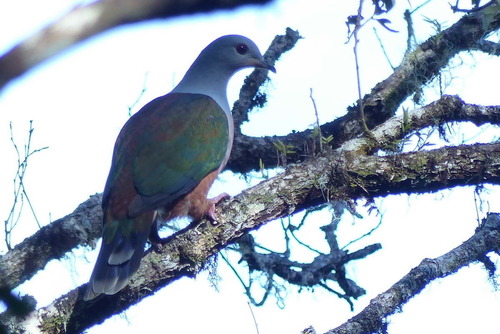 Rufescent Imperial-Pigeon
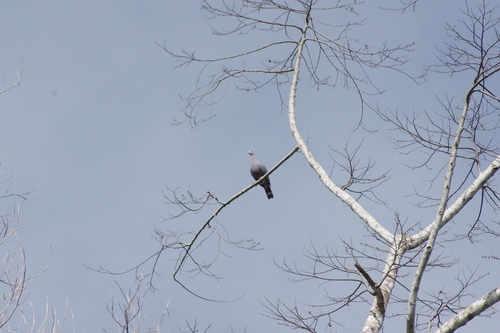 Pinon's Imperial-Pigeon
In short
The most reliable way to separate Rufescent Imperial-Pigeon from Pinon's Imperial-Pigeon is by focusing on the distinctive plumage of Rufescent: look for a combination of a slaty-grey head, metallic green back and wings, and a unique chestnut belly with a pale orange chest. Rufescent also shows a blackish tail with a blue gloss and, in some subspecies, reddish-purple iridescence on the mantle. Pinon's Imperial-Pigeon lacks these specific color contrasts, and is generally less richly colored. Juvenile Rufescent Imperial-Pigeons have a paler head and neck and a vaguely greyish breast, which can be a pitfall if not carefully checked. Both species are similar in size and shape, but Rufescent is slightly larger and bulkier. In the field, focus on the rich rufous and vinous tones of Rufescent, especially on the underparts, and the metallic upperparts, which Pinon's does not match.
Identification tips
- Juvenile plumage: Juvenile Rufescent Imperial-Pigeons have a paler head and neck and a vaguely greyish breast, lacking the rich vinous and chestnut tones of adults. If you see an immature imperial-pigeon with a washed-out head and breast, consider Rufescent.
- Head color: Adult Rufescent shows a slaty-grey head, which contrasts with the metallic green back. Pinon's lacks this sharp contrast and is generally plainer.
- Upperparts: Rufescent's back and wing coverts are metallic green with bronzy and bluish reflections, sometimes with reddish-purple iridescence (subspecies chalconota). Pinon's does not show this metallic or iridescent effect.
- Tail: Rufescent has a blackish tail with a blue gloss, which can be striking in good light. Pinon's tail is not described as having this gloss or intensity.
- Underparts: Rufescent has a pale orange throat and chest, vinous breast, and deep chestnut belly and flanks. Pinon's underparts are less richly colored and lack the rufous/chestnut tones.
- Feet and eye color: Rufescent has red feet and a reddish eye, which may be visible at close range. Pinon's is not described as having such strong colors.
- Sex differences: Female Rufescent is similar to the male but with less reddish iridescence. Pinon's sexual dimorphism is not described, so do not rely on sex differences for that species.
- Flight views: In flight, look for the metallic upperwing and blue-glossed tail of Rufescent. Pinon's lacks these features and will appear more uniform.
- Size and bulk: Rufescent is slightly larger and bulkier, especially the male, but this is only useful if you have a direct comparison.
- Behavior: Rufescent is more likely to be found deep in the forest, sitting quietly at mid-levels. Pinon's may be more visible at forest edges or in less dense areas.
- Vocalizations: If you hear a slow, mournful hum or a hollow 'woo', consider Rufescent, but both species are usually silent and not reliably separated by voice.
- Rarity: Rufescent is much rarer and more local than Pinon's. If you are in an area where both occur, the default is Pinon's unless you see the distinctive Rufescent plumage.
- Pitfalls: Immature Rufescent can look washed-out and lack the rich colors of adults, which may cause confusion with Pinon's. Always check for the combination of head, upperparts, and underparts color.
- Context: Both species are forest pigeons of New Guinea, but Rufescent's strict forest interior preference and rarity are clues if habitat is known.
- Checklist: For any large imperial-pigeon, first check for metallic green and blue gloss on the upperparts and tail, then look for chestnut underparts and a slaty-grey head. Absence of these features points to Pinon's.
Size
Rufescent Imperial-Pigeon is slightly larger, with males reaching 41–42 cm (16–17 in) and females 37–39 cm (15 in), both sexes weighing around 21–22 ounces. Pinon's Imperial-Pigeon is similar in size but typically not as robust or long as the largest Rufescent individuals. In practice, size alone is not a strong separator unless both species are seen side by side, but a noticeably large, heavy imperial-pigeon in New Guinea forests is more likely to be Rufescent.
Plumage
Juvenile Rufescent Imperial-Pigeons can be told by their paler head and neck and a breast that appears vaguely greyish, lacking the strong vinous and chestnut tones of adults. Adults (both sexes) of Rufescent show a slaty-grey head, metallic green back and wing coverts with bronzy and bluish reflections, a blackish tail with a blue gloss, a pale orange throat and chest, vinous breast, and deep chestnut belly and flanks. Subspecies chalconota adds reddish-purple iridescence on the mantle and back. Females are similar but with less reddish iridescence. Pinon's Imperial-Pigeon lacks these specific metallic and rufous tones, and does not show the combination of slaty-grey head, metallic green upperparts, and chestnut underparts. The blackish tail with blue gloss and the red feet and eye of Rufescent are also more pronounced than in Pinon's. In flight, the upperwing and tail pattern of Rufescent (especially the metallic and blue gloss) is distinctive if seen well.
Behaviour
Rufescent Imperial-Pigeon is often found sitting quietly in the mid-levels of dense forest and is rarely seen outside forested areas. It is usually silent, but when alarmed, it gives a hollow knock or slurred 'woo' sound. Pinon's Imperial-Pigeon shares similar forest habits but is not described as being as strictly forest-bound or as silent. Both species feed on figs and fruits and are generally unobtrusive, but Rufescent's tendency to remain deep in the forest and its rarity make it less likely to be encountered.
Habitat
Both species occur in New Guinea forests, but Rufescent Imperial-Pigeon is described as rare and strictly forest-dwelling, rarely leaving dense cover. Pinon's Imperial-Pigeon is also a forest species but is not noted as being as rare or as restricted to the forest interior. If you encounter an imperial-pigeon deep in undisturbed forest, especially at mid-levels, Rufescent is more likely, but habitat alone is not diagnostic.
Voice
Rufescent Imperial-Pigeon is usually silent, but when it does vocalize, it produces a slow, mournful hum, a low 'hoo', or a hollow knock that can sound like a slurred 'woo'. Duetting has been observed. Pinon's Imperial-Pigeon is not described in the sources as having distinctive vocalizations, and in practice, neither species is likely to be identified by voice alone in the field.
Rufescent Imperial-Pigeon · Pinon's Imperial-Pigeon · My Tricky Birds