
Ruddy Turnstone vs Great Crested Tern
Arenaria interpres versus Thalasseus bergii
Play a quiz with Ruddy Turnstone and Great Crested Tern
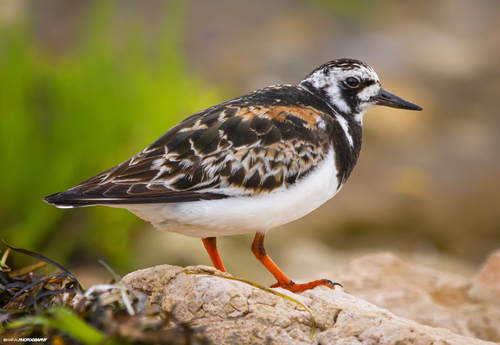 Ruddy Turnstone
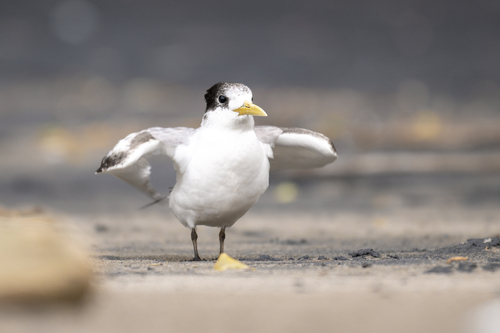 Great Crested Tern
In short
The most reliable field mark to separate Ruddy Turnstone from Great Crested Tern is overall structure and bill: turnstones are short-legged, stocky shorebirds with a short, dark, slightly upturned bill, while Great Crested Terns are much larger, long-winged seabirds with a long, straight yellow bill and a shaggy black crest. In flight, juvenile and non-breeding turnstones show a bold white wingbar and white lower back and rump, while juvenile terns have a variegated upperwing with dark bars and lack the turnstone's harlequin pattern. Turnstones are often seen running on rocky or sandy shores, flipping debris, whereas terns are usually flying over water or perched on beaches and islands. If you see orange legs, it's a turnstone; if you see a long yellow bill and a black crest, it's a tern.
Identification tips
- Bill shape and color: Turnstone has a short, dark, slightly upturned bill; Great Crested Tern has a long, straight, yellow (greenish-tinged) bill. This is visible at all ages and seasons.
- Leg color: Turnstone legs are bright orange (all ages, all seasons); tern legs are black. If you see orange legs, it's a turnstone.
- Overall structure: Turnstone is stocky, short-legged, and compact; tern is long-winged, long-tailed, and slender, with a much longer neck and bill. In flight, terns have pointed wings and a buoyant flight, while turnstones have short, broad wings and a direct, rapid flight.
- Crest: Adult Great Crested Tern has a shaggy black crest at the rear of the head (breeding and non-breeding); turnstone never shows a crest.
- Plumage pattern (adults): Breeding turnstone is harlequin-patterned (black, white, reddish-brown, with a black breast band and white underparts); tern is grey above, white below, with a white forehead and black crest. Non-breeding turnstone is duller but still patterned; tern becomes paler with a white crown and peppered crest.
- Juvenile/immature plumage: Turnstone juveniles are scaly above, with a pale head and bold white wingbar in flight; tern juveniles have barred upperwings and a white crown, but no bold wingbar. If you see a scaly, pale-headed bird with a white wingbar, it's a turnstone.
- Flight pattern: Tern has long, pointed wings and a deeply forked tail, giving a buoyant, gliding flight; turnstone has short, broad wings and a short tail, with rapid, direct flight.
- White in wing and tail (in flight): Turnstone shows a bold white wingbar, white lower back, rump, and tail with dark bands; tern lacks these, showing uniform grey upperwings with some dark bars in juveniles.
- Habitat and behavior: Turnstone is almost always on the ground, running and flipping objects; tern is usually flying over water or perched with other terns, rarely on the ground except at colonies.
- Size: Tern is more than twice as heavy and much longer in wingspan; confusion is more likely at a distance or with lone birds, but size is obvious if both are present.
- Voice: Turnstone's call is a sharp rattle; tern gives loud, crow-like or gull-like calls. If you hear a loud 'kerrak', it's a tern.
- Sex and seasonal variation: Both species have little sexual dimorphism; female turnstones are slightly duller, but this is subtle. Tern sexes are identical.
- Pitfalls: Distant, lone birds on a beach may confuse by size; always check bill, leg color, and body shape. Immature terns may look patterned above, but lack the turnstone's white wingbar and orange legs.
- Associations: Turnstones may mix with other small waders; terns are usually with other terns or gulls.
- When in doubt: Focus on bill length and color, leg color, and presence or absence of a crest. These are visible even at a distance with binoculars.
Size
Ruddy Turnstone is a small, chunky wader: 22–24 cm long, 50–57 cm wingspan, 85–150 g. Great Crested Tern is much larger and more slender: 46–49 cm long, 125–130 cm wingspan, 325–397 g. The tern is more than twice the mass and has a much longer wingspan, making confusion unlikely if seen side by side. The tern's long, pointed wings and long tail contrast with the turnstone's short, broad wings and short tail.
Plumage
-
Juvenile/immature birds: Ruddy Turnstone juveniles have a pale brown head and scaly-looking upperparts due to pale fringes, with a bold white wingbar, white lower back, rump, and tail in flight. Great Crested Tern juveniles have a head pattern like winter adults (white crown, dark mask), and the upperwings are strongly patterned with grey, brown, and white, showing dark bars but not a single bold wingbar; the closed wing appears barred, not scaly.
-
Adult non-breeding: Turnstones are duller, with dark grey-brown upperparts and a dark head with little white, but still show the white wingbar and rump in flight. Terns in non-breeding plumage have a white crown and forehead, peppered black crest, and paler grey upperparts, but always retain the long yellow bill and black legs.
-
Adult breeding: Turnstones are strikingly patterned with reddish-brown upperparts, black-and-white head and breast, and white underparts. Terns have a glossy black shaggy crest, white forehead, and battleship-grey back and wings. The tern's bill is always yellowish, never dark or orange, and the legs are black, never orange.
Behaviour
Ruddy Turnstones forage by running along the shore, flipping stones, seaweed, and debris with their bill to find invertebrates. They may dig, probe, or hammer at prey, and are often seen in small groups on rocky or sandy coasts. Great Crested Terns are aerial fishers, flying over water and diving for fish, or resting in dense colonies on sandbars, islands, or beaches. Terns rarely walk or run on the ground and are almost never seen flipping objects or foraging on the shore like turnstones.
Habitat
Turnstones are almost always found on rocky or sandy coastlines, tidal flats, and beaches, often close to the waterline and among debris. Great Crested Terns are found along coastlines and islands, but are much more likely to be seen flying over open water, perched on sandbars, or in large breeding colonies. If the bird is actively foraging among rocks or wrack, it's almost certainly a turnstone; if it's flying over the sea or perched with other terns, it's a tern.
Voice
Ruddy Turnstone has a staccato, rattling call and a chattering alarm-call, especially in the breeding season. Great Crested Tern is highly vocal at colonies, giving a loud, raucous, crow-like 'kerrak', a 'korrkorrkorr' at the nest, and a hard 'wep wep' in flight. The tern's calls are much louder and more gull-like, while the turnstone's are sharper and more rattling.