

Reunion Harrier vs Long-winged Harrier
Circus maillardi versus Circus buffoni
Play a quiz with Reunion Harrier and Long-winged Harrier
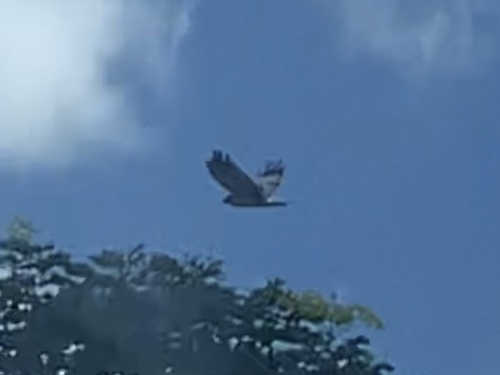 Reunion Harrier
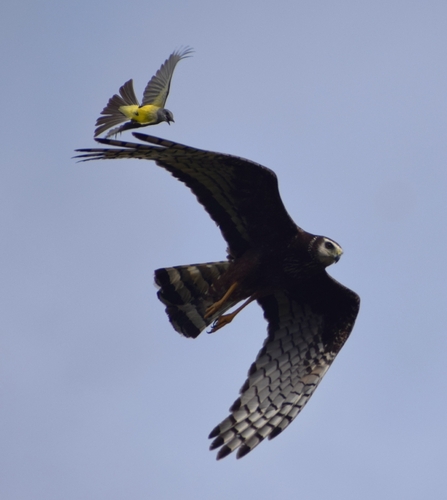 Long-winged Harrier
In short
The most reliable field mark is the overall plumage and wing pattern, especially in females and immatures: Réunion Harrier immatures and females are dark brown with a white rump and barred tail, while Long-winged Harrier shows two distinct morphs (dark and light), with juveniles resembling females but having a more speckled chest. In flight, Long-winged Harrier is notably longer-winged and longer-tailed, with a slimmer, rangier jizz, while Réunion Harrier has broader, rounder wings adapted for maneuvering through forests. Adult males of Réunion Harrier are strikingly patterned with a blackish head/back and white underparts, unlike any Long-winged Harrier morph. Habitat and range are also key: Réunion Harrier is restricted to Réunion Island, while Long-winged Harrier is widespread in South American grasslands and wetlands.
Identification tips
- Location is key: Réunion Harrier is only found on Réunion Island; any harrier seen in South America is Long-winged Harrier.
- Wing shape in flight: Long-winged Harrier has very long, narrow wings and a long tail, giving it a rangy, buoyant flight. Réunion Harrier has broader, more rounded wings and a shorter tail, appearing more compact and agile.
- Adult male plumage: Réunion Harrier males are unique with a blackish head/back, white underparts, and grey tail. No Long-winged Harrier morph matches this pattern.
- Female/immature plumage: Réunion Harrier females and immatures are dark brown with a crisp white rump and barred tail. Long-winged Harrier females and juveniles are either dark (all blackish-brown below) or light (white underparts), with juveniles showing a more speckled chest.
- Rump patch: Both species show a white rump, but it is especially striking on Réunion Harrier immatures/females due to the contrast with the dark brown body.
- Tail pattern: Réunion Harrier females/immatures have a clearly barred tail; Long-winged Harrier juveniles may show some barring, but adults are less distinctly barred.
- Upperwing contrast: Long-winged Harrier (light morph) shows dark primaries contrasting with paler inner wing and coverts; Réunion Harrier's wing pattern is less contrasting, especially in females/immatures.
- Morphs: Only Long-winged Harrier shows both dark and light morphs. Réunion Harrier does not have distinct morphs.
- Facial disc: Long-winged Harrier has a pronounced facial disc (shared with all Circus harriers), but this is not a reliable separation from Réunion Harrier in the field.
- Leg color: Long-winged Harrier has bright orange legs, but this is rarely visible at a distance.
- Size: Long-winged Harrier is larger and longer-winged; Réunion Harrier is smaller and more compact.
- Habitat context: Réunion Harrier is usually in more wooded or mixed habitats, while Long-winged Harrier sticks to open grassland and wetland.
- Flight style: Long-winged Harrier quarters low and glides for long stretches; Réunion Harrier is more likely to be seen maneuvering through or near forest edges.
- Vocalizations: Not usually helpful, but Réunion Harrier's calls are mostly during breeding and rarely heard; Long-winged Harrier may give a 'klee-klee-klee' in flight.
- Pitfalls: Immature/female Réunion Harrier and dark morph Long-winged Harrier can both appear dark with a white rump; check for size, wing shape, and tail length to separate them.
Size
Long-winged Harrier is larger overall, with a length of 46–60 cm and a wingspan of 120–155 cm [wikipedia]. Réunion Harrier is smaller, at 42–55 cm in length [wikipedia]. The difference is most apparent in the field by the Long-winged Harrier's proportionally longer wings and tail, giving it a more elongated, rangy appearance, especially in flight. Réunion Harrier is more compact and broad-winged, reflecting its adaptation to forested habitats.
Plumage
- Juveniles/Immatures: Réunion Harrier immatures and females are dark brown overall with a conspicuous white rump and a barred tail. Long-winged Harrier juveniles resemble females but have a more speckled chest; their overall coloration depends on morph: dark morphs are all blackish-brown below, while light morphs have white underparts.
- Adult males: Réunion Harrier males are distinctive with a blackish head and back, white streaks, white underparts and underwings, a grey tail, and grey/black wings with a white leading edge. Long-winged Harrier males do not show this pattern; instead, light morphs have white underparts and streaked grey/brown upperparts, while dark morphs are uniformly dark below.
- Upperwing pattern: Réunion Harrier (all ages) shows broader, rounded wings with less contrast between coverts and primaries than Long-winged Harrier. Long-winged Harrier (especially light morph) shows darker primaries contrasting with paler inner wing and a generally longer, narrower wing shape.
- Rump and tail: Both species have a white rump, but Réunion Harrier's is especially crisp against the dark brown body in immatures/females. Long-winged Harrier's tail is longer and less obviously barred except in juveniles.
Behaviour
Réunion Harrier is adapted for maneuvering through forests and hunts between trees, using broad, rounded wings for agility. It often avoids closed canopies but is more likely to be seen in native or degraded forests, shrubland, and even cultivated fields. Long-winged Harrier is a classic open-country harrier, quartering low over grasslands and wetlands with a buoyant, gliding flight and long, narrow wings. Its hunting style is more typical of Circus harriers, relying on long, low patrols over open ground.
Habitat
Réunion Harrier is endemic to Réunion Island and is found in a wide range of habitats there, from open landscapes and degraded forests to shrublands, pastures, and cultivated fields, but rarely above 1200 m in Acacia forests. Long-winged Harrier is widespread across South America, inhabiting grasslands and wetlands throughout the continent. If seen outside Réunion or in extensive open grassland/wetland, it is almost certainly Long-winged Harrier.
Voice
Both species are generally quiet. Réunion Harrier is mostly silent except during breeding, when it gives a chattering threat call, a wailing courtship call, and chuckling food-associated calls. Long-winged Harrier is also not very vocal, but may call in flight with a fast 'klee-klee-klee' or a quieter, descending 'thrill.' In practice, vocalizations are rarely diagnostic in the field.