

Retz's Helmetshrike vs Brubru
Prionops retzii versus Nilaus afer
Play a quiz with Retz's Helmetshrike and Brubru
 Retz's Helmetshrike
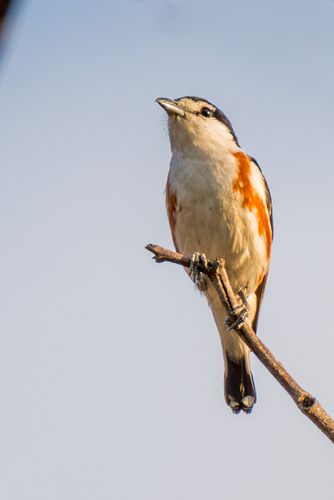 Brubru
In short
The most reliable field mark to separate Brubru from Retz's Helmetshrike is the Brubru's distinctive head pattern: a bold black crown, white supercilium, and black eyestripe in adult males, with a buff or white shoulder patch depending on subspecies. Juvenile Brubru are mottled brown and buff above with barred underparts, while Retz's Helmetshrike lacks these features and instead shows a more uniform, helmeted appearance. Brubru is a smaller, more slender bird, often solitary or in pairs, while Retz's Helmetshrike is typically seen in noisy, cohesive groups. In flight or perched, focus on the Brubru's contrasting head and wing markings versus the helmetshrike's plainer, darker look.
Identification tips
- Juvenile Brubru: Look for a mottled brown, buff, and white upperpart pattern with buff-edged wings and tail, and whitish underparts with brown barring. Retz's Helmetshrike juveniles lack this mottling and barring.
- Adult Brubru head pattern: The combination of a black crown, white supercilium, and black eyestripe is unique among these two. Retz's Helmetshrike has a darker, helmeted head without a strong supercilium.
- Shoulder patch: Brubru shows a buff or white shoulder stripe (depending on subspecies), which stands out on the otherwise black wing. Retz's Helmetshrike lacks this distinct shoulder mark.
- Tail pattern: Brubru has a black tail with white tips and edges to the outer feathers, visible when perched or in flight. Helmetshrike's tail is more uniformly dark.
- Underparts: Brubru adults have white underparts with rufous flanks (less rufous and more streaked in females). Retz's Helmetshrike is more uniform below, lacking the rufous flanks.
- Crest/helmet: Retz's Helmetshrike often shows a prominent crest or 'helmet' shape to the head, especially in adults, which Brubru never shows.
- Bill color: Retz's Helmetshrike may show a red bill (in some subspecies), while Brubru's bill is dark and slender.
- Group size: Brubru is usually solitary or in pairs; helmetshrikes are almost always in noisy groups.
- Behavior: Brubru is quiet and unobtrusive, often high in the canopy. Helmetshrikes are conspicuous, noisy, and move together in a coordinated fashion.
- Habitat: Both use woodland, but Brubru is more tied to large, mature trees and has a larger territory. Helmetshrikes can be found in a wider range of wooded habitats.
- Vocalizations: Listen for Brubru's soft duet ('prrrrruuu' and 'eeeu'); helmetshrikes are more raucous and group-oriented in their calls.
- Sex/age variation: Female Brubru is duller, browner, and less rufous than the male, with some streaking below. Juvenile Brubru is much more mottled and barred than any helmetshrike.
- Flight views: Brubru shows contrasting white in the tail and shoulder patch; helmetshrike is more uniform and lacks these pale panels.
- Confusion risk: Immature Brubru may be mistaken for helmetshrike due to duller colors, but the mottled upperparts and barred underparts are still distinctive.
- When marks fail: In poor light or at distance, rely on group size and behavior—solitary or paired, quiet birds are likely Brubru; noisy, gregarious parties are helmetshrikes.
Size
Brubru is a small passerine, measuring 12–15 cm in length [wikipedia], and is notably more petite and slender than Retz's Helmetshrike, which is a bulkier, more robust bird (exact measurements not supplied, but helmetshrikes are generally larger). The Brubru's delicate build and relatively long tail can be apparent when seen side by side with the chunkier, short-tailed helmetshrike. Use size with caution unless both species are seen together, as helmetshrikes can appear smaller in dense foliage.
Plumage
- Juvenile/immature Brubru: Mottled brown, buff, and white above, with buff edgings to wing and tail feathers; underparts are whitish with brown barring. This pattern is unique among the two, as Retz's Helmetshrike juveniles do not show this degree of mottling or barring.
- Adult male Brubru (nominate): Black crown, white supercilium and forehead, black eyestripe, black back with a tawny strip, black tail with white tips/edges, black wings with a buff or white shoulder stripe (subspecies dependent), white underparts with rufous flanks. Females are duller, browner, and less rufous, with some underpart streaking.
- Retz's Helmetshrike: Lacks the Brubru's bold head pattern and wing panel. Instead, it has a more uniform dark head with a prominent 'helmet' crest, a red bill (in some subspecies), and generally darker, more uniform plumage without the strong supercilium or shoulder patch. The helmeted look is distinctive in adults but can be subtle in immatures.
- Flight views: Brubru shows strong contrast in the wing and tail, especially the white-tipped tail and shoulder patch; helmetshrike is more uniform and lacks these pale panels.
Behaviour
Brubru is typically solitary or in pairs, moving restlessly but quietly through the canopy. It is unobtrusive and often difficult to spot, rarely joining groups except in mixed-species flocks outside the breeding season. Retz's Helmetshrike, by contrast, is highly social, usually found in noisy, cohesive family groups that move together through the trees. This difference in social behavior can be a strong clue: a lone bird is likely a Brubru, while a chattering party is probably helmetshrikes.
Habitat
Brubru requires large trees and is found in woodland and savanna across most of sub-Saharan Africa, often occupying larger territories than expected for its size due to its foraging style. Retz's Helmetshrike also inhabits woodland and forest edges but is often more tolerant of secondary growth and is more likely to be encountered in groups moving through a variety of wooded habitats. Both can overlap in range, but Brubru is more selective for mature trees.
Voice
Brubru's song is a duet: the male gives a soft 'prrrrruuu' call, often answered by the female's 'eeeu'. This duet is distinctive and can help separate it from helmetshrikes, which are generally noisier and more varied in their calls, often chattering as a group. If you hear a soft, paired duet, think Brubru; if you hear a noisy, mixed chorus, suspect helmetshrikes.