

Motmot

Red-eyed Dove vs Emerald-spotted Wood-Dove

Streptopelia semitorquata versus Turtur chalcospilos

Play a quiz with Red-eyed Dove and Emerald-spotted Wood-Dove
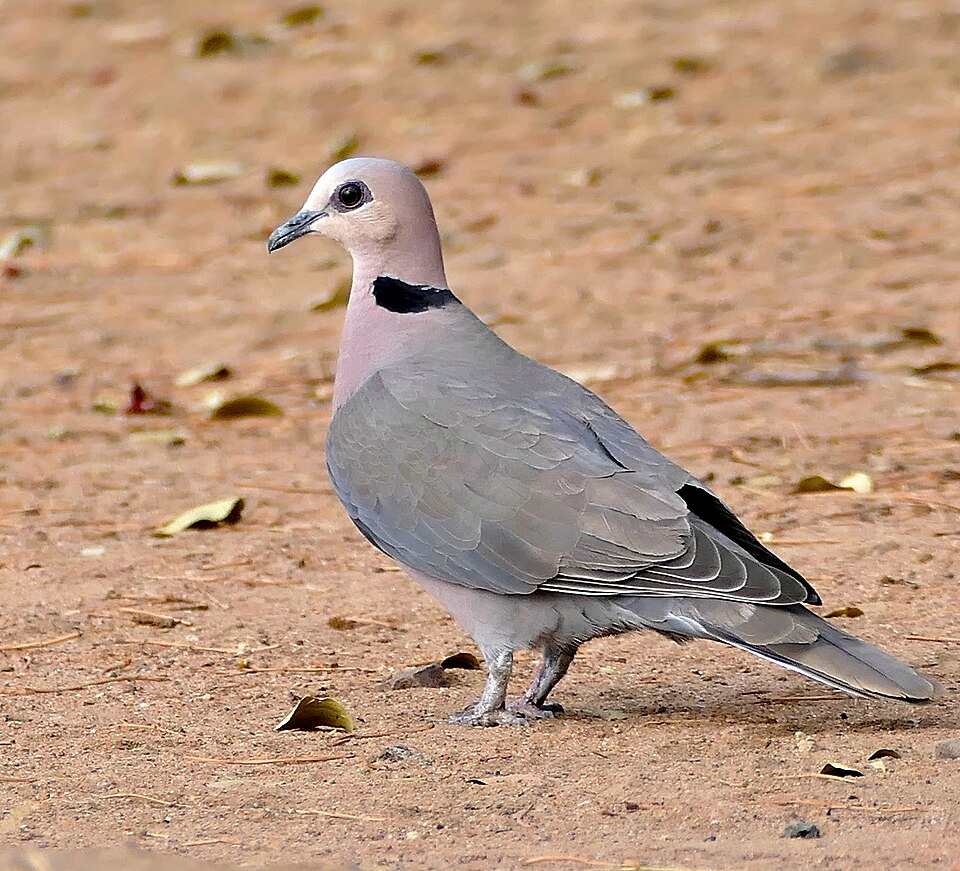
Red-eyed Dove (Streptopelia semitorquata) Red-eyed Dove
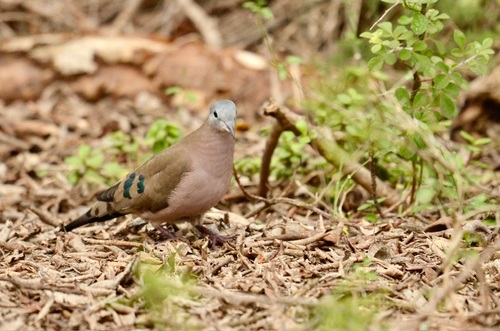
Emerald-spotted Wood-Dove (Turtur chalcospilos) Emerald-spotted Wood-Dove

Media

Loading…

In short

The most reliable field mark to separate Red-eyed Dove from Emerald-spotted Wood-Dove is size: the Red-eyed Dove is much larger and bulkier, with a noticeably longer body and heavier build. In flight or perched, Red-eyed Dove shows a distinctive black half-collar on the neck and lacks the bright green wing spots of the wood-dove. Juveniles of both species are duller, but the emerald-green wing patches of the wood-dove (even if muted in immatures) are never matched by Red-eyed Dove. If you see a medium-to-large dove with reddish or wine-colored underparts and a dark neck collar, it's Red-eyed Dove; a small, plump dove with metallic green wing spots is Emerald-spotted Wood-Dove.

Identification tips

  1. Size is the quickest separator: Red-eyed Dove is much larger and bulkier than Emerald-spotted Wood-Dove. If the bird looks small and compact, it's almost certainly the wood-dove.
  2. Metallic green wing spots: Only Emerald-spotted Wood-Dove shows bright green metallic patches on the folded wings (adults and most immatures). Red-eyed Dove never has green on the wings.
  3. Neck collar: Red-eyed Dove shows a black half-collar on the side of the neck (adults and most juveniles), while Emerald-spotted Wood-Dove lacks any neck collar.
  4. Underpart color: Red-eyed Dove has dark mauve-pink to wine-red underparts, especially on the neck and breast, while Emerald-spotted Wood-Dove is paler pinkish-mauve, fading to white on the belly.
  5. Head and face: Red-eyed Dove's forehead is pale bluish-grey merging into a darker crown; Emerald-spotted Wood-Dove has a bluish-grey forehead, crown, and nape, but is overall paler.
  6. Tail pattern: Emerald-spotted Wood-Dove has blackish bands on the lower back and tail, while Red-eyed Dove's rectrices are dark grey basally and light brownish-grey distally, lacking strong banding.
  7. Bill color: Both have dark bills, but Emerald-spotted Wood-Dove's bill is blackish with a red base, which may be visible at close range; Red-eyed Dove's bill is entirely black.
  8. Leg and orbital skin: Both have purplish red legs and orbital skin, but these are not reliable in the field unless seen very well.
  9. Juvenile confusion: Juvenile Emerald-spotted Wood-Dove has duller green wing spots and buff feather fringes, but the green is still present. Juvenile Red-eyed Dove is overall duller and browner, but never shows green wing spots.
  10. Flight style: Red-eyed Dove flies with strong, regular wingbeats and occasional sharp flicks; Emerald-spotted Wood-Dove's flight is less described but is generally weaker and more fluttery due to its smaller size.
  11. Habitat context: In open, dry woodland, Emerald-spotted Wood-Dove is more likely; in wetter, denser woodland or near water, Red-eyed Dove is more expected, but both can overlap in some areas.
  12. Perched posture: Red-eyed Dove often perches high and upright, appearing long-necked and heavy. Emerald-spotted Wood-Dove is more likely to be seen on the ground or low in bushes, looking compact and short-necked.
  13. Vocalization: If you hear a three-part, drawn-out cooing sequence (two long coos, descending series, then rapid coos), it's Emerald-spotted Wood-Dove. Red-eyed Dove's call is not described here, so use this only if the wood-dove's call is heard.
  14. Sexes similar: Both species show little sexual dimorphism, so all field marks apply to both males and females.
  15. Geographical variation: Emerald-spotted Wood-Dove is monotypic with only clinal variation; Red-eyed Dove is larger in the Ethiopian Highlands, but this is not a field mark unless comparing populations regionally.

Size

Red-eyed Dove is dramatically larger, with an average body mass of 235 g versus just 56 g for Emerald-spotted Wood-Dove [wikidata]. Red-eyed Dove reaches about 30 cm in length, making it the largest 'ringneck' dove in its range, while Emerald-spotted Wood-Dove is much smaller at around 20 cm. The difference is obvious in the field: Red-eyed Dove appears long-bodied and robust, while Emerald-spotted Wood-Dove is compact and short-tailed. Even at a distance or in mixed flocks, the size gap is striking and is often the first clue.

Plumage

Juvenile and immature birds: Both species are duller when young, but key marks persist. Juvenile Emerald-spotted Wood-Doves have duller green spots on the wings and buff fringes to the feathers, but the green metallic patches are still visible, though less vibrant. Red-eyed Dove juveniles are overall browner and duller than adults, but never show any green wing spots; their most distinctive feature is the dark half-collar on the neck, which is present but less crisp in young birds.

Adults: Red-eyed Dove has a pale bluish-grey forehead blending into a darker crown, dark mauve-pink to wine-red neck and underparts, greyish brown upperparts, and a black half-collar on the neck. Its wings are dark slaty blue with black primaries, and the underwing is bluish-grey. Emerald-spotted Wood-Dove is pale grey-brown above, with a bluish-grey forehead and crown, pinkish-grey throat, and mauve-pink underparts fading to white on the belly. The most diagnostic feature is the metallic green spots on the folded wings, visible in all plumages except the dullest juveniles. The tail of the wood-dove has blackish bands, and the bill is blackish with a red base, while Red-eyed Dove's bill is black. Both species have some reddish or pink tones on the underparts, but Red-eyed Dove is much darker and richer in color.

Behaviour

Both species are typically seen singly or in pairs rather than large flocks, but Emerald-spotted Wood-Dove may gather in small groups at waterholes. Red-eyed Dove often perches higher in trees and may be seen flying with strong, regular wingbeats and occasional sharp flicks, typical of pigeons. Emerald-spotted Wood-Dove forages mostly on the ground for seeds and is less likely to be seen perched prominently. Both species build stick nests in trees or shrubs and lay two eggs, but these behaviors are not useful for field separation.

Habitat

Red-eyed Dove is widespread and common in a wide range of wooded habitats across sub-Saharan Africa, except for deserts. It is often found in forests near rivers, gardens, and wooded urban areas. Emerald-spotted Wood-Dove prefers open, drier deciduous woodland and secondary growth, avoiding evergreen rainforest and true desert. If you are in dense forest or close to water, Red-eyed Dove is more likely; in drier, open woodland, especially with scattered trees and bush, Emerald-spotted Wood-Dove is more expected. However, there is some habitat overlap, so plumage and size are more reliable.

Voice

Red-eyed Dove's call is not described in the provided notes. Emerald-spotted Wood-Dove has a distinctive three-part call: two soft long coos, a series of slow descending coos lasting about 10 seconds, and a final burst of rapid coos for 4 seconds, decreasing in volume. If you hear this complex, drawn-out cooing sequence, it points to Emerald-spotted Wood-Dove. In the absence of a description for Red-eyed Dove's voice, vocalization is only diagnostic if you hear the wood-dove's unique pattern.

Submit a better description

Use the same sections as the comparison. Your text is published immediately.

The most reliable field mark to separate Red-eyed Dove from Emerald-spotted Wood-Dove is size: the Red-eyed Dove is much larger and bulkier, with a noticeably longer body and heavier build. In flight or perched, Red-eyed Dove shows a distinctive black half-collar on the neck and lacks the bright green wing spots of the wood-dove. Juveniles of both species are duller, but the emerald-green wing patches of the wood-dove (even if muted in immatures) are never matched by Red-eyed Dove. If you see a medium-to-large dove with reddish or wine-colored underparts and a dark neck collar, it's Red-eyed Dove; a small, plump dove with metallic green wing spots is Emerald-spotted Wood-Dove.

  1. Size is the quickest separator: Red-eyed Dove is much larger and bulkier than Emerald-spotted Wood-Dove. If the bird looks small and compact, it's almost certainly the wood-dove.
  2. Metallic green wing spots: Only Emerald-spotted Wood-Dove shows bright green metallic patches on the folded wings (adults and most immatures). Red-eyed Dove never has green on the wings.
  3. Neck collar: Red-eyed Dove shows a black half-collar on the side of the neck (adults and most juveniles), while Emerald-spotted Wood-Dove lacks any neck collar.
  4. Underpart color: Red-eyed Dove has dark mauve-pink to wine-red underparts, especially on the neck and breast, while Emerald-spotted Wood-Dove is paler pinkish-mauve, fading to white on the belly.
  5. Head and face: Red-eyed Dove's forehead is pale bluish-grey merging into a darker crown; Emerald-spotted Wood-Dove has a bluish-grey forehead, crown, and nape, but is overall paler.
  6. Tail pattern: Emerald-spotted Wood-Dove has blackish bands on the lower back and tail, while Red-eyed Dove's rectrices are dark grey basally and light brownish-grey distally, lacking strong banding.
  7. Bill color: Both have dark bills, but Emerald-spotted Wood-Dove's bill is blackish with a red base, which may be visible at close range; Red-eyed Dove's bill is entirely black.
  8. Leg and orbital skin: Both have purplish red legs and orbital skin, but these are not reliable in the field unless seen very well.
  9. Juvenile confusion: Juvenile Emerald-spotted Wood-Dove has duller green wing spots and buff feather fringes, but the green is still present. Juvenile Red-eyed Dove is overall duller and browner, but never shows green wing spots.
  10. Flight style: Red-eyed Dove flies with strong, regular wingbeats and occasional sharp flicks; Emerald-spotted Wood-Dove's flight is less described but is generally weaker and more fluttery due to its smaller size.
  11. Habitat context: In open, dry woodland, Emerald-spotted Wood-Dove is more likely; in wetter, denser woodland or near water, Red-eyed Dove is more expected, but both can overlap in some areas.
  12. Perched posture: Red-eyed Dove often perches high and upright, appearing long-necked and heavy. Emerald-spotted Wood-Dove is more likely to be seen on the ground or low in bushes, looking compact and short-necked.
  13. Vocalization: If you hear a three-part, drawn-out cooing sequence (two long coos, descending series, then rapid coos), it's Emerald-spotted Wood-Dove. Red-eyed Dove's call is not described here, so use this only if the wood-dove's call is heard.
  14. Sexes similar: Both species show little sexual dimorphism, so all field marks apply to both males and females.
  15. Geographical variation: Emerald-spotted Wood-Dove is monotypic with only clinal variation; Red-eyed Dove is larger in the Ethiopian Highlands, but this is not a field mark unless comparing populations regionally.

Red-eyed Dove is dramatically larger, with an average body mass of 235 g versus just 56 g for Emerald-spotted Wood-Dove [wikidata]. Red-eyed Dove reaches about 30 cm in length, making it the largest 'ringneck' dove in its range, while Emerald-spotted Wood-Dove is much smaller at around 20 cm. The difference is obvious in the field: Red-eyed Dove appears long-bodied and robust, while Emerald-spotted Wood-Dove is compact and short-tailed. Even at a distance or in mixed flocks, the size gap is striking and is often the first clue.

Juvenile and immature birds: Both species are duller when young, but key marks persist. Juvenile Emerald-spotted Wood-Doves have duller green spots on the wings and buff fringes to the feathers, but the green metallic patches are still visible, though less vibrant. Red-eyed Dove juveniles are overall browner and duller than adults, but never show any green wing spots; their most distinctive feature is the dark half-collar on the neck, which is present but less crisp in young birds.

Adults: Red-eyed Dove has a pale bluish-grey forehead blending into a darker crown, dark mauve-pink to wine-red neck and underparts, greyish brown upperparts, and a black half-collar on the neck. Its wings are dark slaty blue with black primaries, and the underwing is bluish-grey. Emerald-spotted Wood-Dove is pale grey-brown above, with a bluish-grey forehead and crown, pinkish-grey throat, and mauve-pink underparts fading to white on the belly. The most diagnostic feature is the metallic green spots on the folded wings, visible in all plumages except the dullest juveniles. The tail of the wood-dove has blackish bands, and the bill is blackish with a red base, while Red-eyed Dove's bill is black. Both species have some reddish or pink tones on the underparts, but Red-eyed Dove is much darker and richer in color.

Both species are typically seen singly or in pairs rather than large flocks, but Emerald-spotted Wood-Dove may gather in small groups at waterholes. Red-eyed Dove often perches higher in trees and may be seen flying with strong, regular wingbeats and occasional sharp flicks, typical of pigeons. Emerald-spotted Wood-Dove forages mostly on the ground for seeds and is less likely to be seen perched prominently. Both species build stick nests in trees or shrubs and lay two eggs, but these behaviors are not useful for field separation.

Red-eyed Dove is widespread and common in a wide range of wooded habitats across sub-Saharan Africa, except for deserts. It is often found in forests near rivers, gardens, and wooded urban areas. Emerald-spotted Wood-Dove prefers open, drier deciduous woodland and secondary growth, avoiding evergreen rainforest and true desert. If you are in dense forest or close to water, Red-eyed Dove is more likely; in drier, open woodland, especially with scattered trees and bush, Emerald-spotted Wood-Dove is more expected. However, there is some habitat overlap, so plumage and size are more reliable.

Red-eyed Dove's call is not described in the provided notes. Emerald-spotted Wood-Dove has a distinctive three-part call: two soft long coos, a series of slow descending coos lasting about 10 seconds, and a final burst of rapid coos for 4 seconds, decreasing in volume. If you hear this complex, drawn-out cooing sequence, it points to Emerald-spotted Wood-Dove. In the absence of a description for Red-eyed Dove's voice, vocalization is only diagnostic if you hear the wood-dove's unique pattern.

Discard your changes?

You have unsaved edits. If you leave now, those changes will be lost.

Red-eyed Dove · Emerald-spotted Wood-Dove · My Tricky Birds