

Pygmy Cormorant vs European Shag
Microcarbo pygmaeus versus Gulosus aristotelis
Play a quiz with Pygmy Cormorant and European Shag
 Pygmy Cormorant
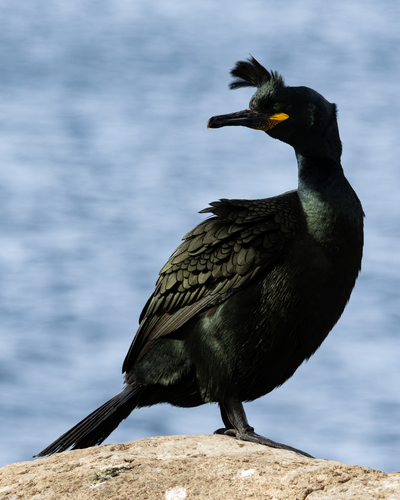 European Shag
In short
The most reliable field mark between Pygmy Cormorant and European Shag is overall structure: Pygmy Cormorant is distinctly smaller and more compact, with a notably longer tail and shorter, stubbier bill, while European Shag is larger, slimmer, and shows a longer, thinner bill and a greenish sheen in adults. Juvenile and immature birds can be especially confusing, but the Pygmy Cormorant's proportionally long tail and lack of a yellow throat patch are key. In flight, the Pygmy Cormorant looks short-necked and long-tailed, while the Shag appears sleeker with a more pointed bill. Habitat can help: Pygmy Cormorant is found inland on lakes and rivers, while Shag is strictly coastal.
Identification tips
- Size and structure: Pygmy Cormorant is distinctly smaller, more compact, and has a proportionally longer tail and shorter neck than European Shag. This is most obvious when perched or in flight.
- Bill shape: Pygmy Cormorant has a short, stubby bill; European Shag has a longer, thinner, more pointed bill. Bill shape is a reliable field mark at all ages.
- Tail length: Pygmy Cormorant's tail is noticeably longer and wedge-shaped, often extending well past the folded wings when perched. Shag's tail is shorter and more squared-off.
- Throat patch: European Shag always shows a yellow throat patch at the base of the bill, even in juveniles. Pygmy Cormorant lacks any yellow on the face or throat at all ages.
- Plumage gloss: Adult Shags have a metallic green sheen to their plumage, especially in breeding season, sometimes called 'green cormorant.' Pygmy Cormorant is matte dark brown-black with no greenish gloss.
- Crest: In breeding season, adult Shags show a small crest on the crown. Pygmy Cormorant never has a crest.
- Underparts (juveniles): Juvenile Shags have darker underparts, while Pygmy Cormorant juveniles are more uniformly brownish-black.
- Perching behavior: Pygmy Cormorant often perches in trees or dense vegetation near water. Shag almost always perches on rocks or cliffs, rarely in trees.
- Habitat: Pygmy Cormorant is found inland on lakes, marshes, and slow rivers; Shag is strictly coastal, on rocky shores and cliffs. Inland sightings are almost always Pygmy Cormorant.
- Flight jizz: Pygmy Cormorant in flight looks short-necked, long-tailed, and compact. Shag is longer-necked, slimmer, and shows a more pointed bill and yellow throat patch if seen well.
- Associations: Pygmy Cormorant is often seen with herons, egrets, and spoonbills in freshwater habitats. Shag is usually with other seabirds on the coast.
- Seasonal context: If seen in winter on a coastal cliff or rocky island, both are possible, but habitat and structure remain reliable. Inland in any season, Shag is extremely unlikely.
- Confusion with Great Cormorant: Both species are smaller and lighter than Great Cormorant, but Shag is slimmer and has a thinner bill than both Great and Pygmy Cormorant.
- Group behavior: Pygmy Cormorant often hunts and perches in groups, sometimes with other waterbirds. Shag is more solitary or in small groups on rocks.
- Pitfalls: Immature Shags may appear dull and dark, but the yellow throat patch and slimmer, longer bill are always present. Pygmy Cormorant never shows yellow on the face or a long, thin bill.
Size
Pygmy Cormorant is much smaller and lighter-built than European Shag. Pygmy Cormorant measures 64–78 cm in length [wikipedia], while European Shag is 68–78 cm long [wikipedia], but the Shag is bulkier with a longer wingspan (95–110 cm). In the field, Pygmy Cormorant appears noticeably more compact and less elongated, with a shorter neck and smaller overall bulk. The Shag's longer, slimmer body and neck, and longer, thinner bill, are apparent when the two are seen side by side.
Plumage
- Juveniles/immatures: Both species are dark overall, but juvenile Shags have darker underparts, while Pygmy Cormorant juveniles lack the yellow throat patch and have a more uniform brownish-black tone. No distinctive upperwing pattern is noted for either species in the sources, so structure and bare part color are more useful for young birds.
- Adults: Pygmy Cormorant is matte dark brown-black overall with no green sheen and lacks any yellow on the face. European Shag adults have a metallic green-tinged sheen (especially in breeding plumage) and a yellow throat patch at all ages. Breeding Shags also show a small crest, absent in Pygmy Cormorant. Tail feathers differ: Pygmy Cormorant's tail is longer and more wedge-shaped, while Shag's is shorter and more squared-off.
- Flight: Pygmy Cormorant in flight looks short-necked and long-tailed, with no obvious pale or yellow on the face. Shag in flight is longer-necked, slimmer, and shows a yellow throat patch if seen well.
Behaviour
Pygmy Cormorant often perches in trees or dense vegetation near inland waters, sometimes in groups, and is frequently seen with herons and egrets. It hunts in groups and is adapted to human-altered wetlands. European Shag is strictly coastal, almost always seen on rocky shores, cliffs, or at sea, and rarely perches in trees. Shags often sit on rocks or low cliffs and are less likely to be seen inland. Both species dive for fish, but Pygmy Cormorant is more likely to be seen in freshwater habitats and perched above water.
Habitat
Habitat is a strong separator: Pygmy Cormorant is found on inland lakes, slow rivers, marshes, and sometimes rice fields or flooded areas with trees and shrubs, avoiding mountainous, cold, or dry regions. It is rarely coastal except in winter, and then prefers estuaries or barrier lakes. European Shag is strictly a marine/coastal species, breeding and wintering on rocky coasts, islands, and sea cliffs of western and southern Europe, southwest Asia, and north Africa. It is not found inland. If you see a cormorant inland, it is almost certainly not a Shag.