

Purple-throated Carib vs Caribbean Martin
Eulampis jugularis versus Progne dominicensis
Play a quiz with Purple-throated Carib and Caribbean Martin
 Purple-throated Carib
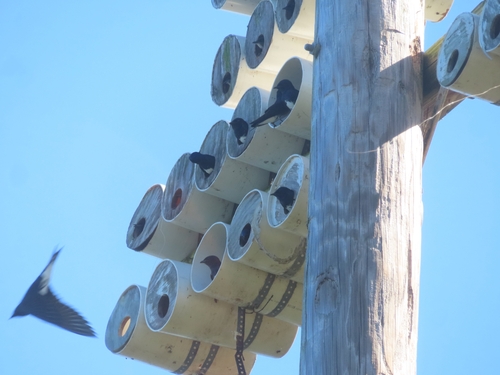 Caribbean Martin
In short
The most reliable field mark to separate Purple-throated Carib from Caribbean Martin is overall structure and plumage: the carib is a compact, short-tailed hummingbird with a decurved bill and brilliant, iridescent colors, while the martin is a large, long-winged swallow with a forked tail and white underparts. Immature Purple-throated Caribs show a distinctive orange throat with red speckles, unlike any martin. In flight, martins are broad-winged and swallow-like, while caribs have rapid, hummingbird-style wingbeats and hover. Bill shape and tail structure are instant giveaways if seen well. Confusion is most likely when seeing a dark bird in fast flight or at a distance, but careful attention to shape and color will resolve the ID.
Identification tips
- Size and shape: Caribbean Martin is much larger and bulkier than Purple-throated Carib. If the bird looks swallow-sized or larger, it's a martin; if it's tiny and hummingbird-shaped, it's a carib.
- Bill shape: Carib has a medium-length, decurved bill (more so in females), specialized for nectar feeding. Martin has a short, broad, flat bill typical of swallows. Bill shape is diagnostic at close range.
- Tail shape: Martin has a distinctly forked tail, especially obvious in flight or when perched. Carib's tail is short and square or slightly rounded, never forked.
- Flight style: Carib hovers and makes rapid, darting flights between flowers; martin glides, soars, and makes sweeping aerial sallies for insects, rarely if ever hovering.
- Plumage - throat and chest: Adult carib has a fiery purplish-red throat and chest (iridescent), while martin never shows red or purple on the throat. Immature carib has an orange throat with red speckles, a unique mark not seen in martins.
- Plumage - underparts: Martin always shows white lower underparts and undertail, even in duller females and juveniles. Carib is dark below with iridescent color, never white.
- Plumage - back and wings: Carib's back is velvety black with bright golden green wings; martin is glossy blue-black above, lacking green or gold tones.
- Sex differences: Both male and female caribs look alike, but female has a longer, more curved bill. In martins, males are glossier blue-black, females/juveniles are duller with more brownish tones.
- Habitat context: Carib is usually seen at flowers in forested or semi-open areas; martin is often in open country, near water, or perched on wires/buildings.
- Perching behavior: Martin perches upright on wires or exposed branches, often in groups. Carib perches more horizontally, usually alone or in loose association with flowers.
- Feeding behavior: Carib feeds at flowers (nectar) and sometimes catches insects; martin is exclusively aerial insectivore, never seen feeding at flowers.
- Vocalizations: Martin gives a gurgly chew-chew call; carib, if heard, would give high-pitched chips or trills, not swallow-like sounds.
- Seasonal context: Both species are present in the Caribbean, but martins may be more likely in open or urban areas, especially near nesting sites.
- Potential pitfalls: At a distance, a martin in strong light may look dark and compact, but the forked tail, white belly, and broad wings will separate it from the carib. Immature carib's orange-speckled throat is unique and diagnostic.
- When in doubt: Focus on bill shape, tail structure, and underpart color. These are the fastest and most reliable ways to separate the two in the field.
Size
Purple-throated Carib is much smaller, measuring 11–12 cm in length and weighing 7–12 g [wikipedia]. Caribbean Martin is a large swallow, about 18.5 cm long and weighing 40 g [wikipedia]. The martin is nearly twice as long and several times heavier, with a much more robust body and longer wings and tail. Even at a distance, the martin's size and proportions are noticeably larger and more elongated than the compact, short-tailed carib.
Plumage
- Immature/juvenile contrast: Immature Purple-throated Caribs have an orange throat and chest with red speckles, which is unique and not seen in any age of Caribbean Martin. Juvenile and female martins are duller than adult males, with grey-brown breast and flanks and white lower underparts, but never show orange or speckled throats.
- Adult contrast: Adult Purple-throated Caribs of both sexes have a velvety black crown and back, fiery purplish-red throat and chest, bright golden green wings, and a metallic greenish-blue tail. The martin adult male is glossy blue-black above with white lower underparts; females and juveniles are duller but always show white on the belly and under the tail. The carib never shows white underparts, and the martin never shows iridescent red or green plumage.
- Wing pattern: No distinctive upperwing panels or trailing edge marks are described for either species, but the martin's wings are broad and suited for gliding, while the carib's are narrower and adapted for hovering.
Behaviour
Purple-throated Carib behaves like a typical hummingbird: it hovers at flowers, feeds on nectar, and occasionally catches small arthropods on the wing or from foliage. Males defend flower territories. Caribbean Martin is a classic swallow, hunting insects on the wing with strong, gliding flight and often seen in flocks. It never hovers or feeds at flowers. Perched, the martin sits upright on wires or branches, while the carib perches more horizontally and is often seen darting between flowers.
Habitat
Purple-throated Carib is found in flowering trees from mid-levels to treetops, often in forested or semi-open areas where nectar is available. Caribbean Martin breeds in cavities in banks, buildings, or old woodpecker holes, and is often seen in open country, near water, or around human settlements. The martin is more likely in open or urban areas, while the carib is usually in more vegetated, flower-rich habitats.
Voice
Caribbean Martin gives a gurgly chew-chew call, typical of swallows. No vocalization is described for Purple-throated Carib in these notes, but hummingbirds generally give high-pitched chips or trills, very different from the martin's swallow-like calls.