

Purple Finch vs Cassin's Finch
Haemorhous purpureus versus Haemorhous cassinii
Play a quiz with Purple Finch and Cassin's Finch
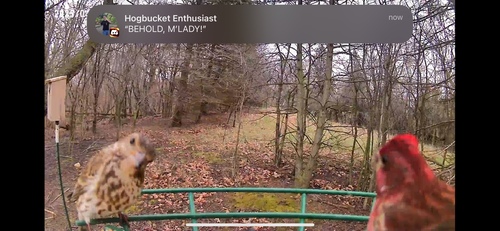 Purple Finch
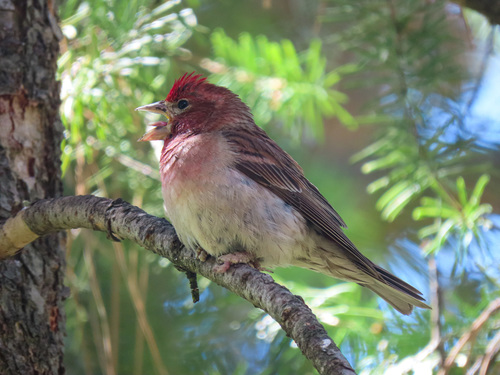 Cassin's Finch
In short
The most reliable field mark between Purple Finch and Cassin's Finch is the bill: Cassin's Finch shows a noticeably longer, more pointed bill, while Purple Finch has a shorter, blunter bill. Adult males of both species are raspberry-red, but Cassin's is usually slightly larger and longer-winged, with less distinct facial markings in females. Female Purple Finches have a bold whitish eyebrow, while female Cassin's Finches have plainer faces. Both species have brown wings and tails, but subtle differences in structure and facial pattern are key, especially in non-breeding or immature birds.
Identification tips
- Bill shape and length: Cassin's Finch has a noticeably longer, more pointed bill; Purple Finch's bill is shorter and blunter. This is the most reliable structural difference, visible even at a distance if the bird is side-on.
- Facial pattern in females/immatures: Female and immature Purple Finches show a strong, crisp white eyebrow (supercilium) and a contrasting dark malar (mustache) stripe. Female Cassin's Finches have a much weaker or absent eyebrow, giving a plainer, less marked face.
- Overall size and structure: Cassin's Finch is slightly larger and longer-winged, but this is often hard to judge unless both species are side by side. Cassin's can look lankier and longer-tailed.
- Male plumage: Both adult males are raspberry-red, but Cassin's may appear brighter or more extensive red. This is variable and not reliable on its own.
- Back streaking: Both species have streaked backs, but the pattern is not a strong separator.
- Underpart streaking: Both females are heavily streaked below, but Purple Finch is more contrasting, with darker and more defined streaks on a whiter background.
- Tail shape: Both have short, forked brown tails; tail shape is not diagnostic.
- Wing and flight pattern: No distinctive upperwing or flight pattern differences are described for any age; do not rely on this feature.
- Habitat context: In the mountains of western North America, especially in high-elevation coniferous forests, Cassin's Finch is much more likely. In the northeast or lowland forests, Purple Finch is expected.
- Subspecies confusion: Western Purple Finches (H. p. californicus) can look darker and have a longer bill, but still show a stronger eyebrow than Cassin's.
- Flock behavior: Cassin's Finch is more likely to be seen in flocks outside the breeding season, but Purple Finches can also form flocks.
- Seasonal movement: Both species can move in winter, but Cassin's is more likely to descend from mountains to lower elevations.
- Voice: No diagnostic vocal differences are provided in the notes; do not rely on song or call for separation in this context.
- Pitfalls: Beware of House Finch confusion (not covered here); always check bill shape and facial pattern first.
- When in doubt: If the facial pattern is bold and contrasting, especially with a strong white eyebrow, lean toward Purple Finch. If the face is plain and the bill is long and pointed, suspect Cassin's Finch.
Size
Cassin's Finch is generally larger: length averages 16 cm (6.3 in) and weight 24–34 g (0.8–1.2 oz), while Purple Finch is 12–16 cm (4.7–6.3 in) and 19.8–28.4 g (0.7–1.0 oz) [wikipedia][avonet]. The difference is subtle in the field, but Cassin's often appears a bit longer and heavier, especially in direct comparison.
Plumage
- Juvenile/Immature/Non-breeding birds: Both species have brown wings and tails, and streaked underparts. No distinctive upperwing or flight pattern differences are described for these ages, so separation relies on facial pattern and structure.
- Adult males: Both are raspberry-red on the head, breast, back, and rump, with streaked backs. Cassin's Finch males may appear slightly brighter or more extensive red, but this is variable and unreliable. Both have brown wings and tails.
- Adult females: Purple Finch females have light brown upperparts and white underparts with strong dark brown streaks, plus a bold white supercilium (eyebrow). Cassin's Finch females are similar but facial markings are less distinct—eyebrow is fainter or absent, and overall face is plainer. Both have streaked underparts, but Purple Finch is more contrasting. Subspecies of Purple Finch (H. p. californicus) can be darker and more greenish, with a longer bill, but still show a stronger eyebrow than Cassin's.
Behaviour
Both species forage in trees and sometimes on the ground, mainly eating seeds, buds, and berries. Cassin's Finch is more likely to be seen in flocks outside the breeding season. No strong behavioral differences are noted for field separation.
Habitat
Purple Finch breeds in northern US, southern Canada, and the west coast, favoring coniferous and mixed forests, and can be found in a wider range of wooded habitats. Cassin's Finch is more strictly associated with coniferous forests in mountainous western North America, nesting in large conifers and moving to lower elevations in winter. Overlap can occur in the west, but Cassin's is much more tied to high-elevation or montane coniferous habitats.