

Motmot

ムラサキマシコ 対 ズアカマシコ

Haemorhous purpureus 対 Haemorhous cassinii

ムラサキマシコとズアカマシコのクイズ
ムラサキマシコ (Haemorhous purpureus) ムラサキマシコ
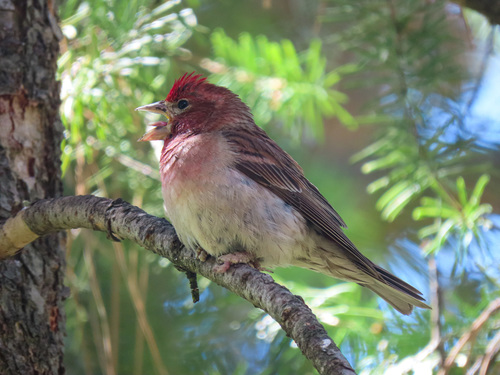
ズアカマシコ (Haemorhous cassinii) ズアカマシコ

メディア

読み込み中…

要点

ムラサキマシコとズアカマシコの最も信頼できるフィールドマークはくちばしです:ズアカマシコは明らかに長く、尖ったくちばしを持ち、ムラサキマシコは短く、鈍いくちばしを持っています。両種の成鳥オスはラズベリー赤ですが、ズアカマシコは通常、わずかに大きく、翼が長く、メスの顔のマーキングはあまりはっきりしていません。メスのムラサキマシコは大胆な白い眉を持ち、メスのズアカマシコはより地味な顔をしています。両種は茶色の翼と尾を持っていますが、構造と顔のパターンの微妙な違いが重要であり、特に非繁殖期や未成熟の鳥において顕著です。

識別のコツ

  1. くちばしの形と長さ: ズアカマシコは明らかに長く、尖ったくちばしを持ち、ムラサキマシコのくちばしは短く、鈍いです。これは最も信頼できる構造的な違いであり、鳥が横から見える場合は遠くからでも確認できます。
  2. メス/未成熟の顔のパターン: メスと未成熟のムラサキマシコは強く、鮮明な白い眉(スーペリシリウム)と対照的な暗いマラール(口ひげ)ストライプを示します。メスのズアカマシコははるかに弱いか、眉がないため、より地味で目立たない顔になります。
  3. 全体的なサイズと構造: ズアカマシコはわずかに大きく、翼が長いですが、両種が並んでいないと判断が難しいことがよくあります。ズアカマシコはより細長く、尾が長く見えることがあります。
  4. オスの羽毛: 両方の成鳥オスはラズベリー赤ですが、ズアカマシコはより明るく、広範囲に赤く見えることがあります。これは変動があり、単独では信頼できません。
  5. 背中の縞模様: 両種は縞模様のある背中を持っていますが、パターンは強い区別要因ではありません。
  6. 腹部の縞模様: 両メスは下部が強く縞模様になっていますが、ムラサキマシコはより対照的で、白い背景に暗く、より明確な縞模様があります。
  7. 尾の形: 両方とも短く、分かれた茶色の尾を持っています;尾の形は診断的ではありません。
  8. 翼と飛行パターン: いかなる年齢においても、特異な上翼や飛行パターンの違いは記載されていません;この特徴に頼らないでください。
  9. 生息地の文脈: 北アメリカ西部の山々、特に高地の針葉樹林では、ズアカマシコがはるかに見られる可能性が高いです。北東部や低地の森林では、ムラサキマシコが期待されます。
  10. 亜種の混乱: 西部のムラサキマシコ(H. p. californicus)はより暗く見え、くちばしが長くなることがありますが、それでもズアカマシコよりも強い眉を示します。
  11. 群れの行動: ズアカマシコは繁殖期以外に群れで見られる可能性が高いですが、ムラサキマシコも群れを形成することがあります。
  12. 季節的移動: 両種は冬に移動することがありますが、ズアカマシコは山から低地に降りる可能性が高いです。
  13. 声: ノートには診断的な声の違いは提供されていません;この文脈での区別には歌や鳴き声に頼らないでください。
  14. 落とし穴: ハウスマシコの混乱に注意してください(ここではカバーされていません);まずくちばしの形と顔のパターンを確認してください。
  15. 疑わしい場合: 顔のパターンが大胆で対照的であり、特に強い白い眉がある場合は、ムラサキマシコに傾いてください。顔が地味でくちばしが長く尖っている場合は、ズアカマシコを疑ってください。

大きさ

ズアカマシコは一般的に大きいです:長さは平均16 cm(6.3 in)、体重は24–34 g(0.8–1.2 oz)で、ムラサキマシコは12–16 cm(4.7–6.3 in)、19.8–28.4 g(0.7–1.0 oz)です [wikipedia][avonet]。フィールドでの違いは微妙ですが、ズアカマシコはしばしば少し長く、重く見えます、特に直接比較するときに。

羽色

行動

両種は木の中や時には地面で採餌し、主に種、芽、ベリーを食べます。ズアカマシコは繁殖期以外に群れで見られる可能性が高いです。フィールドでの区別のための強い行動の違いは記載されていません。

生息環境

ムラサキマシコは北米北部、カナダ南部、西海岸で繁殖し、針葉樹林や混合林を好み、より広範な森林生息地に見られます。ズアカマシコは北米西部の山岳地帯の針葉樹林に厳密に関連しており、大きな針葉樹に巣を作り、冬には低地に移動します。西部では重複が発生することがありますが、ズアカマシコは高地または山岳の針葉樹生息地に非常に結びついています。

より良い説明を送る

比較と同じ項目を使ってください。文章はすぐに公開されます。

The most reliable field mark between Purple Finch and Cassin's Finch is the bill: Cassin's Finch shows a noticeably longer, more pointed bill, while Purple Finch has a shorter, blunter bill. Adult males of both species are raspberry-red, but Cassin's is usually slightly larger and longer-winged, with less distinct facial markings in females. Female Purple Finches have a bold whitish eyebrow, while female Cassin's Finches have plainer faces. Both species have brown wings and tails, but subtle differences in structure and facial pattern are key, especially in non-breeding or immature birds.

  1. Bill shape and length: Cassin's Finch has a noticeably longer, more pointed bill; Purple Finch's bill is shorter and blunter. This is the most reliable structural difference, visible even at a distance if the bird is side-on.
  2. Facial pattern in females/immatures: Female and immature Purple Finches show a strong, crisp white eyebrow (supercilium) and a contrasting dark malar (mustache) stripe. Female Cassin's Finches have a much weaker or absent eyebrow, giving a plainer, less marked face.
  3. Overall size and structure: Cassin's Finch is slightly larger and longer-winged, but this is often hard to judge unless both species are side by side. Cassin's can look lankier and longer-tailed.
  4. Male plumage: Both adult males are raspberry-red, but Cassin's may appear brighter or more extensive red. This is variable and not reliable on its own.
  5. Back streaking: Both species have streaked backs, but the pattern is not a strong separator.
  6. Underpart streaking: Both females are heavily streaked below, but Purple Finch is more contrasting, with darker and more defined streaks on a whiter background.
  7. Tail shape: Both have short, forked brown tails; tail shape is not diagnostic.
  8. Wing and flight pattern: No distinctive upperwing or flight pattern differences are described for any age; do not rely on this feature.
  9. Habitat context: In the mountains of western North America, especially in high-elevation coniferous forests, Cassin's Finch is much more likely. In the northeast or lowland forests, Purple Finch is expected.
  10. Subspecies confusion: Western Purple Finches (H. p. californicus) can look darker and have a longer bill, but still show a stronger eyebrow than Cassin's.
  11. Flock behavior: Cassin's Finch is more likely to be seen in flocks outside the breeding season, but Purple Finches can also form flocks.
  12. Seasonal movement: Both species can move in winter, but Cassin's is more likely to descend from mountains to lower elevations.
  13. Voice: No diagnostic vocal differences are provided in the notes; do not rely on song or call for separation in this context.
  14. Pitfalls: Beware of House Finch confusion (not covered here); always check bill shape and facial pattern first.
  15. When in doubt: If the facial pattern is bold and contrasting, especially with a strong white eyebrow, lean toward Purple Finch. If the face is plain and the bill is long and pointed, suspect Cassin's Finch.

Cassin's Finch is generally larger: length averages 16 cm (6.3 in) and weight 24–34 g (0.8–1.2 oz), while Purple Finch is 12–16 cm (4.7–6.3 in) and 19.8–28.4 g (0.7–1.0 oz) [wikipedia][avonet]. The difference is subtle in the field, but Cassin's often appears a bit longer and heavier, especially in direct comparison.

  • Juvenile/Immature/Non-breeding birds: Both species have brown wings and tails, and streaked underparts. No distinctive upperwing or flight pattern differences are described for these ages, so separation relies on facial pattern and structure.
  • Adult males: Both are raspberry-red on the head, breast, back, and rump, with streaked backs. Cassin's Finch males may appear slightly brighter or more extensive red, but this is variable and unreliable. Both have brown wings and tails.
  • Adult females: Purple Finch females have light brown upperparts and white underparts with strong dark brown streaks, plus a bold white supercilium (eyebrow). Cassin's Finch females are similar but facial markings are less distinct—eyebrow is fainter or absent, and overall face is plainer. Both have streaked underparts, but Purple Finch is more contrasting. Subspecies of Purple Finch (H. p. californicus) can be darker and more greenish, with a longer bill, but still show a stronger eyebrow than Cassin's.

Both species forage in trees and sometimes on the ground, mainly eating seeds, buds, and berries. Cassin's Finch is more likely to be seen in flocks outside the breeding season. No strong behavioral differences are noted for field separation.

Purple Finch breeds in northern US, southern Canada, and the west coast, favoring coniferous and mixed forests, and can be found in a wider range of wooded habitats. Cassin's Finch is more strictly associated with coniferous forests in mountainous western North America, nesting in large conifers and moving to lower elevations in winter. Overlap can occur in the west, but Cassin's is much more tied to high-elevation or montane coniferous habitats.

変更を破棄しますか?

保存していない編集があります。今離れると失われます。

ムラサキマシコ · ズアカマシコ · 苦手な鳥