

purple finch vs cassin's finch
Haemorhous purpureus versus Haemorhous cassinii
Jogue um quiz com purple finch e cassin's finch
 purple finch
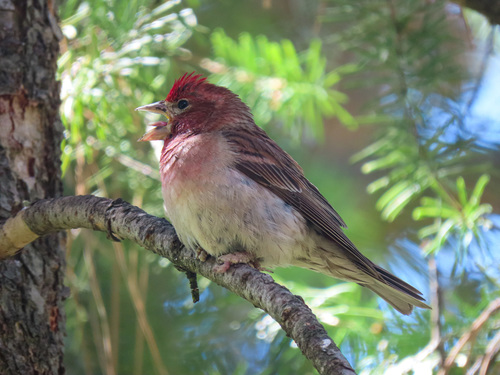 cassin's finch
Em resumo
A marca de campo mais confiável entre o purple finch e o cassin's finch é o bico: o cassin's finch apresenta um bico visivelmente mais longo e mais pontudo, enquanto o purple finch tem um bico mais curto e mais grosso. Os machos adultos de ambas as espécies são vermelho-framboesa, mas o cassin's é geralmente um pouco maior e com asas mais longas, com marcas faciais menos distintas nas fêmeas. As fêmeas do purple finch têm uma sobrancelha branca ousada, enquanto as fêmeas do cassin's finch têm rostos mais simples. Ambas as espécies têm asas e caudas marrons, mas diferenças sutis na estrutura e no padrão facial são fundamentais, especialmente em aves não reprodutoras ou imaturas.
Dicas de identificação
- Formato e comprimento do bico: O cassin's finch tem um bico visivelmente mais longo e mais pontudo; o bico do purple finch é mais curto e grosso. Esta é a diferença estrutural mais confiável, visível mesmo à distância se a ave estiver de lado.
- Padrão facial em fêmeas/imaturas: As fêmeas e imaturas do purple finch mostram uma sobrancelha branca forte e nítida (supercílios) e uma faixa malar (bigode) escura contrastante. As fêmeas do cassin's finch têm uma sobrancelha muito mais fraca ou ausente, dando um rosto mais simples e menos marcado.
- Tamanho e estrutura geral: O cassin's finch é ligeiramente maior e com asas mais longas, mas isso muitas vezes é difícil de julgar, a menos que ambas as espécies estejam lado a lado. O cassin's pode parecer mais esguio e com cauda mais longa.
- Plumagem dos machos: Ambos os machos adultos são vermelho-framboesa, mas o cassin's pode parecer mais brilhante ou ter um vermelho mais extenso. Isso é variável e não confiável por si só.
- Listras nas costas: Ambas as espécies têm costas listradas, mas o padrão não é um separador forte.
- Listras na parte inferior: Ambas as fêmeas são fortemente listradas na parte inferior, mas o purple finch é mais contrastante, com listras mais escuras e definidas em um fundo mais claro.
- Formato da cauda: Ambas têm caudas marrons curtas e bifurcadas; o formato da cauda não é diagnóstico.
- Padrão de asas e voo: Nenhuma diferença distinta no padrão de asas ou de voo é descrita para qualquer idade; não confie nesta característica.
- Contexto de habitat: Nas montanhas do oeste da América do Norte, especialmente em florestas coníferas de alta elevação, o cassin's finch é muito mais provável. No nordeste ou em florestas de planície, espera-se o purple finch.
- Confusão de subespécies: Os purple finches ocidentais (H. p. californicus) podem parecer mais escuros e ter um bico mais longo, mas ainda mostram uma sobrancelha mais forte do que o cassin's.
- Comportamento em bandos: O cassin's finch é mais provável de ser visto em bandos fora da temporada de reprodução, mas os purple finches também podem formar bandos.
- Movimento sazonal: Ambas as espécies podem se mover no inverno, mas o cassin's é mais provável de descer das montanhas para altitudes mais baixas.
- Voz: Nenhuma diferença vocal diagnóstica é fornecida nas notas; não confie em canções ou chamadas para separação neste contexto.
- Armadilhas: Cuidado com a confusão com o house finch (não abordado aqui); sempre verifique primeiro o formato do bico e o padrão facial.
- Quando em dúvida: Se o padrão facial for ousado e contrastante, especialmente com uma sobrancelha branca forte, incline-se para o purple finch. Se o rosto for simples e o bico for longo e pontudo, suspeite do cassin's finch.
Tamanho
O cassin's finch é geralmente maior: o comprimento médio é de 16 cm (6,3 in) e o peso de 24–34 g (0,8–1,2 oz), enquanto o purple finch mede 12–16 cm (4,7–6,3 in) e 19,8–28,4 g (0,7–1,0 oz) [wikipedia][avonet]. A diferença é sutil em campo, mas o cassin's frequentemente parece um pouco mais longo e pesado, especialmente em comparação direta.
Plumagem
- Aves juvenis/imaturas/não reprodutoras: Ambas as espécies têm asas e caudas marrons, e partes inferiores listradas. Nenhuma diferença distinta no padrão de asas ou de voo é descrita para essas idades, portanto, a separação depende do padrão facial e da estrutura.
- Machos adultos: Ambos são vermelho-framboesa na cabeça, peito, costas e rabo, com costas listradas. Os machos do cassin's finch podem parecer ligeiramente mais brilhantes ou ter um vermelho mais extenso, mas isso é variável e não confiável. Ambos têm asas e caudas marrons.
- Fêmeas adultas: As fêmeas do purple finch têm partes superiores marrons claras e partes inferiores brancas com listras escuras marrons fortes, além de um supercílios (sobrancelha) branco ousado. As fêmeas do cassin's finch são semelhantes, mas as marcas faciais são menos distintas—o supercílios é mais fraco ou ausente, e o rosto geral é mais simples. Ambas têm partes inferiores listradas, mas o purple finch é mais contrastante. Subespécies do purple finch (H. p. californicus) podem ser mais escuras e mais esverdeadas, com um bico mais longo, mas ainda mostram uma sobrancelha mais forte do que o cassin's.
Comportamento
Ambas as espécies forrageiam em árvores e às vezes no chão, principalmente comendo sementes, brotos e frutas. O cassin's finch é mais provável de ser visto em bandos fora da temporada de reprodução. Nenhuma diferença comportamental forte é notada para separação em campo.
Habitat
O purple finch se reproduz no norte dos EUA, sul do Canadá e na costa oeste, favorecendo florestas coníferas e mistas, e pode ser encontrado em uma gama mais ampla de habitats florestais. O cassin's finch está mais estritamente associado a florestas coníferas em montanhas do oeste da América do Norte, nidificando em grandes coníferas e se movendo para altitudes mais baixas no inverno. A sobreposição pode ocorrer no oeste, mas o cassin's está muito mais ligado a habitats coníferos de alta elevação ou montanhosos.