

Piratic Flycatcher vs Variegated Flycatcher
Legatus leucophaius versus Empidonomus varius
Play a quiz with Piratic Flycatcher and Variegated Flycatcher
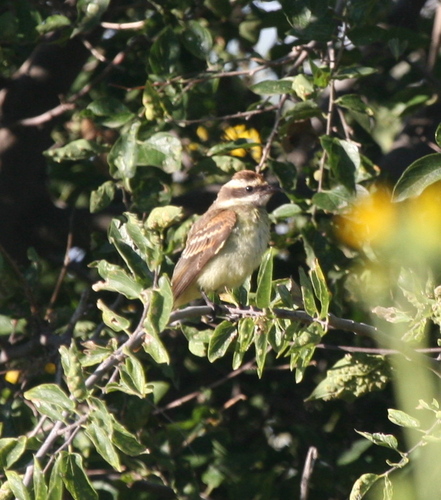 Piratic Flycatcher
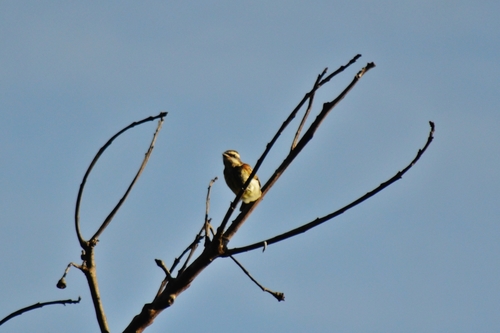 Variegated Flycatcher
In short
The most reliable field mark between Piratic Flycatcher and Variegated Flycatcher is the pattern and color of the wing coverts and tail edges, especially in juveniles and perched birds. Juvenile Piratic Flycatchers show wide cinnamon edges on the wing coverts and rusty edges to the tail, while juvenile Variegated Flycatchers have wide white edges on the coverts and rufous tail edges. Adults of both species have a hidden yellow crown patch and similar overall shape, but Variegated Flycatcher is distinctly larger and has a more mottled, streaked upperpart appearance. Subtle differences in underpart streaking, bill color, and supercilium shape also help separate them, but beware of overlap in posture and general coloration.
Identification tips
- Juvenile wing and tail edges: Look for wide cinnamon edges on the wing coverts and rusty tail edges in juvenile Piratic Flycatcher; Variegated juveniles have wide white edges on the coverts and rufous tail edges. These marks are most visible on perched birds or in good flight views.
- Upperpart pattern: Adult Variegated Flycatcher shows a distinctly mottled or streaked upperpart appearance due to pale whitish streaks, while Piratic Flycatcher is more uniformly dark grayish-brown or olive-brown with only pale feather edges.
- Tail color and edges: Variegated Flycatcher has a dark brown or blackish tail with rufous feather edges; Piratic Flycatcher has a dusky brown or blackish brown tail with lighter (not rufous) edges, sometimes only on the inner webs.
- Supercilium shape: Both species have a broad whitish supercilium, but in Piratic Flycatcher it is duller and wraps under the crown, with faint grayish streaks to the rear; in Variegated, it is longer and extends almost around the nape, often appearing more prominent.
- Crown patch: Both have a mostly hidden yellow crown patch in adults, but this is rarely visible in the field. Juveniles of both species lack the yellow crown patch.
- Underpart streaking: Piratic Flycatcher has bold, wide brownish or olive streaks on the breast, sides, and flanks; Variegated Flycatcher has much less distinct streaking, mainly on the breast and sides, and juveniles are unstreaked below.
- Bill color: Piratic Flycatcher has a short, wide, stubby bill that is mostly brownish black with a browner base to the mandible. Variegated Flycatcher has a blackish bill with a pale pinkish base to the mandible; this can be subtle but may help in close views.
- Cheek and face pattern: Piratic Flycatcher has white cheeks with dusky lores, ear coverts, and a moustachial stripe. Variegated Flycatcher has whitish cheeks with a wide dusky band below them and a wide dusky band from the lores to the ear coverts, giving a more contrasted facial pattern.
- Leg color: Both have dark legs and feet, not a useful separator.
- Size and structure: Variegated Flycatcher is larger and often appears bulkier and longer-tailed than Piratic Flycatcher, but beware of overlap and posture effects.
- Jizz in flight: Both species sally for insects from exposed perches; Variegated may appear more elongated in flight due to its larger size and longer tail.
- Seasonal presence: In Mexico and Central America, Piratic Flycatcher is absent in winter (late September to January), so a flycatcher with these features in that season is more likely Variegated (though both are rare as vagrants in the US).
- Habitat overlap: Both species use similar habitats, so context is not a strong separator except at range edges.
- Juvenile underparts: Juvenile Piratic Flycatchers are paler below with few or no streaks, while juvenile Variegated Flycatchers are also unstreaked but may appear even paler and less marked overall.
- Subspecies variation: Subspecies of Piratic Flycatcher (L. l. variegatus) can be significantly larger, and Variegated Flycatcher subspecies (E. v. rufinus) is smaller and paler above with more olivaceous streaks and less bold underpart streaking. These differences are subtle and best used in combination with other marks.
Size
Variegated Flycatcher is noticeably larger than Piratic Flycatcher, with a length of 18–19 cm compared to Piratic's 14.5–17 cm. Piratic Flycatcher weighs about 23 g, while Variegated Flycatcher is around 25 g. In the field, Variegated often appears bulkier and longer-tailed, but size alone can be misleading if not seen side-by-side.
Plumage
- Juveniles: Piratic Flycatcher juveniles lack the yellow crown patch, have light cinnamon tips on the crown feathers, a buffy supercilium, wide cinnamon edges on the wing coverts, rusty edges on the tail, and paler, less streaked underparts. Variegated Flycatcher juveniles also lack the yellow crown patch but have unstreaked underparts and wide white edges on the wing coverts and flight feathers, with rufous tail edges.
- Adults: Both species have a blackish crown with a mostly hidden yellow patch, a broad whitish supercilium, and dark upperparts. Piratic Flycatcher upperparts are dark grayish-brown or olive-brown with pale feather edges, while Variegated Flycatcher has a more mottled or streaked appearance due to pale whitish streaks on the upperparts. Variegated's rump and uppertail coverts are rufous, and the tail has rufous feather edges; Piratic's uppertail coverts have rusty or cinnamon edges, and the tail is dusky brown with lighter edges. Underpart streaking is bolder and more extensive on Piratic (broad brownish or olive streaks on breast, sides, flanks) than on Variegated (indistinct streaks, mostly on breast and sides).
Behaviour
Both species perch openly and sally for insects, but Variegated Flycatcher is more likely to join mixed-species flocks and may be seen foraging at mid-levels or in treetops. Piratic Flycatcher is a partial migrant and may be absent from some areas in winter, while Variegated is more consistently present in its range. Both can be seen hawking insects from exposed perches, but Variegated may also take fruit, especially when migrating.
Habitat
Both species overlap widely in range and habitat, being found from Mexico and Trinidad through most of South America (except Chile). Both use open woodlands, forest edges, and semi-open habitats. Piratic Flycatcher is a partial migrant in Central America and Mexico, vacating these areas in the non-breeding season, while Variegated Flycatcher is more resident but also migrates within South America. Habitat is not a strong separator except at the edges of their ranges or in migration.
Piratic Flycatcher · Variegated Flycatcher · My Tricky Birds