
Pink-necked Green-Pigeon vs Yellow-footed Green-Pigeon
Treron vernans versus Treron phoenicopterus
Play a quiz with Pink-necked Green-Pigeon and Yellow-footed Green-Pigeon
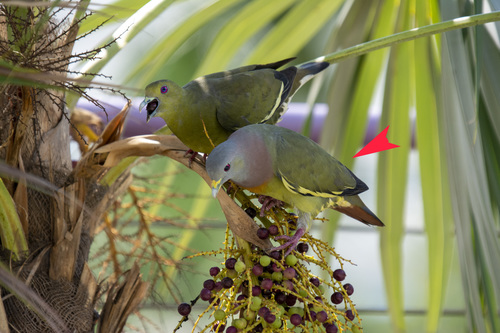 Pink-necked Green-Pigeon
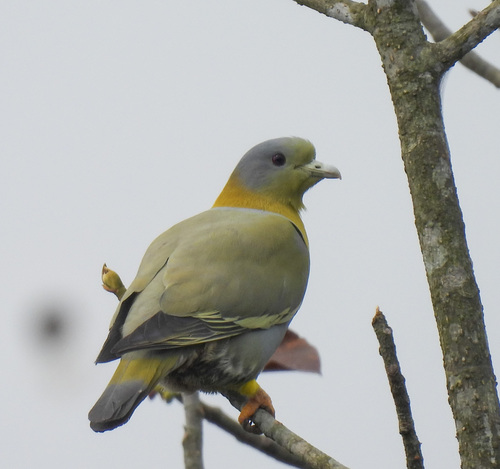 Yellow-footed Green-Pigeon
In short
The most reliable field mark between Pink-necked and Yellow-footed Green-Pigeon is the male Pink-necked’s unique pink neck and orange breast, which is never shown by Yellow-footed. In flight, Pink-necked of all ages shows a distinct yellow bar across the wing, while Yellow-footed lacks this feature. Females and immatures are trickier: both are greenish, but Pink-necked is smaller and has a yellowish belly and face, while Yellow-footed is bulkier with striking yellow legs and feet. If you see the legs well, Yellow-footed’s bright yellow is diagnostic. Both are green pigeons, but their ranges overlap only in parts of Southeast Asia, so location can help. Structure and subtle plumage differences can clinch the ID even when the classic male Pink-necked is not present.
Identification tips
- Male Pink-necked’s pink neck and orange breast are unique: If you see a pigeon with a pink neck and orange lower breast, it is a male Pink-necked. Yellow-footed never shows these colors on the neck or breast.
- Yellow bar across the wing (in flight): All ages and sexes of Pink-necked show a yellow bar across the wing (from yellow-edged tertials) in flight. Yellow-footed never shows this bar; its wings are more uniformly green.
- Leg color (perched birds): Yellow-footed has bright yellow or yellow-orange legs and feet, very obvious when perched and diagnostic if seen well. Pink-necked’s legs are pink or reddish, never yellow.
- Size and structure: Yellow-footed is larger and bulkier, with a longer body and tail. Pink-necked is smaller, more compact, and lighter.
- Female and immature confusion: Female and juvenile Pink-necked are greenish with a yellowish belly, throat, and face, and a greenish crown/nape. Juveniles are greyer above. Yellow-footed females and immatures are more uniform green above and below, and always have yellow legs.
- Tail pattern: Pink-necked has a grey tail with a black terminal band and chestnut uppertail coverts. Yellow-footed’s tail is less distinctly marked.
- Head color: Male Pink-necked has a grey head; female Pink-necked has a greenish crown and nape. Yellow-footed adults have a bluish-grey or greyish crown and nape, and a yellowish-green forehead and throat.
- Habitat and range: If in India or western Southeast Asia, especially in drier or more wooded habitats, Yellow-footed is more likely. In the Malay Peninsula, Greater Sundas, or the Philippines, especially in gardens or urban parks, Pink-necked is the default.
- Behavior: Both species are often in small flocks and feed on fruit, so behavior is not a strong separator.
- Bill color: Pink-necked’s bill is white, pale blue-green or grey; Yellow-footed’s bill color is not diagnostic here.
- Voice: Both are quiet, but Pink-necked may give a tri-syllabic whistle ending in a coo; not a reliable field mark.
- Sexual dimorphism: Only Pink-necked shows strong sexual dimorphism (males with pink/orange, females greenish); Yellow-footed is less dimorphic, with both sexes similar.
- Pitfalls: Immature Pink-necked can look very similar to Yellow-footed females, but check for size, yellow wing bar (in flight), and leg color.
- When marks fail: If you cannot see the legs or the bird is in poor light, focus on size, wing bar in flight, and any hint of pink/orange on the breast or neck.
- Local abundance: In urban parks and gardens in Southeast Asia, Pink-necked is often abundant and approachable; Yellow-footed is more likely in less urban, wooded settings.
Size
Yellow-footed Green-Pigeon is noticeably larger, reaching about 33 cm in length, while Pink-necked is medium-sized at 25–30 cm. This size difference is apparent in direct comparison, with Yellow-footed looking bulkier and longer-tailed. Pink-necked is also lighter in weight (105–160 g) compared to Yellow-footed (not specified here, but consistently described as larger and heavier in the genus).
Plumage
- Juvenile/Immature/Female: Both species are greenish, but Pink-necked (especially females and juveniles) is smaller, with a yellowish belly, throat, and face, and a greenish crown and nape. Juvenile Pink-necked are greyer above than adults. Yellow-footed is more uniform green above, but the most striking feature is its bright yellow or yellow-orange legs and feet, visible when perched or sometimes in flight.
- Adult Male: Male Pink-necked is unmistakable with a grey head, pink neck and upper breast, and orange lower breast, plus a yellow bar across the wing in flight. Yellow-footed males lack any pink or orange on the neck or breast, instead showing a bluish-grey crown/nape, yellowish-green forehead/throat, and a broad yellow or olive-yellow collar.
- Wing Pattern (all ages): Pink-necked shows a yellow bar across the wing (from yellow-edged tertials) in flight, which Yellow-footed lacks. Both have green wings, but Yellow-footed’s are more uniform without the yellow bar.
- Tail: Pink-necked has a grey tail with a black terminal band and chestnut uppertail coverts; Yellow-footed’s tail is less distinctly marked.
Behaviour
Both species are usually seen in small groups or flocks, often feeding on fruit in trees. Pink-necked is more likely to be seen in open areas, gardens, and city parks, while Yellow-footed is often in wooded or forest-edge habitats. Both can be approachable and are not particularly shy. No major behavioral differences are diagnostic in the field.
Habitat
Pink-necked Green-Pigeon is widespread in Southeast Asia, favoring lowland forests, forest edges, mangroves, gardens, plantations, and even urban parks. Yellow-footed Green-Pigeon is common in the Indian subcontinent and parts of Southeast Asia, usually in wooded habitats, forest edges, and groves, but less often in dense urban areas. If you are in India or western Southeast Asia, Yellow-footed is more likely; in the Malay Peninsula, Greater Sundas, or the Philippines, Pink-necked predominates.
Voice
Both species are generally quiet and not very vocal. Pink-necked Green-Pigeon produces a tri-syllabic whistling call ending in a coo, and sometimes a rasping "krrak krrak"; it is not known for persistent cooing. Yellow-footed’s calls are not described in detail here, but are not a primary field mark for separation.
Pink-necked Green-Pigeon · Yellow-footed Green-Pigeon · My Tricky Birds