

Pink-necked Green-Pigeon vs Orange-breasted Green-Pigeon
Treron vernans versus Treron bicinctus
Play a quiz with Pink-necked Green-Pigeon and Orange-breasted Green-Pigeon
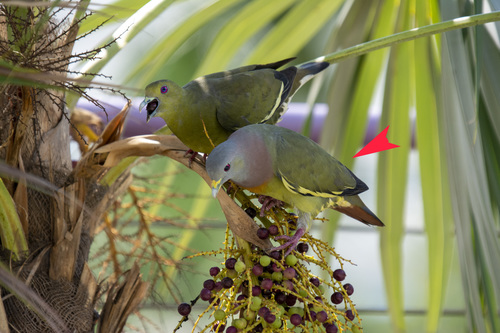 Pink-necked Green-Pigeon
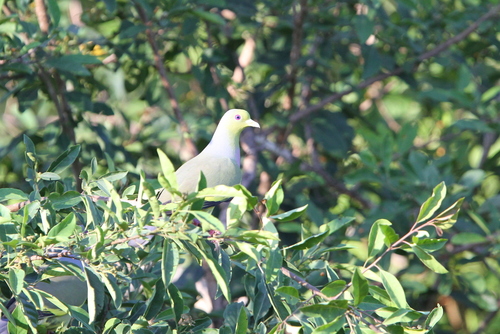 Orange-breasted Green-Pigeon
In short
The most reliable field mark between Pink-necked and Orange-breasted Green-Pigeons is the male's head and breast coloration: male Pink-necked has a grey head and pinkish neck, while male Orange-breasted lacks grey on the head and shows a lilac and orange breast band. In flight, Pink-necked shows a yellow bar across the wing (from yellow-edged tertials), which Orange-breasted lacks. Females and immatures are trickier, but Pink-necked females have a greenish crown and yellowish face, while Orange-breasted females are yellow below with a yellowish-green crown. Both species are medium-sized green pigeons, but Orange-breasted is heavier on average. Habitat overlap is possible in Southeast Asia, but Pink-necked is more urban and coastal, while Orange-breasted prefers forested areas. Calls are not especially distinctive in the field, but Pink-necked is less vocal overall.
Identification tips
- Male head and breast color: Male Pink-necked has a grey head and pinkish neck/upper breast, with orange lower breast; male Orange-breasted has a yellowish-green crown, no grey on the head, and a narrow lilac band above a broad orange band on the breast. This is the most reliable mark for adult males.
- Female face and crown: Female Pink-necked shows a greenish crown and yellowish face/throat; female Orange-breasted has a yellowish-green crown but is bright yellow below, lacking the orange/lilac breast bands.
- Wing pattern in flight: Pink-necked (all ages) shows a yellow bar across the wing (from yellow-edged tertials), especially visible in flight; Orange-breasted lacks this yellow wing bar.
- Tail and uppertail coverts: Pink-necked has chestnut uppertail coverts; Orange-breasted's are bronzed, and its undertail coverts are cinnamon (with greenish spots in females).
- Upper tail color in females: Orange-breasted females have central tail feathers slaty grey, a subtle but useful mark when seen well.
- Juvenile plumage: Both species' juveniles resemble females, but Pink-necked juveniles are greyer above, which may help if seen closely.
- Bill and leg color: Pink-necked has a white, pale blue-green, or grey bill and pink/reddish legs; Orange-breasted's bill/leg color is not highlighted as distinctive in the sources.
- Size: Orange-breasted is heavier (175 g vs. up to 160 g for Pink-necked), but length is similar; size is only useful with direct comparison.
- Habitat context: Pink-necked is common in urban, coastal, and open habitats, often in gardens and plantations; Orange-breasted is more strictly a forest bird, rarely urban.
- Behavior: Orange-breasted may be seen feeding on the ground or slowly walking along branches; Pink-necked is more likely to be seen in flocks in open areas.
- Vocalization: Calls are not reliably separable in the field; both are generally quiet.
- Sexual dimorphism: Both species are sexually dimorphic, but the male's head and breast coloration is the quickest way to separate them when sex is known.
- No maroon on wing: Orange-breasted lacks maroon on the wing, but so does Pink-necked; this mark is more useful to separate other Treron species.
- Overlap and range: If in the Indian subcontinent or deep forest, Orange-breasted is more likely; in urban Southeast Asia, Pink-necked is the default.
- Pitfalls: Immature and female birds are most easily confused; focus on face, crown, and underpart color, and look for the yellow wing bar in flight for Pink-necked.
Size
Orange-breasted Green-Pigeon is heavier (average adult mass ~175 g [wikidata]) than Pink-necked Green-Pigeon (105–160 g [wikipedia]), though both are medium-sized pigeons. Length is similar (Pink-necked: 25–30 cm), so size alone is not a strong field mark unless birds are side-by-side. Structure is not highlighted as diagnostic in the sources.
Plumage
-
Juvenile/immature birds: Both species' juveniles resemble adult females, but Pink-necked juveniles are greyer above. No unique upperwing pattern for immatures is described for Orange-breasted; Pink-necked's yellow-edged tertials (creating a yellow bar in flight) may be visible even in young birds, but this is best confirmed in adults.
-
Adult males: Pink-necked males have a grey head, pinkish neck/upper breast, and orange lower breast, with a yellow bar across the wing in flight. Orange-breasted males lack grey on the head, have a yellowish-green crown, a lilac band on the upper breast, and a broader orange band below. Both have green wings, but Orange-breasted lacks maroon on the wing and does not show the yellow wing bar.
-
Adult females: Pink-necked females are smaller, with a yellowish belly, throat, and face, and a greenish crown and nape. Orange-breasted females are yellow below, lack the orange/lilac breast bands, and have a yellowish-green crown. Their undertail coverts are cinnamon with greenish spots (vs. chestnut uppertail coverts in Pink-necked). Upper tail in Orange-breasted females has central feathers slaty grey.
-
Tail: Both have grey tails with a broad subterminal dark band, but Pink-necked has chestnut uppertail coverts, while Orange-breasted's are bronzed.
Behaviour
Both species forage quietly in trees, often in pairs or small groups. Orange-breasted is noted for slow, deliberate movement along branches and sometimes feeds on the ground. Pink-necked is more often seen in open areas, gardens, and urban environments, sometimes in larger flocks. Flight style is typical for pigeons: fast and direct with regular wingbeats. Male Orange-breasted Green-Pigeons may be seen fighting during breeding season, slapping with wings and pecking.
Habitat
Pink-necked Green-Pigeon is common in Southeast Asia, especially in lowland and coastal areas, and adapts well to gardens, plantations, and urban settings. It is often found at forest edges and in mangroves, rarely deep in dense forest. Orange-breasted Green-Pigeon prefers forested habitats, including the Terai, lower Himalayas, Western and Eastern Ghats, and Sri Lankan forests, generally below 1,500 m. Its range extends from the Indian subcontinent into Southeast Asia, but it is less urban and more tied to forest than Pink-necked. Overlap is possible in Thailand, Malaysia, and parts of Indonesia, but context can help: city parks and coastal gardens favor Pink-necked; interior forests favor Orange-breasted.
Voice
Neither species is especially vocal. Pink-necked Green-Pigeon is generally quiet, calling mainly at communal roosts or when food is found; its call is a tri-syllabic whistle ending in a coo, or a rasping 'krrak krrak'. Orange-breasted Green-Pigeon gives a low, subdued series of modulated wandering whistles. In practice, calls are not the most reliable field marks for separation.
Pink-necked Green-Pigeon · Orange-breasted Green-Pigeon · My Tricky Birds