

Pink-necked Green-Pigeon vs Mindanao Jungle Flycatcher
Treron vernans versus Vauriella goodfellowi
Play a quiz with Pink-necked Green-Pigeon and Mindanao Jungle Flycatcher
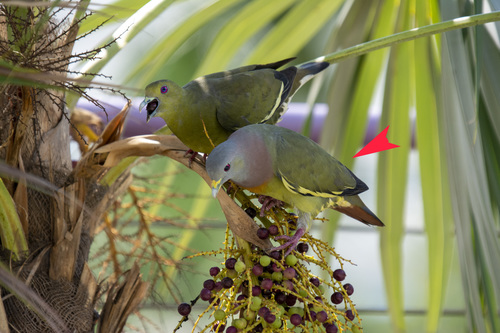 Pink-necked Green-Pigeon
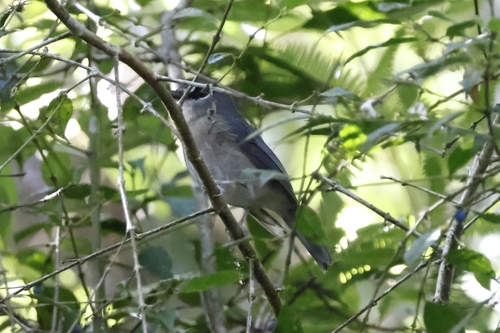 Mindanao Jungle Flycatcher
In short
The most reliable field mark to separate Pink-necked Green-Pigeon from Mindanao Jungle Flycatcher is overall structure and color: the pigeon is a robust, medium-sized, green-plumaged bird with a thick bill and, in males, a striking pink neck, while the flycatcher is much smaller, slender, and brownish-gray with a pale belly, white spectacles, and a fine, hooked bill. In flight, the pigeon shows a yellow bar across the wing (from yellow-edged tertials), which is never present on the flycatcher. Juvenile pigeons may lack the male's pink neck but remain bulkier and greener than the flycatcher. The two species differ dramatically in jizz, habitat, and voice, with the pigeon often in open lowland areas and the flycatcher restricted to montane Mindanao forests.
Identification tips
- Size and shape: Pink-necked Green-Pigeon is much larger and bulkier than Mindanao Jungle Flycatcher. Even a female or juvenile pigeon is noticeably more robust than the flycatcher, which is slender and upright.
- Bill shape: The pigeon has a thick, pale bill (white, blue-green, or grey), while the flycatcher has a small, black bill with a hooked tip. Bill color and shape are visible at close range.
- Leg color: Both species may show pinkish legs, but this is not a strong separator. Focus on other marks.
- Male Pink-necked Green-Pigeon: Only the male pigeon has a pink neck and upper breast with orange lower breast—never seen in the flycatcher. If you see pink or orange on the neck/breast, it's the pigeon.
- Female/juvenile pigeon vs flycatcher: Female and juvenile pigeons lack the pink/orange, but are still greenish above and yellowish below, with a yellow bar across the wing in flight. Flycatcher is always gray-brown above and pale below, with no green or yellow.
- Wing pattern in flight: Pigeon shows a yellow bar across the wing (from yellow-edged tertials) and black primaries—this is visible in all ages and sexes. Flycatcher has plain brownish wings with no bars or panels.
- Facial pattern: Flycatcher has white spectacles and forehead, dark eyering and lores, and a generally 'masked' look. Pigeon lacks any white on the face; males have a grey head and pink neck, females are greenish/yellowish.
- Tail pattern: Pigeon has a grey tail with a black terminal band and chestnut uppertail coverts, visible when perched or in flight. Flycatcher has a plain tail with no strong pattern.
- Plumage tones: Pigeon is always greenish (even in juveniles), with yellow and sometimes pink/orange. Flycatcher is always earth-toned (gray-brown, pale below), with no green/yellow/pink.
- Habitat: Pigeon is found in lowland, open, or edge habitats, often near humans. Flycatcher is restricted to montane forest on Mindanao—never in lowland gardens or plantations.
- Behavior: Pigeon perches upright on exposed branches, sometimes in groups, feeding on fruit. Flycatcher is solitary, forages low in dense forest, and makes short sallies for insects.
- Voice: Pigeon gives deep, whistling or rasping calls, rarely vocal except at roosts or when feeding. Flycatcher gives high-pitched, rapid, accelerating/decelerating notes.
- Range: If you are not on Mindanao in montane forest, you are almost certainly not seeing Mindanao Jungle Flycatcher. Pigeon is widespread across Southeast Asia and the Philippines.
- Sexual dimorphism: Only the pigeon is sexually dimorphic (male with pink/orange, female more green/yellow). Flycatcher shows little to no sex difference in plumage.
- Pitfalls: Female and juvenile pigeons can be mistaken for other green pigeons, but not for the flycatcher if you check for size, wing bar, and overall color. Flycatcher is never green or yellow and lacks any wing bar.
Size
Pink-necked Green-Pigeon is significantly larger, at 25–30 cm in length and 105–160 g in weight [wikipedia], compared to the Mindanao Jungle Flycatcher, which is 17–18 cm long and much lighter [wikipedia]. The pigeon is stocky and robust, with a thick neck and broad wings, while the flycatcher is slender, with a fine-billed, upright posture typical of Muscicapidae. Even a female or juvenile pigeon dwarfs the flycatcher in bulk and length.
Plumage
- Juvenile/immature comparison: Juvenile Pink-necked Green-Pigeons resemble females, being greenish above and yellowish below, but are generally greyer on the upperparts. They still show the green wings with black primaries and a yellow bar across the wing in flight (from yellow tertial edges). Mindanao Jungle Flycatcher juveniles are not described in detail, but all ages are brownish-gray above, pale below, and lack any green or yellow tones.
- Adult male Pink-necked Green-Pigeon: Striking pink neck and upper breast, orange lower breast, olive-green back, green wings with black primaries and yellow tertial edges (creating a yellow bar in flight), yellowish belly, grey tail with black terminal band, and chestnut uppertail coverts. Female is similar but lacks the pink and orange, being more uniformly greenish with a yellowish belly and face.
- Mindanao Jungle Flycatcher (all ages/sexes): Pale gray-brown above, lighter belly and throat, white spectacles and forehead, dark eyering and lores, pink legs, and a black bill with a hooked tip. No green, yellow, or pink tones anywhere. The overall effect is muted and earth-toned, with a distinctive facial pattern.
- In flight: Only the pigeon shows a yellow bar across the wing; the flycatcher has plain brownish wings with no contrasting panels or bars.
Behaviour
Pink-necked Green-Pigeon is often seen perched upright on exposed branches, sometimes in small flocks, feeding on fruit, or flying with strong, direct wingbeats. It may be found in gardens, plantations, or forest edge, and is often conspicuous due to its size and color. Mindanao Jungle Flycatcher is a solitary, quiet, and unobtrusive bird, typically foraging low in dense montane forest, sallying out to catch insects and then returning to a perch. Its movements are more delicate and flycatcher-like, with less obvious flight and more time spent perched in cover.
Habitat
Pink-necked Green-Pigeon is widespread and common in lowland Southeast Asia, found in a wide range of open and edge habitats, including gardens, plantations, secondary forest, and mangroves, as well as forest edge up to moderate elevations (up to 1200 m in Sulawesi, but mostly lower elsewhere) [wikipedia]. Mindanao Jungle Flycatcher is strictly endemic to montane forests of Mindanao, Philippines, and is not found in lowland or open habitats. Thus, context is a strong clue: a green pigeon in a city park or coastal area is almost certainly not a jungle flycatcher.
Voice
Pink-necked Green-Pigeon is generally quiet, but males may give a tri-syllabic whistling call ending in a coo, or a rasping 'krrak krrak...' at communal roosts or when feeding [wikipedia]. Mindanao Jungle Flycatcher gives a series of rapid, high-pitched, repeated notes that accelerate and decelerate, a typical flycatcher song. The pigeon's calls are deeper and more pigeon-like, while the flycatcher's are higher-pitched and insect-like.
Pink-necked Green-Pigeon · Mindanao Jungle Flycatcher · My Tricky Birds